
TAA i.3.9.6
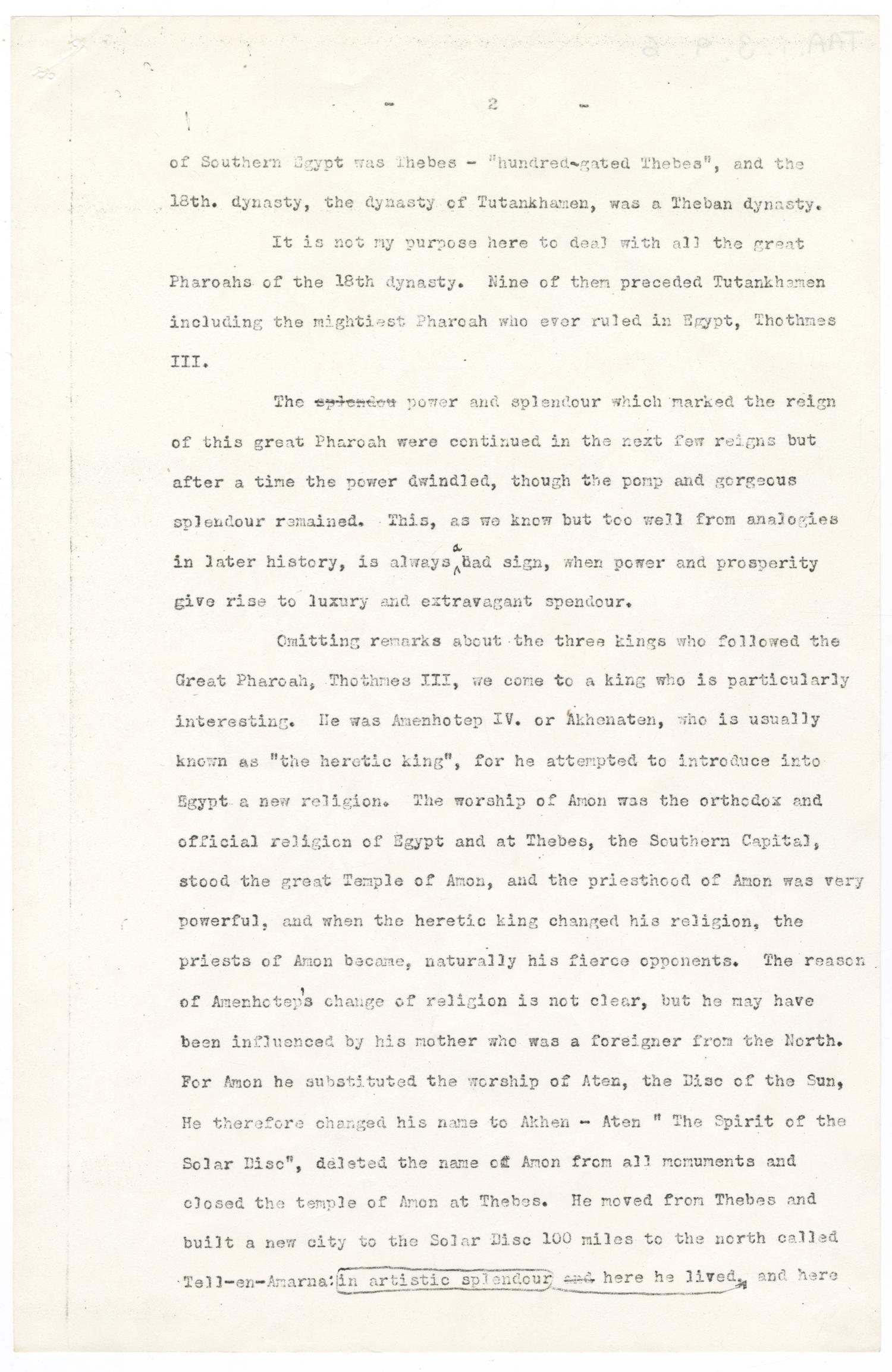
Photocopy of typewritten and annotated notes for a lecture titled 'Scientific Aspects of the Egyptian Discoveries', page 2.

© Griffith Institute,
University of Oxford
– 2 –
of Southern Egypt was Thebes – “hundred-gated Thebes”, and the
18th. dynasty, the dynasty of Tutankhamen, was a Theban dynasty.
It is not my purpose here to deal with all the great
Pharoahssic of the 18th dynasty. Nine of them preceded Tutankhamen
including the mightiest Pharoahsic who ever ruled Egypt, Thothmes
III.
The splendou power and splendour which marked the reign
of this great Pharoahsic were continued in the next few reigns but
after a time the power dwindled, though the pomp and gorgeous
splendour remained. This, as we know too well from analogies
in later history, is always <a> o/<b>ad sign, when power and prosperity
give rise to luxury and extravagant spendoursic.
Omitting remarks about the three kings who followed the
Great Pharoahsic, Thothmes III, we come to a king who is particularly
interesting. He was Amenhotep IV. or Akhenaten, who is usually
known as “the heretic king”, for he attempted to introduce into
Egypt a new religion. The worship of Amon was the orthodox and
official religion of Egypt and at Thebes, the Southern Capital,
stood the great Temple of Amon, and the priesthood of Amon was very
powerful, and when the heretic king changed his religion, the
priests of Amon became, naturally his fierce opponents. The reason
of Amenhotep<’>s change of religion is not clear, but he may have
been influenced by his mother who was a foreigner from the North.
For Amon he substituted the worship of Aten, the Disc of the Sun,
He therefore changed his name to Akhen – Aten “The Spirit of the
Solar Disc”, deleted the name ox[?]/<f> Amon from all momumentssic and
closed the temple of Amon at Thebes. He moved from Thebes and
built a new city to the Solar Disc 100 miles to the north called
Tell-en-Amarna<:> and here he lived <in artistic splendour> and here