
TAA i.3.9.7
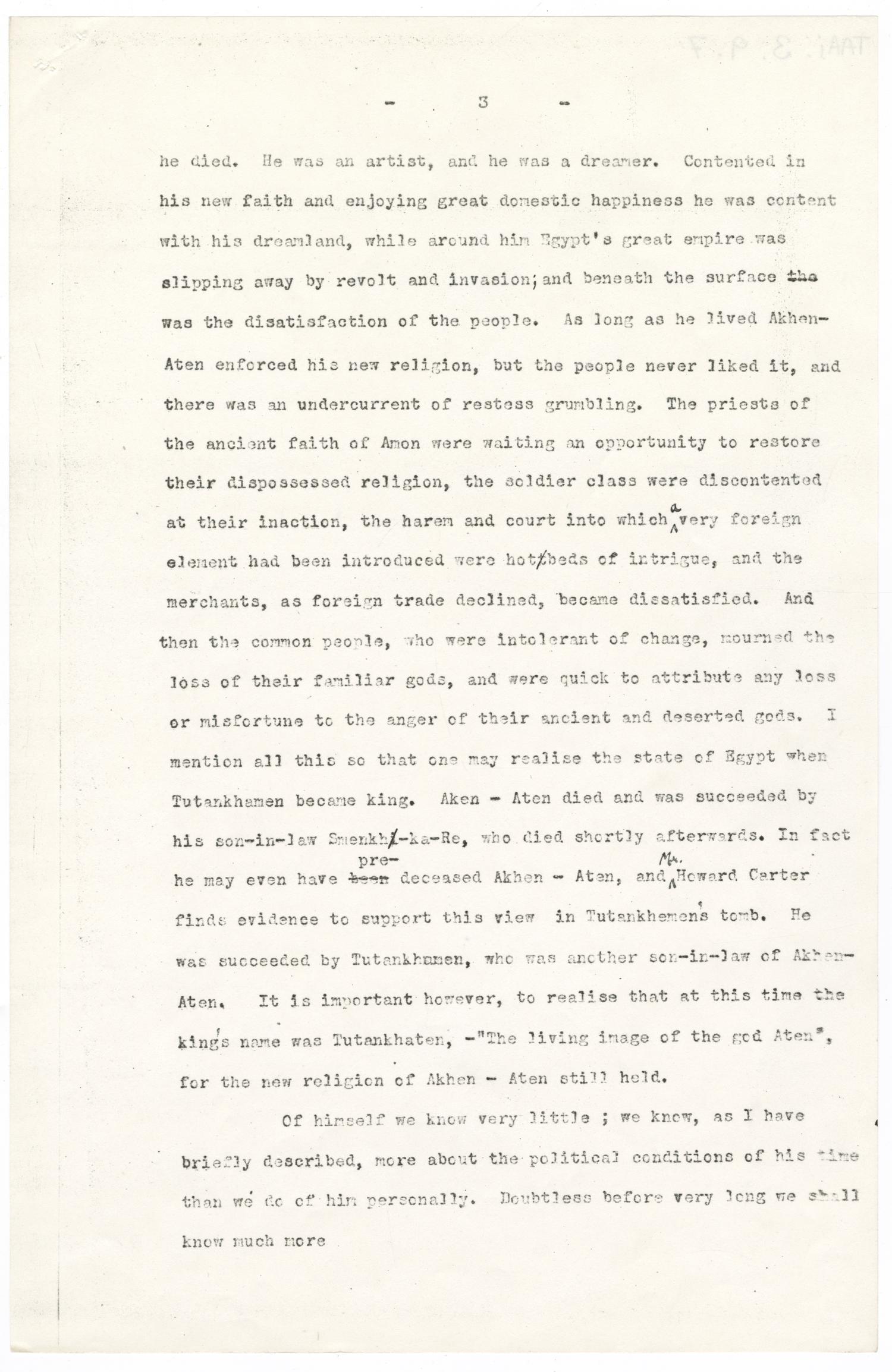
Photocopy of typewritten and annotated notes for a lecture titled 'Scientific Aspects of the Egyptian Discoveries', page 3.
Howard Carter is also mentioned on this page.

© Griffith Institute,
University of Oxford
– 3 –
he died. He was an artist, and he was a dreamer. Contented in
his new faith and enjoying great domestic happiness he was content
with his dreamland, while around him Egypt’s great empire was
slipping away by revolt and invasion<;> and beneath the surface the
was the disatisfactionsic of the people. As long as he lived Akhen-
Aten enforced his new religion, but the people never liked it, and
there was an undercurrent of restesssic grumbling. The priests of
the ancient faith of Amon were waiting [for] an opportunity to restore
their dispossessed religion, the soldier class were discontented
at their inaction, the harem and court into which <a> very foreign
element had been introduced were hottbeds of intrigue, and the
merchants, as foreign trade declined, became dissatisfied. And
then the common people, who were intolerant of change, mourned the
loss of their familiar gods, and were quick to attribute any loss
or misfortune to the anger of their ancient and deserted gods. I
mention all this so that one may realise the state of Egypt when
Tutankhamen became king. Aken – Aten died and was succeeded by
his son-in-law Smenkhi-ka-Re, who died shortly afterwards. In fact
he may even have been/<pre->deceased Akhen – Aten, and <Mr.> Howard Carter
finds evidence to support this view in Tutankhemen<’>ssic tomb. He
was succeeded by Tutankhamen, who was another son-in-law of Akhen-
Aten. It is important however, to realise that at this time the
king<’>s name was Tutankhaten, – “The living image of the god Aten”,
for the new religion of Akhen – Aten still held.
Of himself we know very little; we know, as I have
briefly described, more about the political conditions of his time
than we do of him personally. Doubtless before very long we shall
known much more.