
TAA i.3.9.5
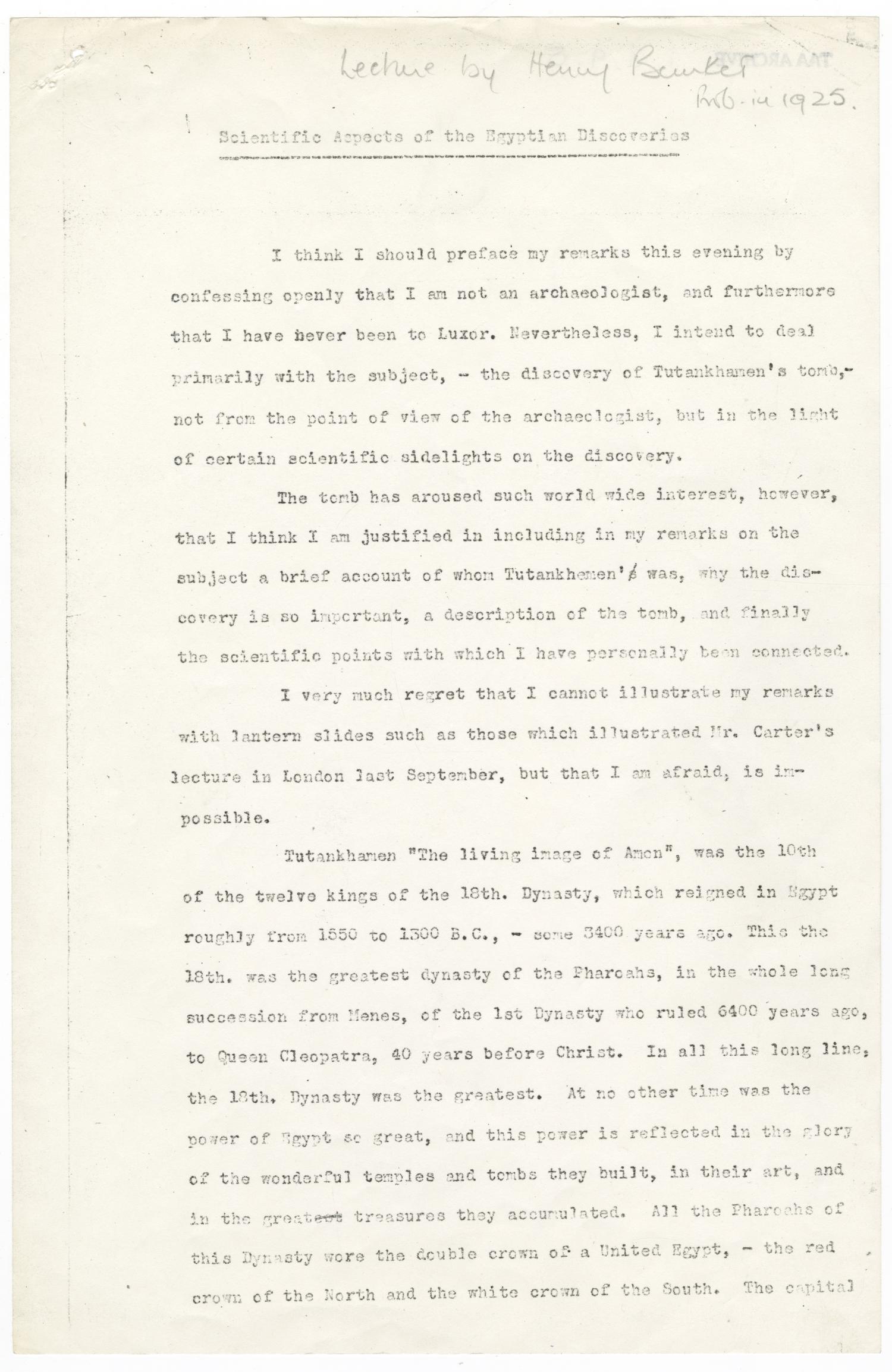
Photocopy of typewritten and annotated notes for a lecture titled 'Scientific Aspects of the Egyptian Discoveries', page 1.
Howard Carter is also mentioned on this page.

© Griffith Institute,
University of Oxford
<Lecture by Henry Bunker
Prob. in 1925.>
Scientific Aspects of the Egyptian Discoveries
I think I should preface my remarks this evening by
confessing openly that I am not an archaeologist, and furthermore
that I have never been to Luxor. Nevertheless, I intend to deal
primarily with the subject, high – the discovery of Tutankhamen’s tomb, –
not from the point of view of the archaeologist, but in the light
of certain scientific sidelights on the discovery.
The tomb has aroused such world wide interest, however,
that I think I am justified in including my remarks on the
subject for a brief account of whom Tutankhemen’ssic was; why the dis-
covery is so important, a description of the tomb, and finally
the scientific points with which I have personally been connected.
I very much regret that I cannot illustrate my remarks
with lantern slides such as those which illustrated Mr. Carter’s
lecture in London last September, but that I am afraid, is im-
possible.
Tutankhamen “The living image of Amen”, was the 10th
of the twelve kings of the 18th. Dynasty, which reigned in Egypt
roughly from 1550 to 1300 B.C., – some 3400 years ago. This the
18th. was the greatest dynasty of the Pharoahssic, in the whole long
succession from Menes, of the 1st Dynasty who ruled 6400 years ago,
to Queen Cleopatra, 40 years before Christ. In all this long line,
the 18th. Dynasty was the greatest. At no other time was the
power of Egypt so great, and this power is reflected in the glory
of the wonderful temples and tombs they built, in their art, and
in the greatest treasures they accumulated. All the Pharoahssic of
this Dynasty wore the double crown of a United Egypt, – the red
crown of the North and the white crown of the South. The capital