
TAA i.3.23.9
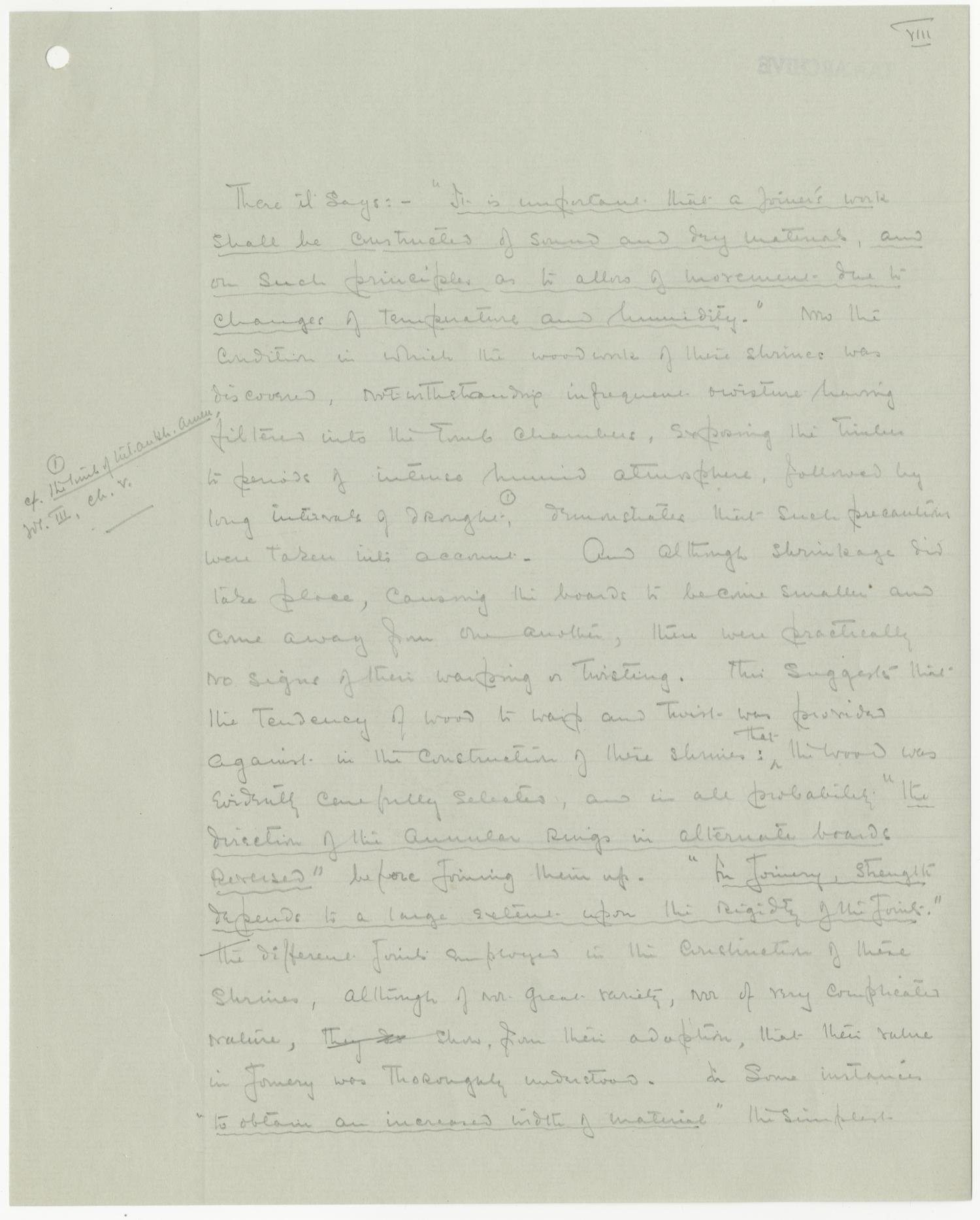
Page 8 of second draft on shrines, handwritten.

© Griffith Institute,
University of Oxford
(VIII)
There it says:- “It is important that a joiner’s work
shall be constructed of sound and dry materials, and
on such principles as to allow of movement due to
changes of temperature and humidity.” Now the
condition in which the woodwork of these shrines was
discovered, notwithstanding infrequent moisture having
filtered into the tomb chambers, exposing the timber
to periods of intense humid atmosphere, followed by
long intervals of drought, (1) demonstrates that such precautions
<(1)
cf. The Tomb of Tut.Ankh.Amen,
Vol. III, ch. V.>
were taken into account. And although shrinkage did
take place, causing the boards to become smaller and
come away from one another, there were practically
no signs of their warping or twisting. This suggests that
the tendency of wood to warp and twist was provided
against in the construction of these shrines: <that> the wood was
evidently carefully selected, and in all probability “the
direction of the annular rings in alternate boards
reversed” before joining them up. “In joinery, strength
depends to a large extent upon the rigidity of the joints.”
The different joints employed in the construction of these
shrines, although of not great variety, nor of very complicated
nature, They do show, from their adaption, that their value
in joinery was thoroughly understood. In some instances
“to obtain an increased width of material” the simplest