
TAA i.3.23.8
Page 7 of second draft on shrines, handwritten.

© Griffith Institute,
University of Oxford
(VII)
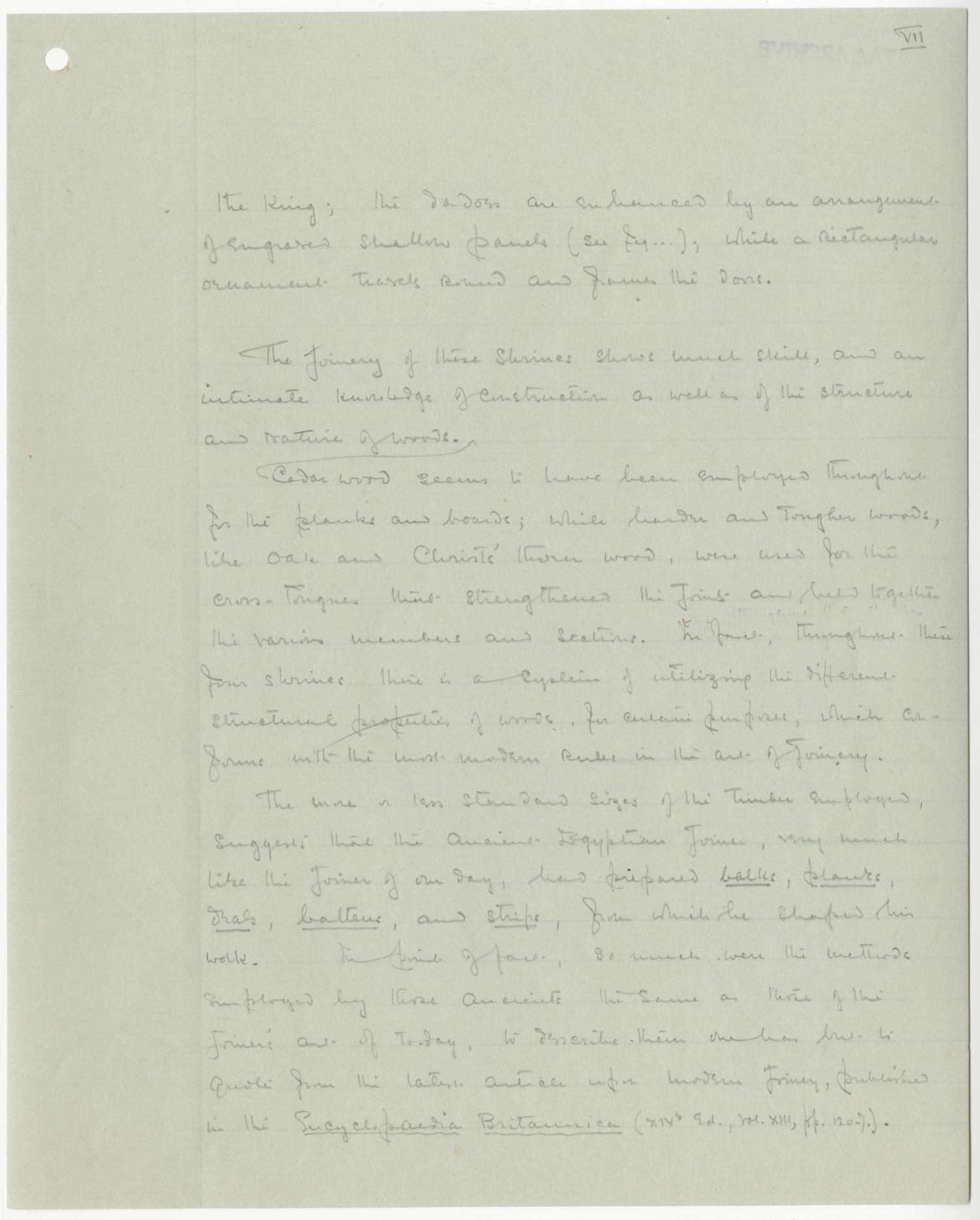
the King; the dadoes are enhanced by an arrangement
of engraved shallow panels (see fig …); while a rectangular
ornament travels round and frames the doors.
The joinery of these shrines shows much skill, and an
intimate knowledge of construction as well as of the structure
and nature of woods.
Cedar wood seems to have been employed throughout
for the planks and boards; while harder and tougher woods,
like oak and Christ’s thorn wood, were used for the
cross-tongues that strengthened the joints and held together
the various members and sections. In fact, throughout these
four shrines there is a system of utilizing the different
structural properties of woods, for certain purposes, which con-
forms with the most modern rules in the art of joinery.
The more or less standard sizes of the timber employed,
suggests that the ancient Egyptian joiner, very much
like the joiner of our day, had prepared balks, planks,
deals, batterns, and strips, from which he shaped his
work. In point of fact, so much were the methods
employed by those ancients the same as those of the
joiners’ art of today, to describe them one has but to
quote from the latest article upon modern joinery, published
in the Encyclopaedia Britannica (XIVth Ed., Vol. XIII, pp. 120cf.).