
TAA i.3.23.7
Page 6 of second draft on shrines, handwritten.

© Griffith Institute,
University of Oxford
(VI)
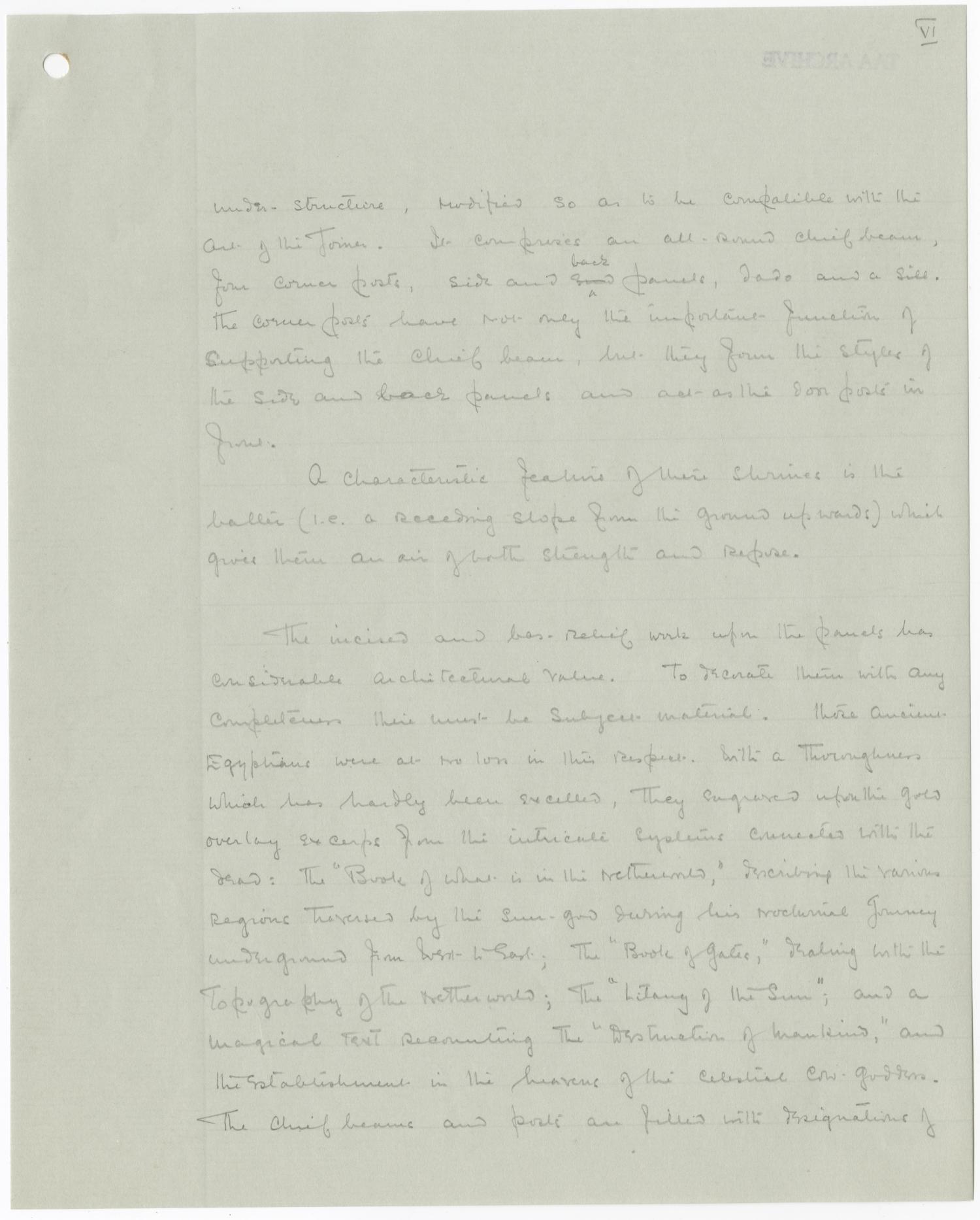
under-structure, modified so as to be compatible with the
art of the joiner. It comprises an all-round chief beam,
four corner posts, side and end/<back> panels, dado and a sill.
The corner posts have not only the important function of
supporting the chief beam, but they form the styles of
the side and back panels and act as the door posts in
front.
A characteristic feature of these shrines is the
batter (i.e. a receding slope from the ground upwards) which
gives them an air of both strength and repose.
The incised and bas-relief work upon the panels has
considerable architectural value. To decorate them with any
completeness there must be subject material. Those ancient
Egyptians were at no loss in this respect. With a thoroughness
which has hardly been excelled, they engraved upon the gold
overlay excerpssic from the intricate systems connected with the
dead: The “Book of what is in the Netherworld”, describing the various
regions traversed by the sun-god during his nocturnal journey
underground from West to East; The “Book of Gates,” dealing with the
Topography of the Netherworld; The “Litany of the Sun”; and a
magical text recounting the “Destruction of Mankind,” and
the establishment in the heavens of the celestial Cow-goddess.
The chief beams and posts are filled with designations of