
TAA i.3.23.6
Page 5 of second draft on shrines, handwritten.

© Griffith Institute,
University of Oxford
(V)
is perfectly suited to their purpose and environment – the
tomb. Their effect is rendered even more impressive by their
gilded all-over decoration. Free standing they are of the
simplest form. With one exception <(1)>, they are surmounted by
<(1)
The first innermost
shrine has a barrel
-vault roof.>
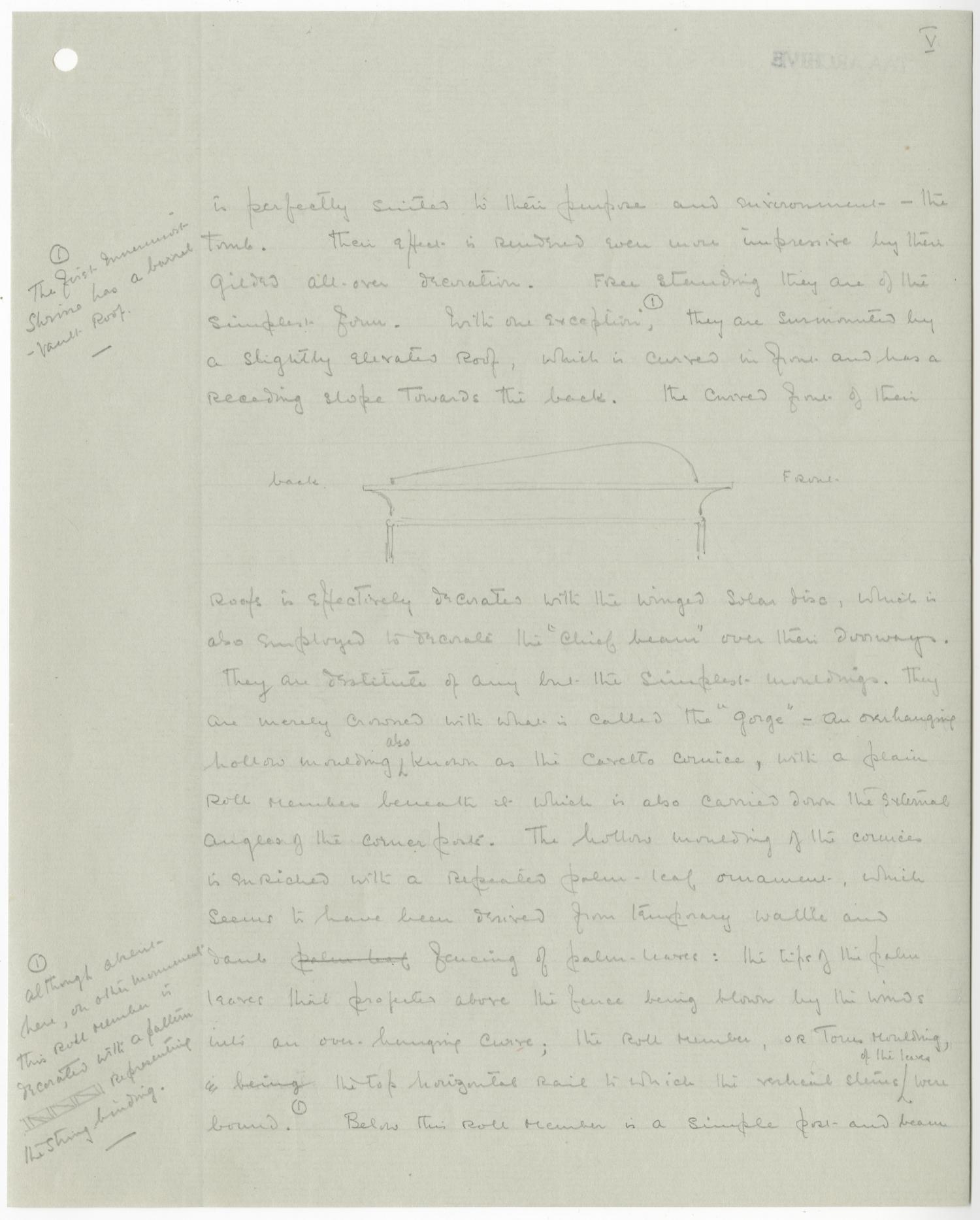
a slightly elevated roof, which is curved in front and has a
receding slope towards the back. The curved front of their
back [ 𓂀 ] Front
roofs is effectively decorated with the winged solar disc, which is
also employed to decorate the “chief beam” over their doorways.
They are destitute of any but the simplest mouldings. They
are merely crowned with what is called the “gorge” – an overhanging
hollow moulding <also> known as the cavetto cornice, with a plain
roll member beneath it which is also carried down the external
angles of the corner posts. The hollow moulding of the cornices
is enriched with a repeated palm-leaf ornament, which
seems to have been derived from temporary wattle and
daub palm-leaf fencing of palm-leaves: the tips of the palm
leaves that projected above the fence being blown by the winds
into an over-hanging curve; the roll member, OR tomb moulding,
is being the top horizontal rail to which the vertical stems <of the leaves> were
bound. (1) Below this roll member is a simple post and beam
<(1)
Although absent
here, on other monument
this roll member is
decorated with a pattern
[ 𓂀 ] representing
the string binding.>