
TAA i.3.23.5
Page 4 of second draft on shrines, handwritten.

© Griffith Institute,
University of Oxford
(IV)
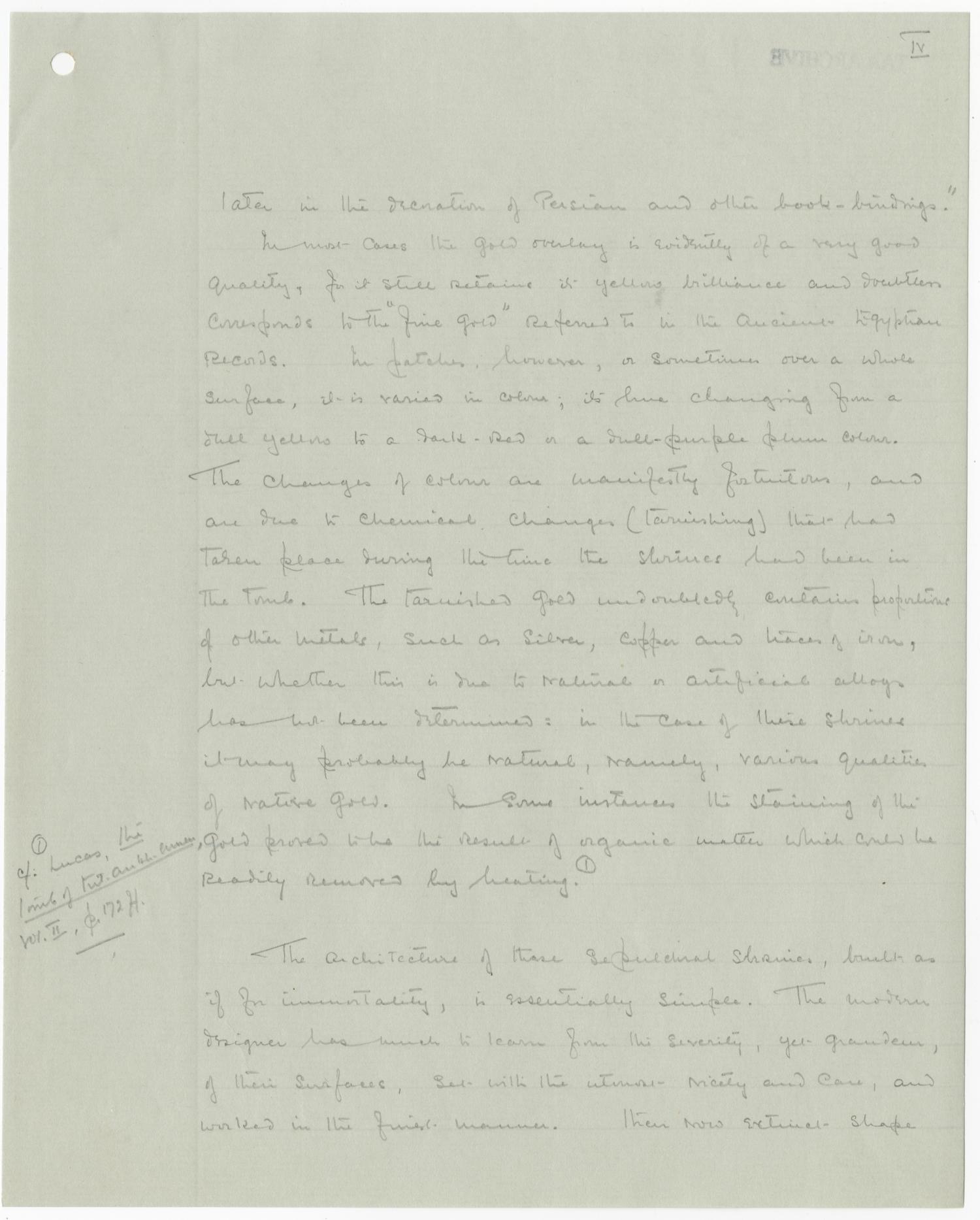
later in the decoration of Persian and other book-bindings.”
In most cases the gold overlay is evidently of a very good
quality, for it still retains its yellow brilliance and doubtless
corresponds to the “fine gold” referred to in the Ancient Egyptian
Records. In patches, however, or sometimes over a whole
surface, it is varied in colour; its hue changing from a
dull yellow to a dark-red or a dull-purple plum colour.
The changes of colour are manifestly fortuitous, and
are due to chemical changes (tarnishing) that had
taken place during the time the shrines had been in
the tomb. The tarnished gold undoubtedly contains proportions
of other metals, such as silver, copper and traces of iron,
but whether this is due to natural or artificial alloys
has not been determined: in the case of these shrines
it may probably be natural, namely, various qualities
of native gold. In some instances the staining of the
gold proved to be the result of organic matter which could be
readily removed by heating. (1)
<(1)
Cf. Lucas, The
Tomb of Tut.Ankh.Amun,
Vol. II, p. 172 ff.>
The architecture of those sepulchral shrines, built as
if for immortality, is essentially simple. The modern
designer has much to learn from the severity, yet grandeur,
of their surfaces, set with the utmost nicety and care, and
worked in the finest manner. Their now extinct shape