
TAA i.3.23.4
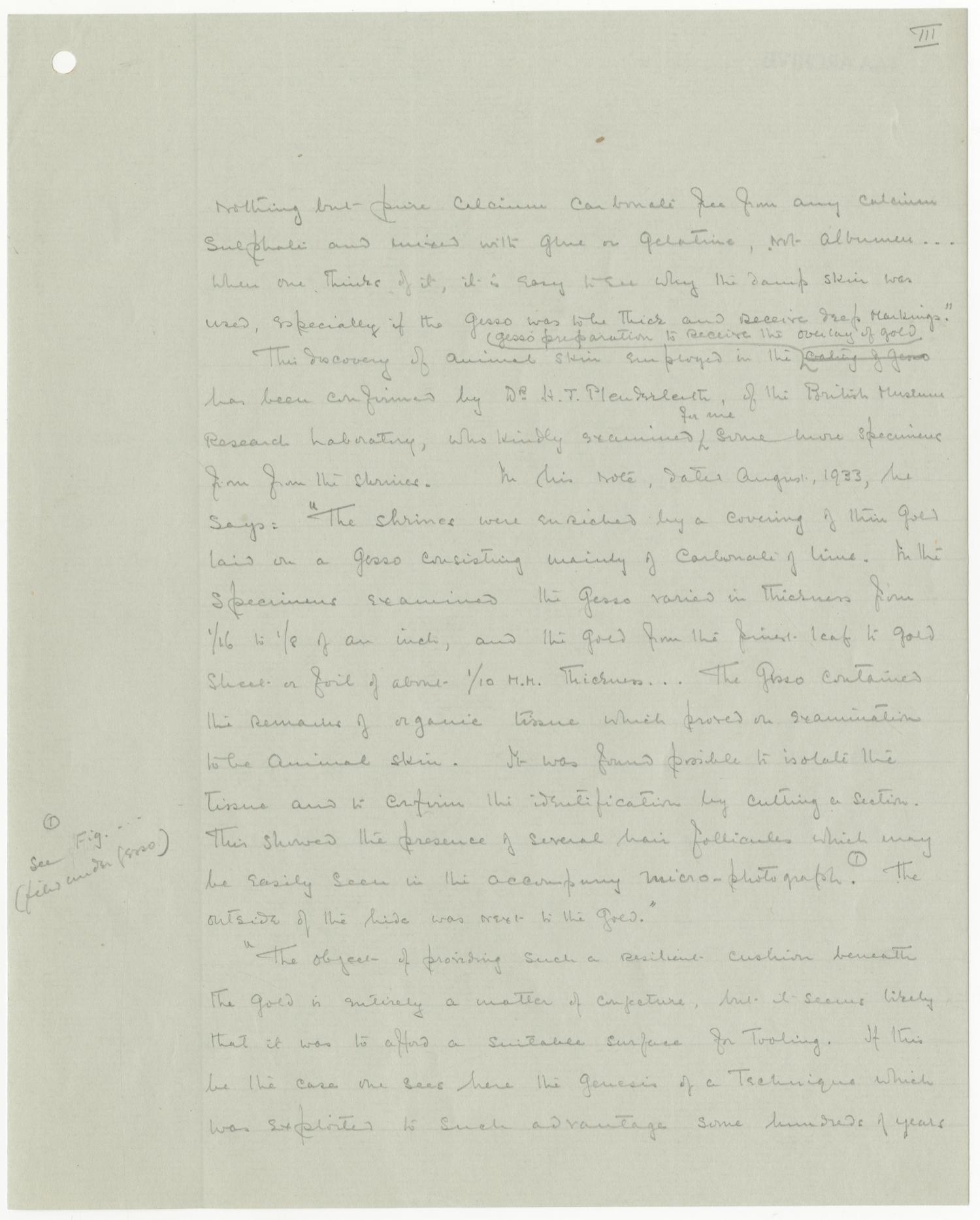
Page 3 of second draft on shrines, handwritten. Harold Plenderleith is also mentioned on this page.

© Griffith Institute,
University of Oxford
(II)
With reference to <the mechanical gilding and> the prepared surfaces of gesso, Mr A. Lucas
says:- “Beneath the gold when it occurs on wood, there is as
a rule a coating of white plaster termed “gesso”, which
consists of whiting to which a little glue has been added
to make it cohere. This is identical with the material used
by modern picture-frame makers for plain gilt-mouldings,
gesso being employed instead of plaster of Paris because
this latter is not sufficiently hard to permit of the burnishing
of gold.” (1)
<(1)
See The Tomb of Tut.Ankh.
Amen, Vol. II,
Appendix II, p. 172.
->
<Insert (A)>
Dr Alexander Scott, in a letter addresssic to me, dated
February 1931, said:- “I believe I have made quite an
interesting discovery concerning the overlying gold leaf and gesso
work upon the sepulchral shrines. I had some small
pieces which I brought away in 1924, and I did observe then
when detaching the gold leaf by means of dilute acid in
order to measure its thickness that there was a semi-transparent
residue which was practically of the same shape and size
as the piece of gesso. At this time I thought it was only
gelatine or albumen which had been rendered insoluble by
time, etc., and put it down the sink. Repeating the work
about three weeks ago, I made some further experiments
with another fragment and found this semi-transparent
residue to the leather, or at least the skin of an animal. This
skin had been embedded in the white powder which seems to be