
TAA i.2.4.9
The text on this page was probably prepared, but then not used, for the publication: Carter, Howard 1933. The tomb of Tut.ankh.Amen vol. 3. London: Cassell.

© Griffith Institute,
University of Oxford
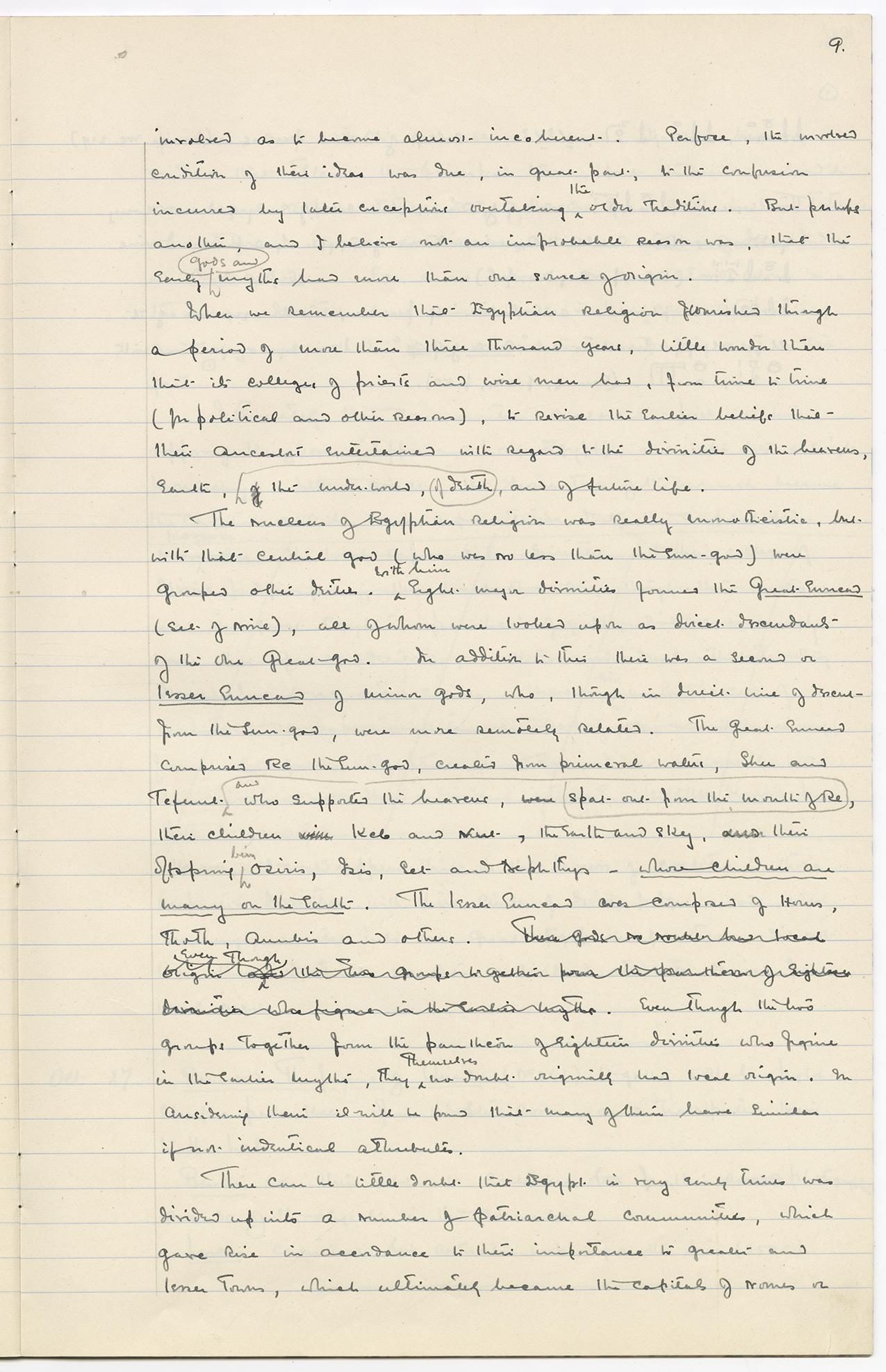
involved as to become almost incoherent. Perforce, the involved
condition of their ideas was due, in great part, to the confusion
incurred by later conceptions overtaking <the> older traditions. But perhaps
another, and I believe not an improbable reason was, that the
early <gods and> myths had more than one source of origin.
When we remember that Egyptian religion flourished through
a period of more than three thousand years, little wonder then
that its colleges of priests and wise men had, from time to time
(in political and other reasons), to revise the earlier beliefs that
their ancestors entertained with regard to the divinities of the heavens,
Earth, <of death,> of the underworld, and of future life.
The nucleus of Egyptian religion was really monotheistic, but
with that central god (who was no less than the Sun-god) were
grouped other deities. <With him> Eight major divinities formed the Great Ennead
(set of nine), all of whom were looked upon as direct descendants
of the One Great god. In addition to this there was a second or
lesser Ennead of minor gods, who, though in direct line of descent
from the Sun-god, were remotely related. The Great Ennead
comprised Re the Sun-god, created from primeval waters, Shu and
Tefnut <spat out from the mouth of Re> <and> who supported the heavens, were ,
their children with[?] Keb and Mu[?]/<Nu>t, the Earth and Sky, and their
offspring <being> Osiris, Isis, Set and Nephthys - whose children are
many on the Earth. The lesser Ennead are composed of Horus,
Thoth, Anubis and others. These gods no doubt have local
origin lasted <even though> the two groups together form the pantheon of Eighteen
Divinities who figure in the earlier myths. Even though the two
groups together form the pantheon of Eighteen divinities who figure
in the earlier myths, they <themselves> no doubt originally had local origin. In
considering them it will be found that many of them have similar
if not identical attributes.
There can be little doubt that Egypt in very early times was
divided up into a number of patriarchal communities, which
gave rise in accordance to their importance to greater and
lesser Towns, which ultimately became the capitals of Nomes or