
TAA i.2.4.8a
Notes on this page refer to text on (facing) page 8.
The text on this page is reproduced in the publication: Carter, Howard 1933. The tomb of Tut.ankh.Amen vol. 3. London: Cassell [PDF, 8.47 MB], 35.

© Griffith Institute,
University of Oxford
(1)
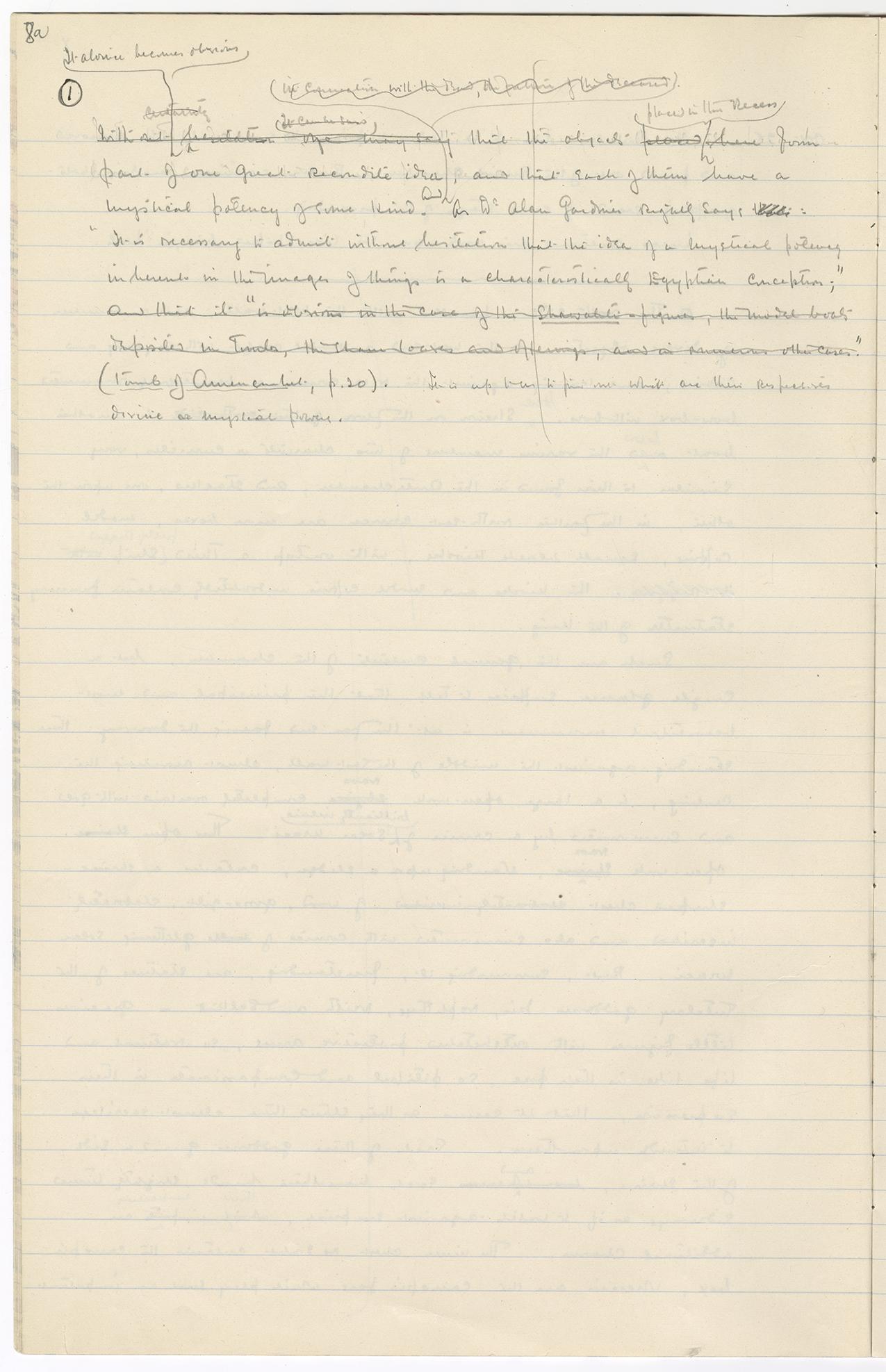
With out hesitation/<certainty> <It at once becomes obvious> one may say/<it can be said> that the objects placed/<placed in the Recess> here form
part of one great recondite idea, and that each of them have a
mystical potency of some kind <and> <in connection with the dead, the future of the deceased.> As Dr Alan Gardiner rightly says there is:
"It is necessary to admit without hesitation that the idea of a mystical potency
inherent in the images of things is a characteristically Egyptian conception;"
and that it "is obvious in the case of the Shawabti-figures, the model boats
deposited in tombs, the sham loaves and offerings, and in numerous other cases".
(Tomb of Amenemhet, p. 20). It is up to us to find not what are their repectivessic
divine are/<or> mystical powers.