
TAA i.2.4.10
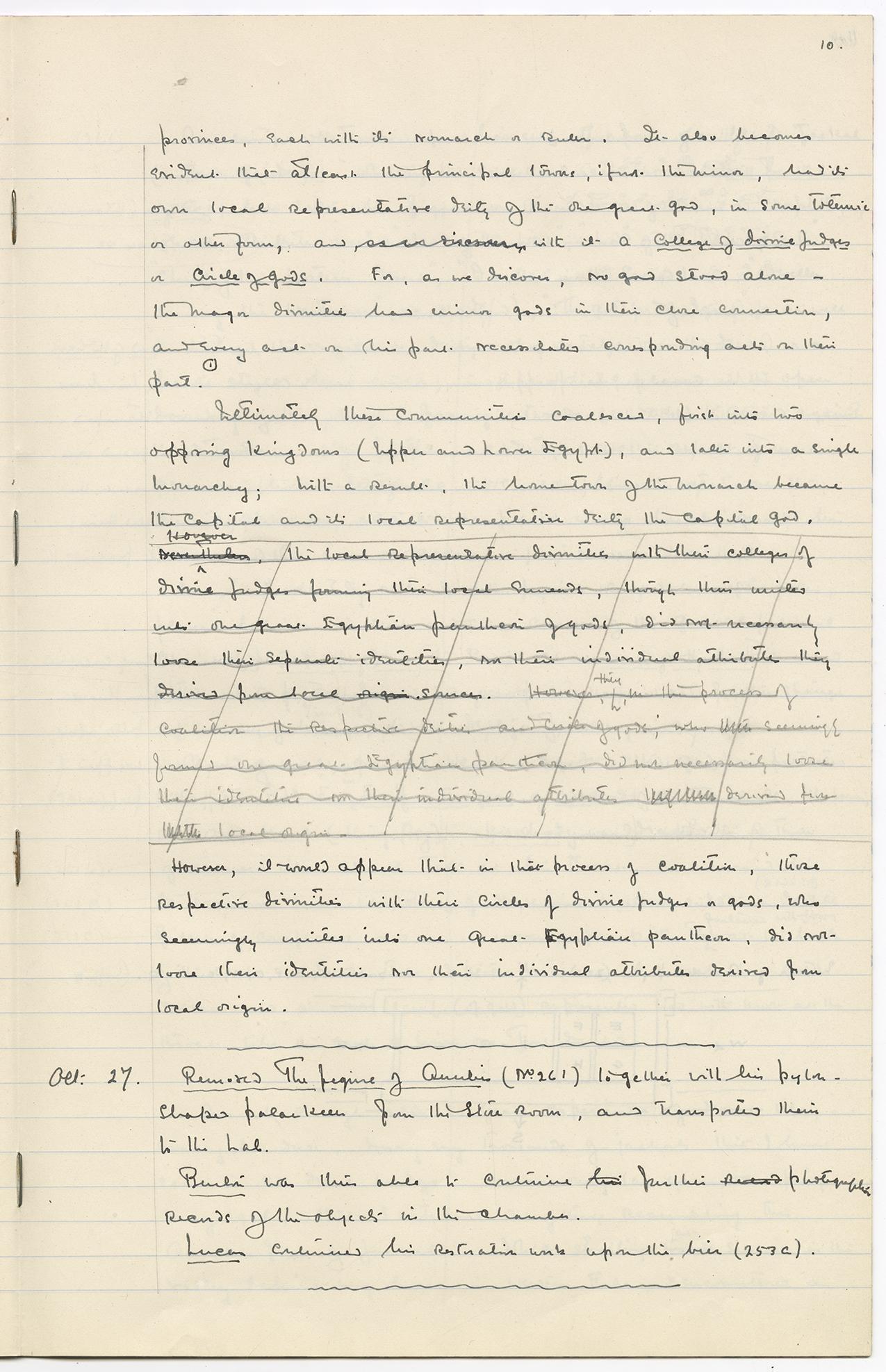
Part of the text is fully struck through, see document image for reference. Strikethrough is reserved for the author’s edits and deletions within the main body of the text, which would otherwise be difficult to distinguish.
The text on this page was probably prepared, but then not used, for the publication: Carter, Howard 1933. The tomb of Tut.ankh.Amen vol. 3. London: Cassell.

© Griffith Institute,
University of Oxford
provinces, each with its nomarch or ruler. It also becomes
evident that at least the principal towns, if not the minor, had its
own local representative deity of the one great god, in some totemic
or other form, and, as we discover with it a College of divine Judges
or Circle of gods. For, as we discover, no god stood alone -
the major divinities had minor gods in their close connection,
and every act on this part necessitated corresponding acts on their
part. (1)
<(1)
[ 𓂀 ], [ 𓂀 ], [ 𓂀 ], ḏȝḏȝ = College of divine persons (Erman voc. 219)
There were the [ 𓂀 ] not only of Osiris, but also of every god and every
goddess. And all the Ancient towns of Egypt had their divine
[ 𓂀 ] (Renouf. B. of dead. p.6).
[ 𓂀 ] implies an association of persons, in consequence of its
etymology translate as "Circle of Gods". It is synonymous with
[ 𓂀 ], [ 𓂀 ]. (Renouf, op. cit., p. 55).>
Ultimately these communities coalesced, first into two
opposing kingdom (Upper and Lower Egypt), and later into a single
monarchy; with a result, the Nome Town of the monarch became
the capital and its local representative deity the capital god.
Nevertheless/<However>, the local representative divinities with their colleges of
divine judges forming their local Enneads, though this united
into one great Egyptian pantheon of gods, did not necessarily
loosesic {lose} their separate identities, not their individual attributes they
derived from local origin. sources. However, <there>, in the process of
coalition the respective deities and circle of gods, who thus seemingly
formed one great Egyptian pantheon, did not necessarily loosesic {lose}
their identities nor their individual attributes they were[?] derived from
local[?] local origin.
However, it would appear that in that process of coalition, those
respective divinities with their circles of divine judges or gods, who
seemingly united into one Great p/<E>gyptian pantheon, did not
loosesic {lose} their identities nor their individual attributes derived from local origin.
Oct. 27.
Removed the figure of Anubis (No 261) together with his pylon-
shaped palankeen from the Store Room, and transported them
to the Lab.
Burton was thus able to continue his further record photographic
records of the objects in the chamber.
Lucas continued his restoration work upon the bier (253a).