
TAA i.2.4.8
Part of the text on this page is reproduced in the publication: Carter, Howard 1933. The tomb of Tut.ankh.Amen vol. 3. London: Cassell [PDF, 8.47 MB], 31, 35.

© Griffith Institute,
University of Oxford
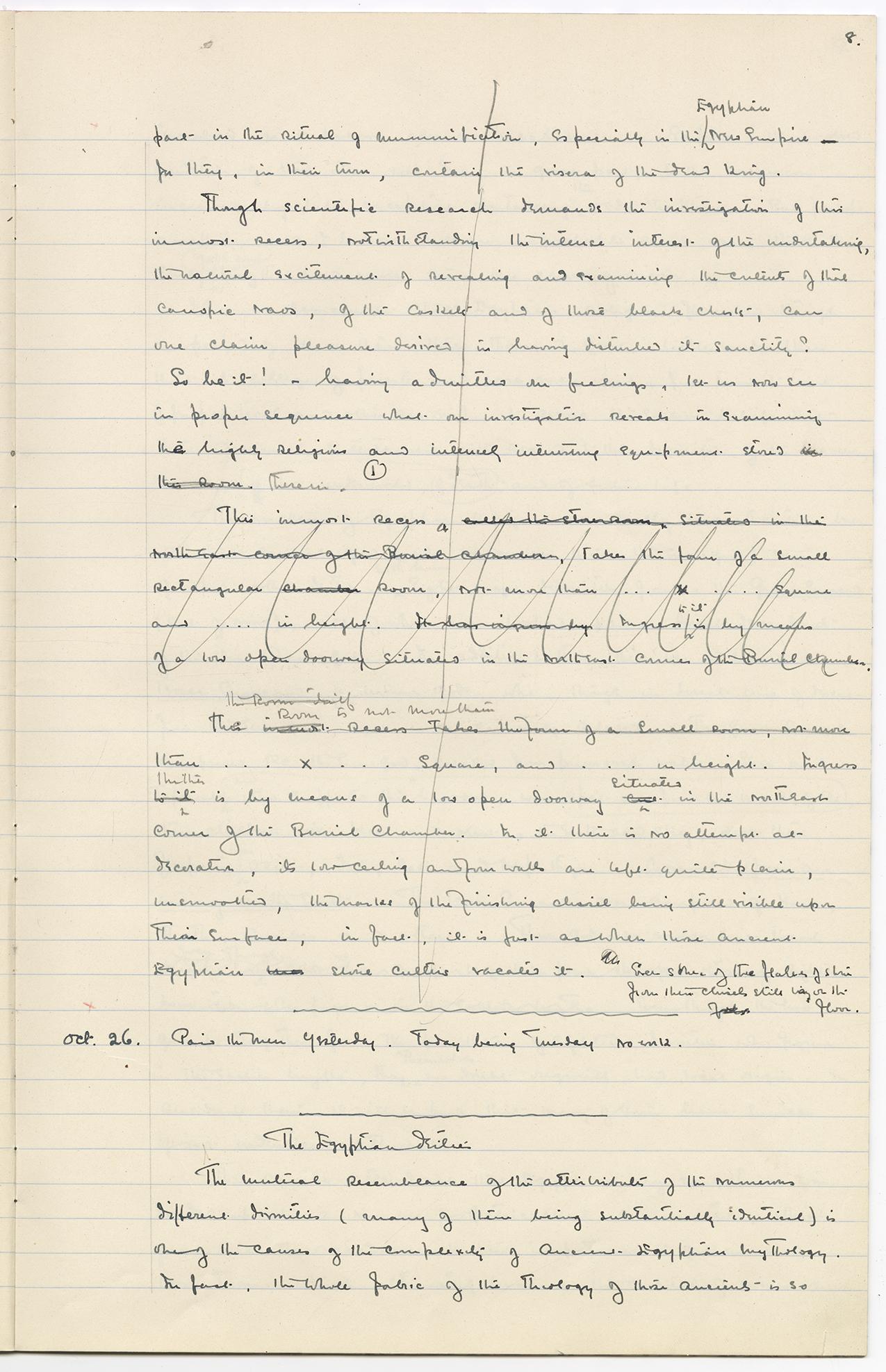
part in the ritual of mummification, especially in the <Egyptian> New Empire as[?]
for they, in their turn, contain the viserasic {viscera} of the dead King.
Though scientific research demands the investigation of this
innermost recess, notwithstanding the intense interest of the undertaking,
the natural excitement of revealing and examining the contents of that
Canopic Naos, of the Casket and of those black chests, can
one claim pleasure derived in having disturbed its sanctity?
So be it! - having admitted our feelings, let us now see
in proper sequence what our investigation reveals in examining
thi/<e> highly religious and intensely interesting equipment stored in
the room <therein.>(1)
<(1)
With out hesitation/<certainty> <It at once becomes obvious> one may say/<it can be said> that the objects placed/<placed in the Recess> here form
part of one great recondite idea, and that each of them have a
mystical potency of some kind <and> <in connection with the dead, the future of the deceased.> As Dr Alan Gardiner rightly says there is:
"It is necessary to admit without hesitation that the idea of a mystical potency
inherent in the images of things is a characteristically Egyptian conception;"
and that it "is obvious in the case of the Shawabti-figures, the model boats
deposited in tombs, the sham loaves and offerings, and in numerous other cases".
(Tomb of Amenemhet, p. 20). It is up to us to find not what are their repectivessic
divine are/<or> mystical powers.>
This innermost recess, called the store-room, situated in the
North East corner of the Burial Chamber, takes the form of a small
rectangular chamber room, not more than … b/<x> …. square
and …. in height. It has ingress by Ingress <to it> is by means
of a low open doorway situated in the North East corner of the Burial Chamber.
This/<e> innermost/<the Room itself> recess takes the form of a small room, not more/<Room is not more than>
than … x … Square, and … in height. Ingress
to it/<thither> is by means of a low open doorway cut/<situated> in the northeast
corner of the Burial Chamber. In it there is no attempt at
decoration, its low ceiling and four walls are left quite plain,
unsmoothed, the marks of the finishing chisel being still visible upon
their surface, in fact, it is just as when those ancient
Egyptian maso stone cutters vacated it.(2)[?] <Even some of the flakes of stone
from their chisels still lie/<ay> on the
xxx[?] floor.
X
Oct. 26.
Paid the men yesterday. Today being Tuesday no work.
.
The Egyptian deities
The material resemblance of the attribributessic {attributes} of the numerous
different divinities (many of them being substantially identical is
one of the causes of the complexity of Ancient Egyptian mythology.
In fact, the whole fabric of the theology of those ancients is so