
TAA i.2.4.19
Most of the text is fully struck through on this page but is not indicated in the transcription, see document image for reference. Strikethrough is reserved for the author’s edits and deletions within the main body of the text, which would otherwise be difficult to distinguish.
Parts of the text on this page are reproduced in the publication: Carter, Howard 1933. The tomb of Tut.ankh.Amen vol. 3. London: Cassell [PDF, 8.47 MB], 38-9, 62.

© Griffith Institute,
University of Oxford
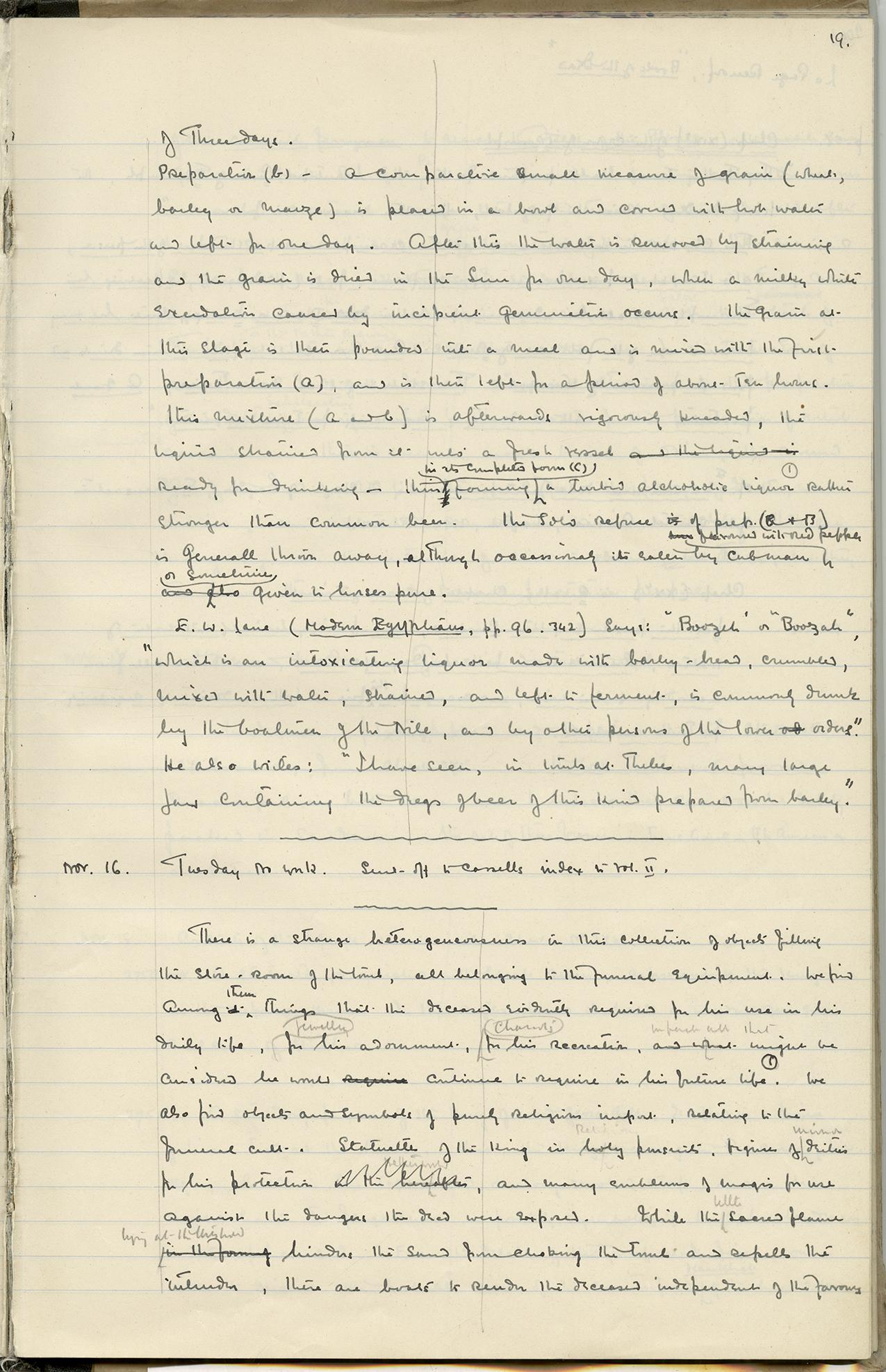
of three days.
Preparation (b) - a comparative small measure of grain (wheat,
barley or maize) is placed in a bowl and covered with hot water
and left for one day. After this the water is removed by straining
and the grain is dried in the Sun for one day, when a milky white
exudation caused by the incipient germination occurs. The grain at
this stage is then pounded into a meal and is mixed with the first
preparation (a), and is then left for a period of about ten hours.
This mixture (a and b) is afterwards vigorously kneaded, the
liquid strained from it into a fresh vessel and the liquid is
ready for drinking – thus forming <in it completed form (c)> a turbid alchoholicsic {alcoholic} liquor(1) rather
stronger than common beer. The solid refuse is of prep. (B/<A> & B)
is generall[y] thrown away, although occassionalysic {occasionally} its eaten by cabman <mix flavoured with red pepper>
and also/<or sometimes> given to horses pure.
E. W. Lane (Modern Egyptians, pp. 96 . 342) says: "Boozeh" or "Boozah",
"which is an intoxicating liquor made with barley-bread, crumbled,
mixed with water, strained, and left to ferment, is commonly drunk
by the boatmen of the Nile, and by other persons of the lower ord orders."
He also writes: "I have seen, in tombs at Thebes, many large
jars containing the dregs of beer of this kind prepared from barley."
Nov. 16.
Tuesday no work. Sent off to Cassells index to Vol. II.
There is a strange heterogeneousness in the collection of objects filling
the Store-Room of the tomb, all belonging to the funeral equipment. We find
among it/<them> things that the deceased evidently required for his use in his
daily life, <jewellery> for his adornment, <chariots> for his recreation, and what/<in fact all that> might be
considered he would require continue to require in his future life(1). We
also find objects and symbols of purely religious import, relating to the
funeral cult. Statuettes of the King in holy/<religious> pursuits, figures of <minor> deities
for his protection in the hereafter/<netherworld>, and many emblems of magissic {magic} for use
against the dangers the dead were exposed. While the <little> sacred flame
in the form of/<lying at the threshold> hinders the sand from choking the tomb and repellssic {repels} the
intruder, there are boats to render the deceased independent of the favours
<(1)
[ 𓂀 ], [ 𓂀 ], [ 𓂀 ], [ 𓂀 ] ḥḳt = beer.
According to Philip Schidrowitz, Ph.D., F.C.S. the apparatus and methods employed <in Europe>
for brewing beer were of a most primitive kind up to the 18th Century,/<.> as the [?]>
<(1)
As man devised his god in image of himself <or as there is reason to believe of was his ancestor>, so his/<the> god, like him,
was supposed to require the self same equipment in etherialsic {ethereal} existence.
The great deity, <the Sun-god Rʿ, especially a Royal god, and Ancestor of all the Pharaohs,> was who was/<and> <naturally> looked upon as a former Sovereign of Egypt,
was invested with all the splendours of the Pharaonic state. He was given
the sumptuous equipment of a Pharaoh(1). Thus the requirements of the
King were precisely/<similar> those of the deity <were precisely those that and of the deity those of the King>
(vide./See Breasted, Journal of Egyptian Archaeology, Vol. IV., parts II-III, pp. 174-176)
(See. F. Ll. Griffith, <Heliopolis>, Encyclopaedia Britannica, Vol. VIII, p. 230. XIth ed.)>