
TAA i.2.4.19a
Notes on this page refer to text on (facing) page 19. The note for 261.f(4) is contined from the note on page 18a.

© Griffith Institute,
University of Oxford
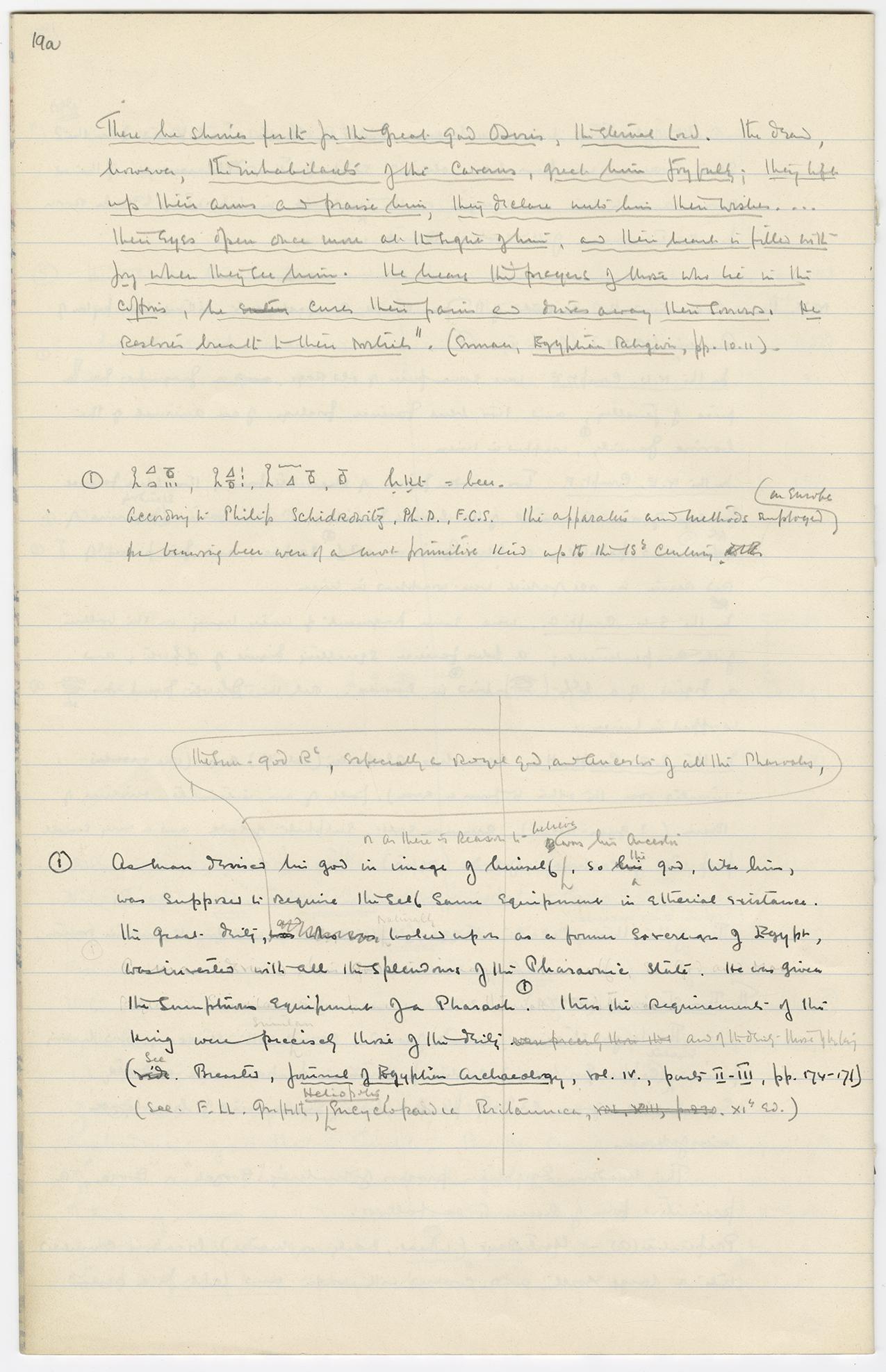
<There he shines forth for the great god Osiris, the eternal Lord. The dead,
however, the inhabitants of the Caverns, greet him joyfully; they lift
up their arms and praise him, they declare unto him their wishes. …
their eyes open once more at the sight of him, and their heart is filled with
joy when they see him. He hears the prayers of those who lie in the
coffins, he enters cures their pain and drives away their sorrows. He
restores breath to their nostrils". (Erman, Egyptian Religion, pp. 10-11).>
(1)
[ 𓂀 ], [ 𓂀 ], [ 𓂀 ], [ 𓂀 ] ḥḳt = beer.
According to Philip Schidrowitz, Ph.D., F.C.S. the apparatus and methods employed <in Europe>
for brewing beer were of a most primitive kind up to the 18th Century,/<.> as the [?]
(1)
As man devised his god in image of himself <or as there is reason to believe of was his ancestor>, so his/<the> god, like him,
was supposed to require the self same equipment in etherialsic {ethereal} existence.
The great deity, <the Sun-god Rʿ, especially a Royal god, and Ancestor of all the Pharaohs,> was who was/<and> <naturally> looked upon as a former Sovereign of Egypt,
was invested with all the splendours of the Pharaonic state. He was given
the sumptuous equipment of a Pharaoh(1). Thus the requirements of the
King were precisely/<similar> those of the deity <were precisely those that and of the deity those of the King>
(vide./See Breasted, Journal of Egyptian Archaeology, Vol. IV., parts II-III, pp. 174-176)
(See. F. Ll. Griffith, <Heliopolis>, Encyclopaedia Britannica, Vol. VIII, p. 230. XIth ed.)