
Unfolding Tutankhamun’s Folding Bed
We are delighted to share a new feature in collaboration with Naoko Nishimoto, who has been working on one of the more unusual objects from the tomb of Tutankhamun: a folding bed (JE 62018; Carter no. 586).
At first glance, the bed is easy to overlook. Unlike the richly decorated pieces found alongside it, it is simply painted white and shows signs of wear. It carries no inscription. Yet, as Nishimoto’s research makes clear, this modest appearance hides a remarkably complex piece of design. She describes it as “one of the most sophisticated artifacts” among surviving examples of ancient Egyptian furniture.
In developing this work, Nishimoto has drawn on a wide range of material. Alongside museum collections and published research, she has made use of photographs, object cards, and excavation records held at the Griffith Institute. These archival sources provide an important visual and documentary foundation for her study, sitting alongside other strands of evidence.

A Bed Designed to Travel
Six beds were discovered in the tomb, but this one stands apart. Folding beds were not unknown in ancient Egypt, but they were usually made in two sections. Tutankhamun’s bed, by contrast, folds into three.
As Nishimoto explains, it was designed to collapse into a compact “Z-form”, making it easier to carry and transport . This is not simply a small adjustment to an existing design. She argues that it represents “a technological innovation without precedent”, with no comparable full-sized example known from other Pharaonic contexts .
Solving a Structural Problem
Designing a bed that folds in three parts created a series of challenges. Standard Egyptian beds relied on a solid wooden frame, strengthened with curved supports to prevent the surface from sagging. Cutting that frame into sections made it far more fragile.
Nishimoto notes that “the frame… was divided into three sections”, a decision that significantly weakened the wood and made it difficult to maintain both strength and comfort.
To make this work, the craftsmen developed a system of metal hinges, each carefully shaped and positioned. One of the most unusual features is a “rare double hinge”, which allows the legs to fold inward and be stored within the frame.
There are also hints that this design did not emerge fully formed. Prototype hinges found at workshop sites suggest a process of experimentation, testing, and adjustment.
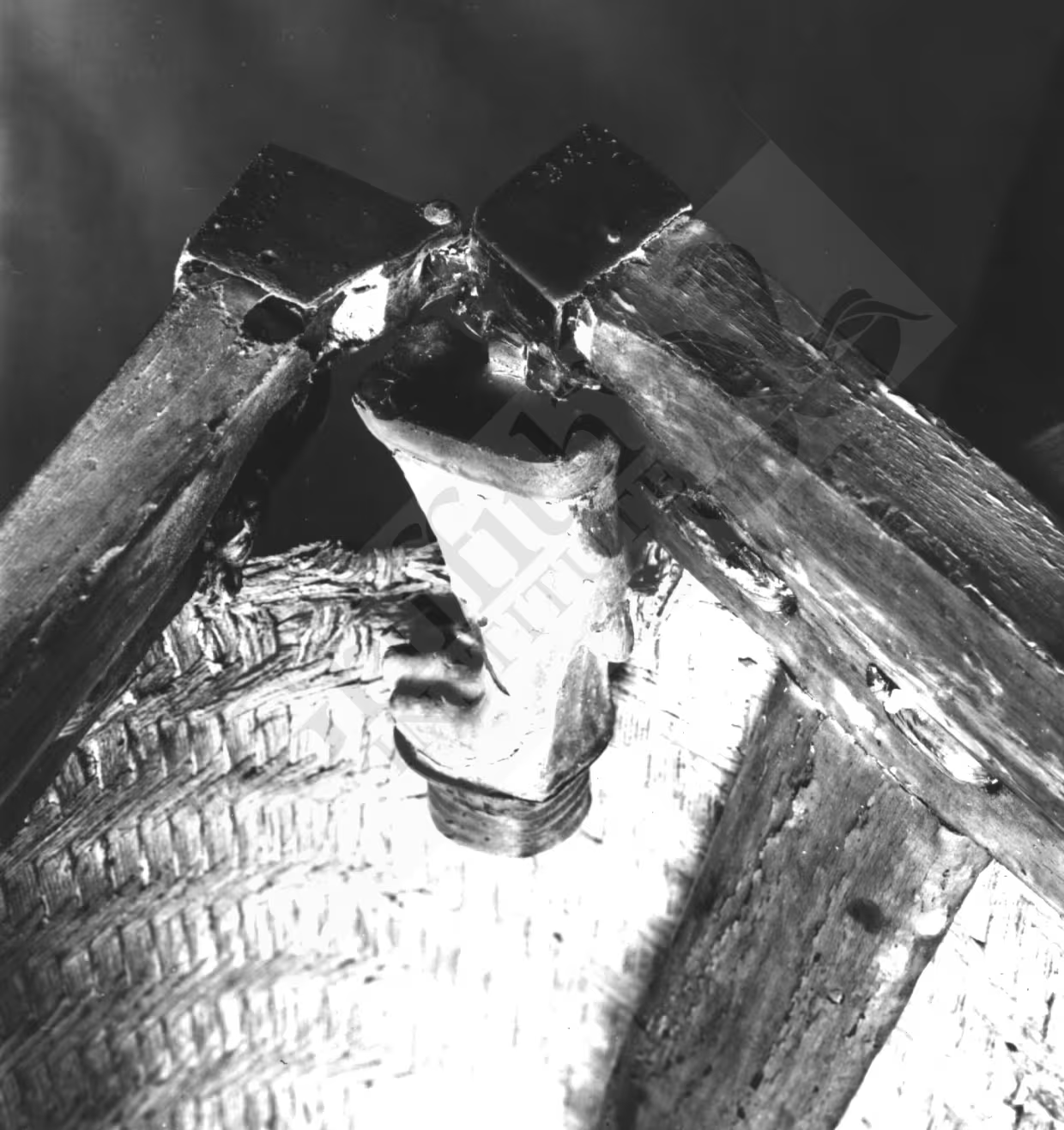
Hinge detail of Carter No.586 TAA i.7.P1479a
Why Eight Legs?
Another striking feature is the number of legs. Instead of the usual four, this bed has eight.
These are carved as lion’s paws, following well-established Egyptian conventions. But the design creates an unusual problem. Egyptian craftsmen were typically very precise in their representation of animal forms, clearly distinguishing front and back limbs. Here, however, the central legs combine features of both.
As Nishimoto points out, this blending is highly unusual and reflects the need to adapt familiar forms to meet new structural demands.

Detail of lion paw legs Carter No.586 TAA i.7.P1479.TAA0923.2
Learning Through Trial and Error
Some of the most revealing evidence comes from the bed’s woven surface. The matting was created by threading cord through holes along the frame. However, the holes near the hinges were never used.
Nishimoto’s reconstruction helps explain why. When the cord was threaded through all the holes, the bed could not fold. As she notes, “the cord was cut off prematurely near the hinge”, suggesting that the original plan had to be revised .
It seems likely that the craftsmen only discovered this problem late in the process, forcing them to undo and redo part of the work. For Nishimoto, this is strong evidence that the bed represents an early experiment in this kind of design.

Detail of matting Carter No.586 TAA i.7.P1479.TAA0923.2
From Archive to Reconstruction
A key part of this project has been bringing together different kinds of evidence. Archival photographs and object records from the Griffith Institute have been used alongside other sources to support the study of the bed’s structure and function.
Building on this research, a 3D reconstruction of the bed has been created, allowing the folding mechanism to be explored in greater detail.
Seeing the Bed in Motion
The videos shown here are derived from that reconstruction and demonstrate how the bed folds into its distinctive Z-shape. They also show how the legs are drawn into the frame as it collapses.
Seeing the bed in motion makes it much easier to understand the relationships between its different parts, and to appreciate the practical challenges described in Nishimoto’s work.
A Different Kind of Object
The folding bed does not have the visual impact of many of the objects found in Tutankhamun’s tomb. Yet it offers something equally valuable: a glimpse into how things were made.
Through careful study, Nishimoto shows that this bed is not just a piece of furniture, but the result of experimentation, problem-solving, and skilled craftsmanship. It preserves traces of decisions, adjustments, and innovations that are rarely visible in the archaeological record.
Further Reading
Naoko Nishimoto, The Folding Bed of Tutankhamun, Mediterraneus 23 (2000), 17–44.
How to cite
Naoko Nishimoto and Lara Bampfield, Unfolding Tutankhamun’s Folding Bed, Griffith Institute, 30 April 2026 URL