Seeing in Three Dimensions: Stereoscopic Images and the Tutankhamun Spatial Archive
Working with the Tutankhamun archive often involves returning to material that has been studied for decades and asking what else it might still contain. For Jenni Navratil, digital imager at the Griffith Institute, this process begins with the image itself: how it was made, how it can be viewed, and what different viewing methods can reveal.

Jenni’s role focuses on creating high quality digital images of a wide range of material, from photographs and glass negatives to documents and objects. Much of her work involves adapting imaging approaches to suit different formats, surfaces, and historical techniques. It was through this close, technical engagement with the photographic material that stereoscopic images emerged as an unexpected but significant feature of the collection.
What are stereoscopic images?
Stereoscopic images are made from two photographs taken from slightly different viewpoints that mimic the different views seen by our left and right eyes. When these images are viewed together, the brain combines them into a single image with depth. The principle mirrors how human vision works: each eye receives a slightly different view, and the brain merges them to produce a three dimensional impression.
As Jenni explains, “a pair of flat images that are slightly different from each other, when carefully paired and viewed together, can be converted by our brain into 3D.” The same principle underlies stereo hearing, where two separate audio inputs are combined into a single spatial experience.
In the nineteenth and early twentieth centuries, stereoscopic photography was widely used for education, entertainment, and documentation. Paired images were viewed through dedicated stereoscopes, and stereo cards became a popular way of experiencing distant places and events.
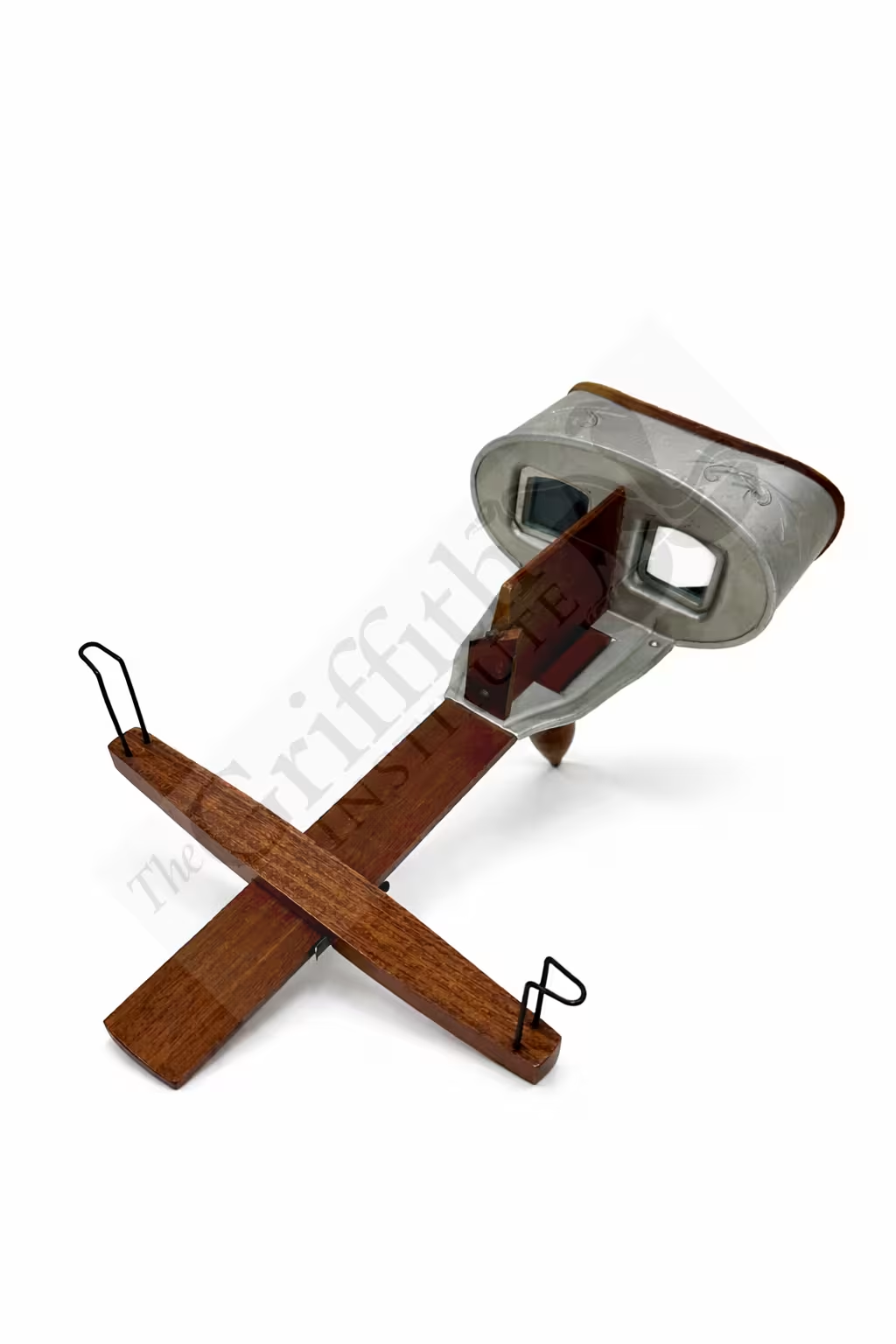
Image of a Stereoscope
Discovering stereoscopy in the Tutankhamun archive
The Tutankhamun archive does not contain purpose made stereoscopic photographs of the excavation. Instead, what makes it unusual is that stereoscopic views can be created retrospectively from existing images.
While digitizing Burton's glass negatives, Jenni noticed that a sequence of photographs he took of Tutankhhamun's gold mask contained two photographs that perfectly matched the left and right eye views needed to make a stereoscopic pair.
Working through the photographic material, Jenni and photographic historian Denis Pellerin from the Brian May Archive of Stereoscopy identified a number of Harry Burton's photographs that were close enough in viewpoint to function as stereoscopic pairs. In these cases, Burton had moved the camera or the objects slightly between shots. When paired, the images produce a clear three-dimensional effect.
This discovery does not suggest that Burton was deliberately creating stereo photographs. Rather, it highlights the precision and consistency of his working method. His careful documentation allows modern viewers to recover visual information that was not originally intended as part of the final photographic record.
What stereoscopic viewing reveals
Viewing these images stereoscopically can bring out details that are difficult to perceive in single photographs. Depth becomes clearer, surfaces are easier to read, and subtle features stand out.
“One example was a crack in the face of a figure,” Jenni explains. “When viewed stereoscopically, the crack was much clearer than in a single photograph.”
This kind of detail changes how the images are read. It draws attention not only to the object being photographed, but to the physical conditions of the excavation, the handling of objects, and the thoroughness of the photographic process. Stereoscopic viewing also reinforces a sense of space, helping viewers understand how objects related to one another within the tomb.
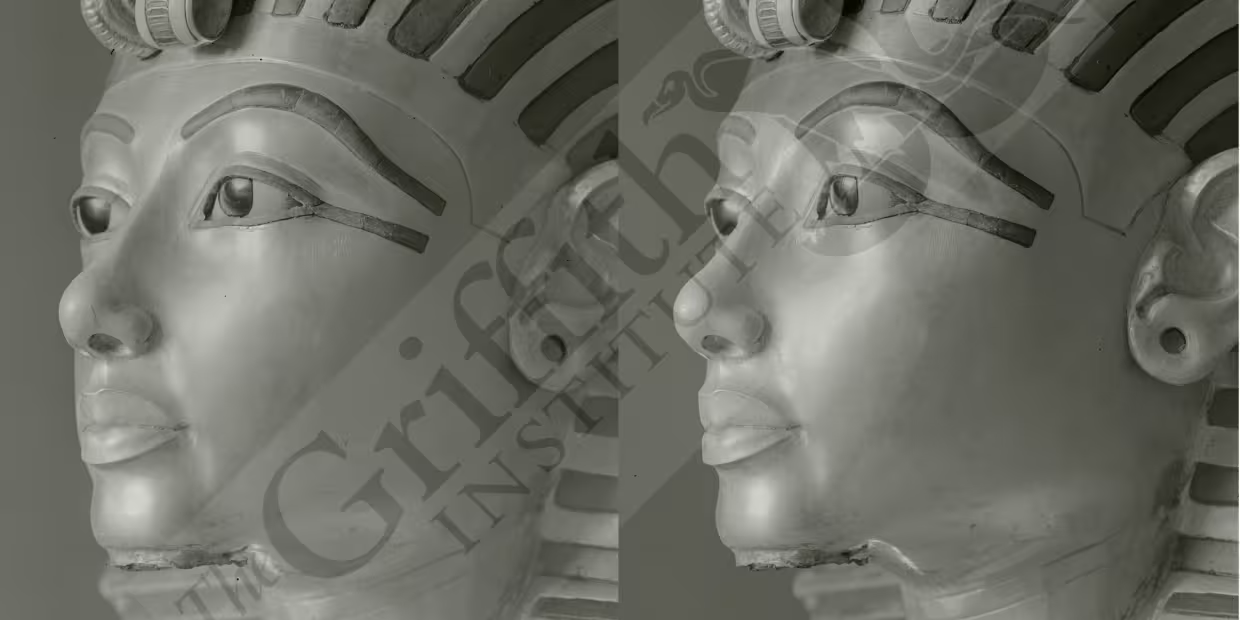
An example of one of the unintentional stereoscopic photographs by Harry Burton discovered by Denis Pellerin of the Brian May Archive of Stereoscopy and Jenni Navratil of the Griffith Institute, Oxford University. Images are Burton p0751 and p0750 displaying the Mask of Tutankhamun Carter 256a.
Viewing stereoscopic images today
Stereoscopic images are no longer confined to specialist equipment or museum displays. Jenni notes that there are now several ways for people to view stereoscopic images at home, including free parallel viewing techniques on digital screens and animated GIFs that allow the images to merge visually (these can be found here). These methods have been developed and shared by researchers and practitioners, including the Brian May Archives of Stereoscopy charity which holds a collection of stereoscopic photos and viewers. These approaches make stereoscopic material accessible without requiring physical viewers, allowing a wider audience to engage with the images.
The London Stereoscopic Company publishes the books and stereocards of Brian May and others.
Photography, skill, and historical practice
The discovery of stereoscopic pairs also reinforces the exceptional quality of Burton’s photography more broadly. Jenni describes him as “a phenomenal photographer,” noting the consistency, clarity, and technical control evident across the archive.
His photographs document the excavation with remarkable care, capturing objects, spaces, and processes in a way that continues to support new forms of analysis. The fact that stereoscopic views can be reconstructed from his work is not accidental, but a consequence of his methodical approach.
Stereoscopy and the Tutankhamun Spatial Archive
This kind of re examination is closely aligned with the aims of the Tutankhamun Spatial Archive. By providing high quality digital images and supporting different ways of viewing and navigating material, the archive allows users to engage with familiar photographs in new ways.
Stereoscopic images are one example of how historical material can be re approached through modern imaging practices. They demonstrate that the archive still contains technical and visual possibilities that depend on how material is viewed, not just on what it depicts.
Rather than presenting photographs as static records, this work treats them as objects that can be re examined, re combined, and re understood through careful digital practice. In doing so, it highlights the continued value of photographic expertise within archival work and the importance of looking closely, even at material that appears well known.
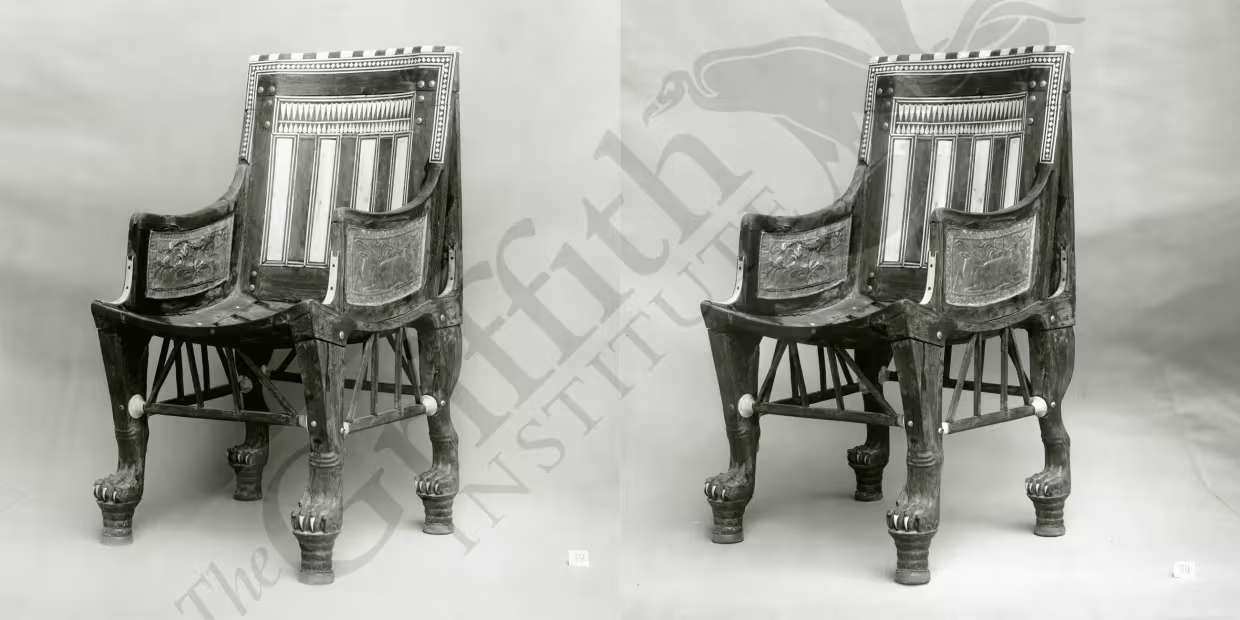
An example of one of the unintentional stereoscopic photographs by Harry Burton discovered by Denis Pellerin of the Brian May Archive of Stereoscopy and Jenni Navratil of the Griffith Institute, Oxford University. Images are Burton p0144a and p0143 displaying the solid ebony chair Carter 039.
Digitisation officer and image specialist - Jenni Navratil
Interviewer and writer - Lara Bampfield
How to cite
Jenni Navratil and Lara Bampfield, Seeing in Three Dimensions: Stereoscopic Images and the Tutankhamun Spatial Archive, Griffith Institute, 27 January 2026 URL