
The Egyptian workforce
It is important to remember that the archive was created by the English, presenting the discovery with a very Eurocentric perspective. This historical source has to be seen in its colonial context: it can show us only one side of the story, inevitably giving a highly partial view of events.
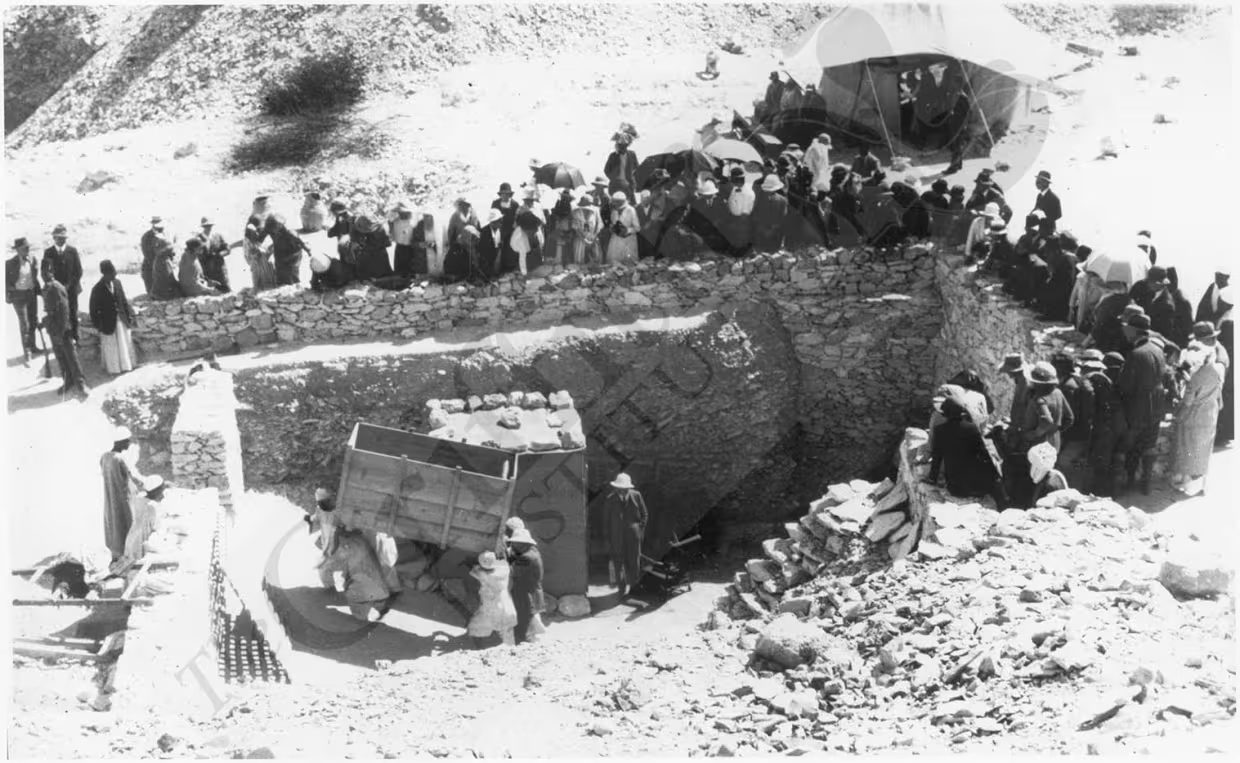
We need to keep in mind that the history of Egyptology as a whole is deeply shaped by colonialism. The archive was created by people who were embedded in that world and its power structures, and it reveals the inequalities in both social and academic worlds.
Howard Carter heavily relied on a large Egyptian workforce – probably around 50 local workmen and dozens of children as was standard practice at that time – during the process of uncovering the tomb and recording its contents.

Carter, Callender and two Egyptian team members dismantling the outer shrine (Carter no. 207) (Burton P0605)
Although it was these men who conducted the physically demanding work, often under harsh weather conditions with high temperatures, they are “invisible” to us in publications.
Their contributions have often been overlooked and their names were not recorded in the official accounts of the discovery.
Carter named and thanked only his four foremen (ru’asa) in his publication: Ahmed Gerigar, Gad Hassan, Hussein Abu Awad and Hussein Ahmed Said. In contrast to the European and American members of the team, the Egyptian workmen didn’t leave any written traces like diaries or letters in the archive.
However, the Egyptian workmen are made visible to us in Harry Burton’s photographs which are a key to understanding the crucial importance of their presence and help us to see their vital role in the discovery.
It was they who removed the wall between the Antechamber and the Burial chamber; lifted shrine roofs, carried baskets, removed rubble, transported objects to the laboratory or loading crates with objects on barges that shipped the artefacts to Cairo.
Thanks to these images we get a more inclusive view of the team, working shoulder to shoulder with Carter.
Modern scholars such as Dr Hend Mohamed Abdel Rahman are researching the histories of Egyptian team members, and restoring their identities (see link below for a lecture by Dr Abdel Rahman). In such ways the archive can enable us to understand the discovery in its context and also the complexities of the excavation process and the various modern narratives that have been built around it.

Removal of the wall between the Antechamber and the Burial chamber (Burton P0504)

Egyptian boy wearing a pectoral (Carter no. 267g–h) (Burton P1189)
An outstanding series of three images was taken by Burton showing an Egyptian boy wearing one of Tutankhamun's necklaces.
One of the photographs was first published in the Illustrated London News in 1927, where the caption stated that is has been taken simply ‘to show the method of suspension’!
His name has not been recorded. However, the boy’s face looking very tense in one of the shots, suggests a much more complex human response.
His expression suggests an awareness of the weight—both the literal physical weight and the metaphorical weight—of ancient history on his shoulders. Despite the fact his name was not recorded at the time, this is an immensely evocative and moving image, showing ancient and modern Egypt touching each other, with the past and present united.
The discovery immediately generated intense interest in Egypt and king Tutankhamun became a figure of national identity. The poet Ahmad Shawqi wrote several poems about Tutankhamun, celebrating the ancient objects’ ability to evoke the life of the young king’s court and linking the rediscovery and rebirth of the king with Egypt’s eternal identity as a nation which was starting to free itself from colonial oppression: ‘Tutankhamen has returned his authority to our sons’.
Listen to a poem by Ahmad Shawqi (audio guide stop from the exhibition "Tutankhamun: Excavating the Archive" at the Weston Library, Oxford (13 April 2022 – 5 February 2023):
https://soundcloud.com/bodleianlibraries/poems-by-ahmad-shawqi
Read this blog post by Prof. Christina Riggs on the identity of the boy:
Water boys and wishful thinking – Christina Riggs
Lecture Dr Hend Mohamed AbdelRahman:
How to cite
Griffith Institute , The Egyptian workforce, Griffith Institute, 17 March 2026 URL