
TAA i.3.9.31
Photocopy of typewritten and annotated notes for a lecture titled 'Scientific Aspects of the Egyptian Discoveries', page 27.
The whole text or part of the text is fully struck through on this page but is not indicated in the transcription. On this page, strikethrough formatting is reserved for the author’s edits and deletions within the main body of the text, which would otherwise be difficult to distinguish.
© Griffith Institute,
University of Oxford
– 27 –
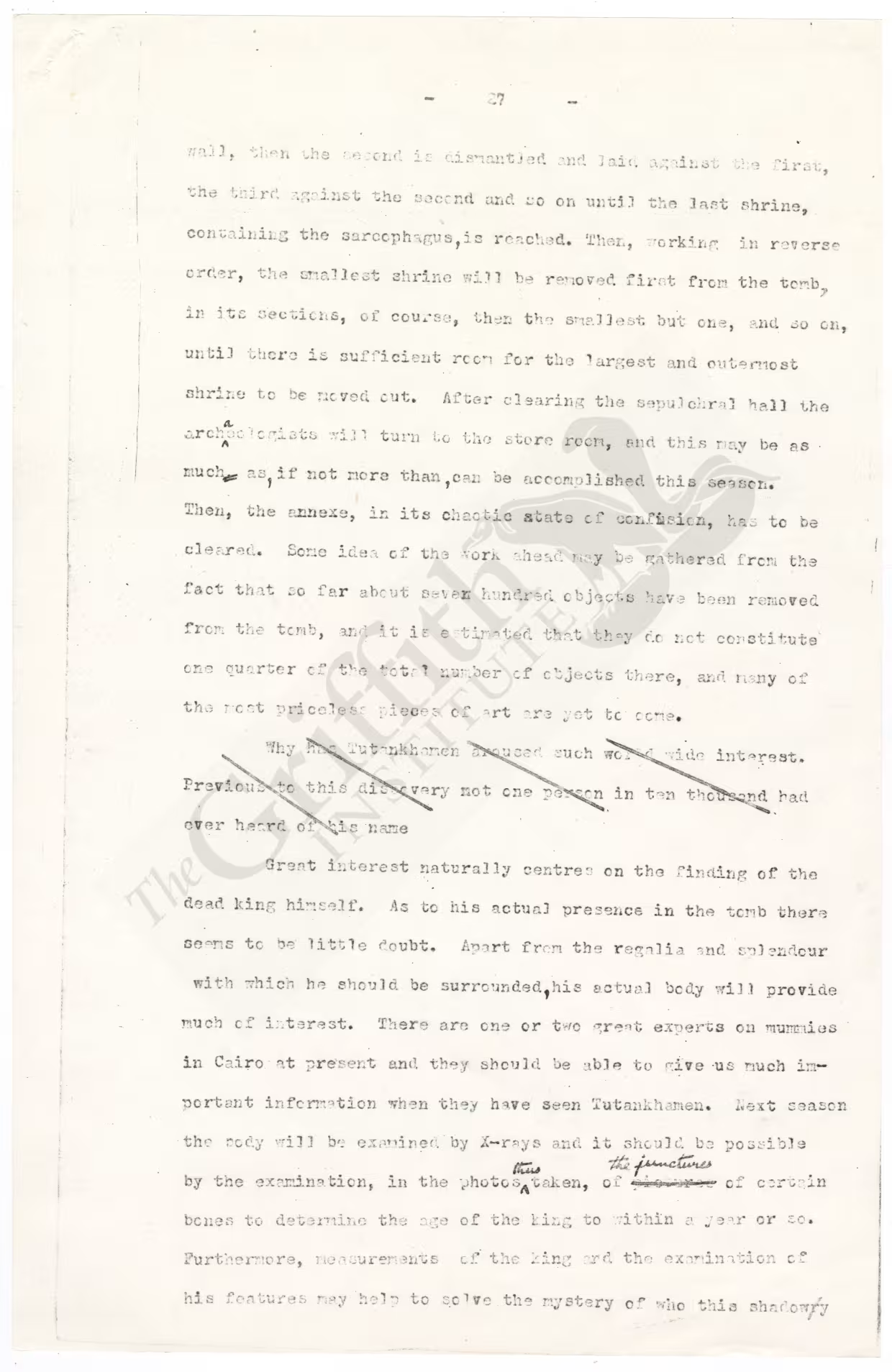
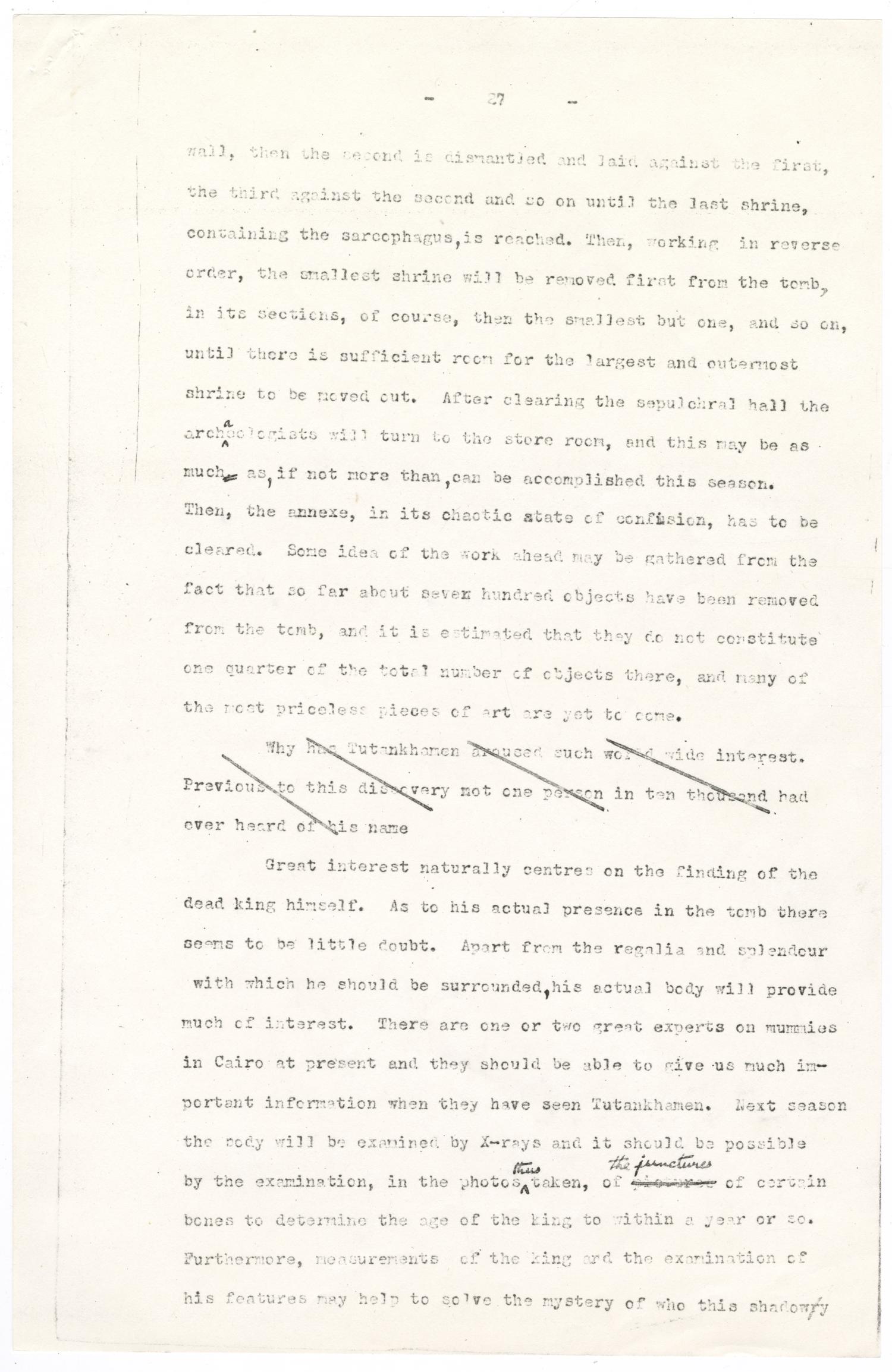
wall, then the second is dismantled and laid against the first,
the third against the second and so on until the last shrine,
containing the sarcophagus<,> is reached. Then, working in reverse
order, the smallest shrine will be removed first from the tomb<,>
it its sections, of course, then the smallest but one, and so on,
until there is sufficient room for the largest and outermost
shrine to be moved out. After clearing the sepulchral hall the
arch<a>eologists will turn to the store room, and this may be as
much, as<,> if not more than<,> can be accomplished this season.
Then, the annexe, in its chaotic state of confi/<u>sion, has to be
cleared. Some idea of the work ahead may be gathered from the
fact that so far about seven hundred objects have been removed
from the tomb, and it is estimated that they do not constitute
one quarter of the total number of objects there, and many of
the most priceless pieces of art are yet to come.
Why has Tutankhamen aroused such world wide interest.
Previous to this discovery not one person in ten thousand had
ever heard of his name
Great interest naturally centres on the finding of the
dead king himself. As to his actual presence in the tomb there
seems to be little doubt. Apart from the regalia and splendour
with which he should be surrounded<,> his actual body will provide
much of interest. There are one or two great experts on mummies
in Cairo at present and they should be able to give us much im-
portant information when they have seen Tutankhamen. Next season
the body will be examined by X-rays and it should be possible
by the examination, in the photos <thus> taken, of pictures/<the junctures>of certain
bones to determine the age of the king to within a year or so.
Furthermore, measurements of the king and the examination of
his features may help to solve the mystery of who this shadowry