
TAA i.3.9.30
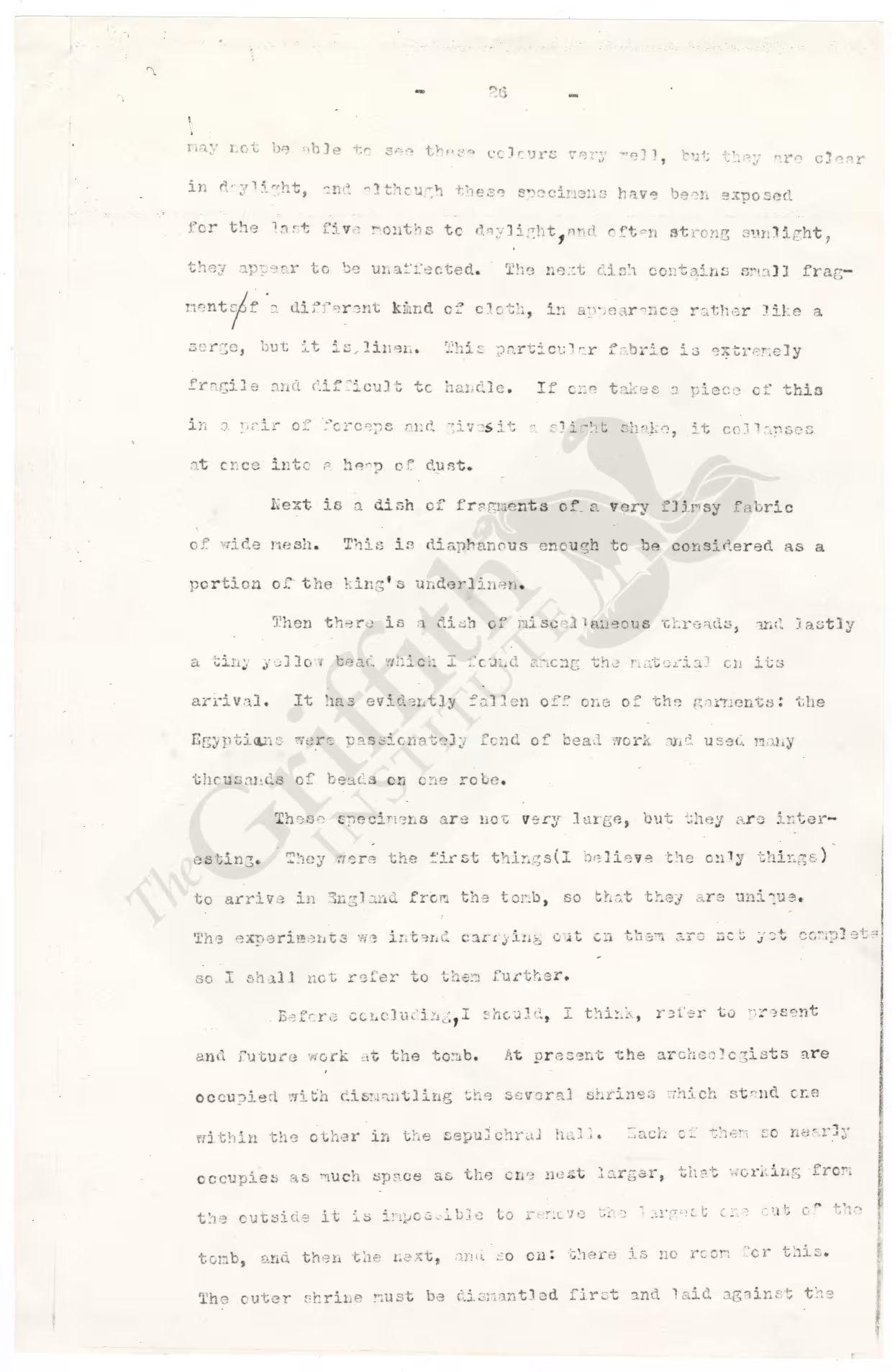
Photocopy of typewritten and annotated notes for a lecture titled 'Scientific Aspects of the Egyptian Discoveries', page 26.

© Griffith Institute,
University of Oxford
– 26 –
may not be able to see these colours very well, but they are clear
in daylight, and although these specimens have been exposed
for the last five months to daylight<,> and often strong sunlight,
they appear to be unaffected. The next dish contains small frag-
ments </> of a different kn/<i>nd of cloth, in appearance rather like a
serge, but it is linen. This particular fabric is extremely
fragile and difficult to handle. If one takes a piece of this
in a pair of forceps and give<s> it a slight shake, it collapses
at once into a heap of dust.
Next is a dish of fragments of a very flimsy fabric
of wide mesh. This is diaphanous enough to be considered as a
portion of the king's underlinen.
Then there is a dish of miscellaneous threads, and lastly
a tiny yellow bead which I found among the material on its
arrival. It has evidently fallen off one of the garments: the
Egyptio/<a>ns were passionately fond of bead work and used many
thousands of beads on one robe.
These specimens are not very large, but they are inter-
esting. They were the first things (I believe the only things)
to arrive in England from the tomb, so that they are unique.
The experiments we intend carrying out on them are not yet complete
so I shall not refer to them further.
Before concluding<,> I should<,> I think, refer to present
and future work at the tomb. At present the archeologistssic are
occupied with dismantling the several shrines which stand one
within the other in the sepulchral hall. Each of them so nearly
occupies as much space as the one nes/<x>t larger, that working from
the outside it is impossible to remove the largest one out of the
tomb, and then the next, and so on: there is no room for this.
The outer shrine must be dismantled first and laid against the