
TAA i.3.5.4
Typewritten and annotated report on the canopic equipment, page 4.
© Griffith Institute,
University of Oxford
(4)
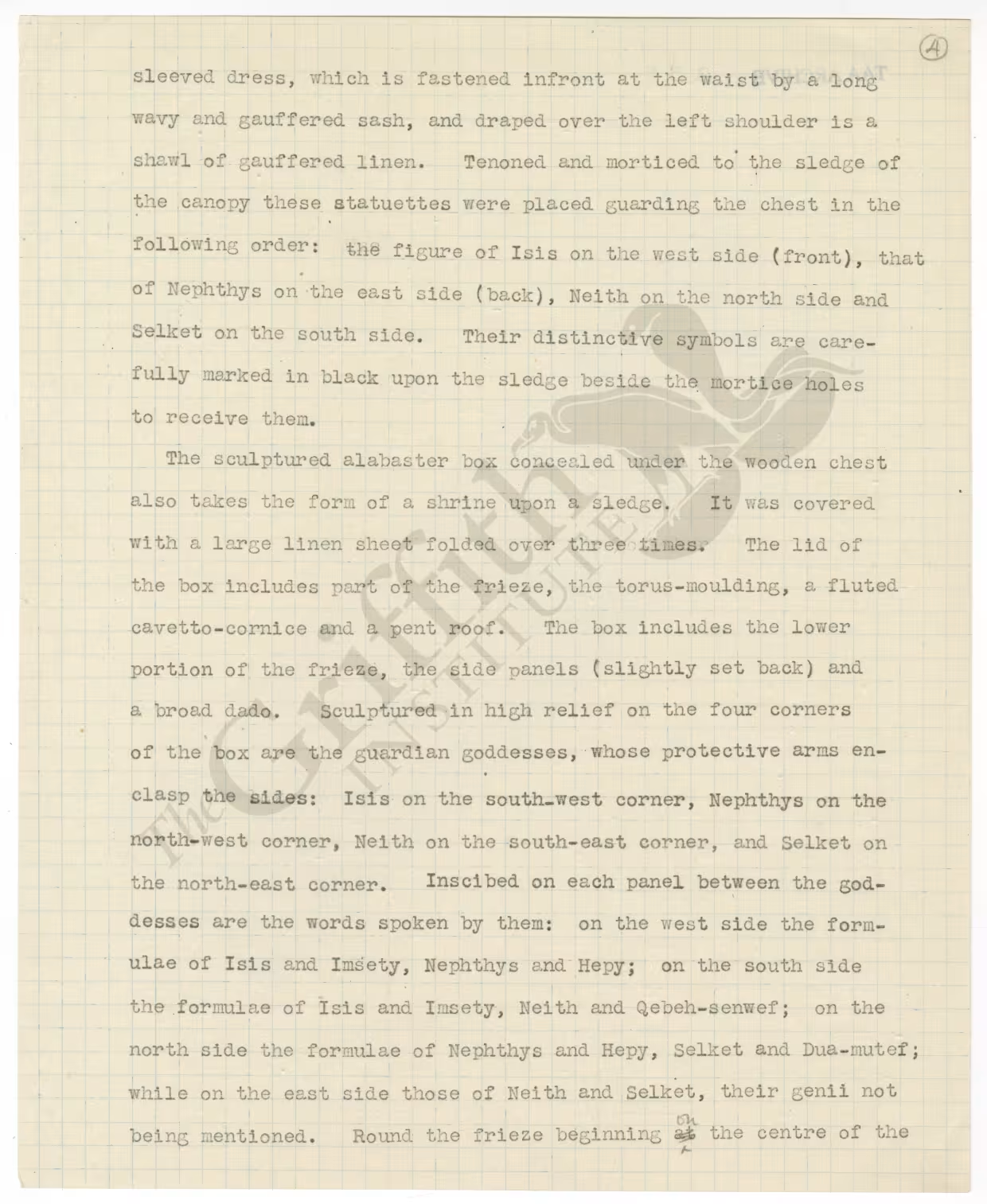
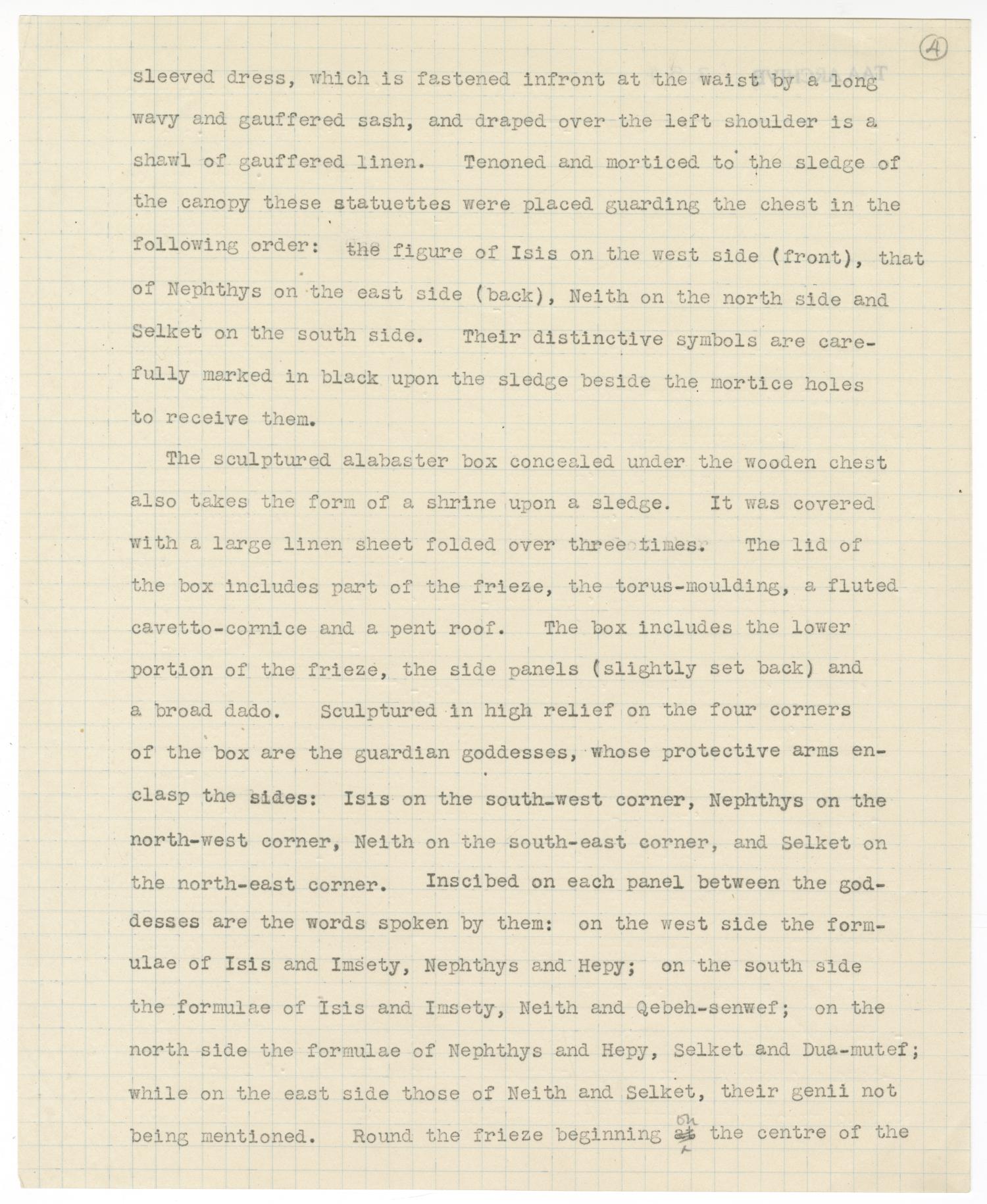
sleeved dress, which is fastened infrontsic at the waist by a long
wavy and gauffered sash, and draped over the left shoulder is a
shawl of gauffered linen. Tenoned and morticed to the sledge of
the canopy these statuettes were placed guarding the chest in the
following order: the figure of Isis on the west side (front), that
of Nephthys on the east side (back), Neith on the north side and
Selket on the south side. Their distinctive symbols are care-
fully marked in black upon the sledge beside the mortice holes
to receive them.
The sculptured alabaster box concealed under the wooden chest
also takes the form of a shrine upon a sledge. It was covered
with a large linen sheet folded over three times. The lid of
the box includes part of the frieze, the torus-moulding, a fluted
cavetto-cornice and a pent roof. The box includes the lower
portion of the frieze, the side panels (slightly set back) and
a broad dado. Sculptured in high relief on the four corners
of the box are the guardian goddesses, whose protective arms en-
clasp the sides: Isis on the south-west corner, Nephthys on the
north-west corner, Neith on the south-east corner, and Selket on
the north-east corner. Inscribed on each panel between the god-
desses are the words spoken by them: on the west side the form-
ulae of Isis and Imsety, Nephthys and Hepy; on the south side
the formulae of Isis and Imsety, Neith and Qebeh-senwef; on the
north side the formulae of Nephthys and Hepy, Selket and Dua-mutef;
while on the east side those of Neith and Selket, their genii not
being mentioned. Round the frieze beginning at/<on> the centre of the