
TAA i.3.23.32
Page 20 of first draft on shrines, handwritten.

© Griffith Institute,
University of Oxford
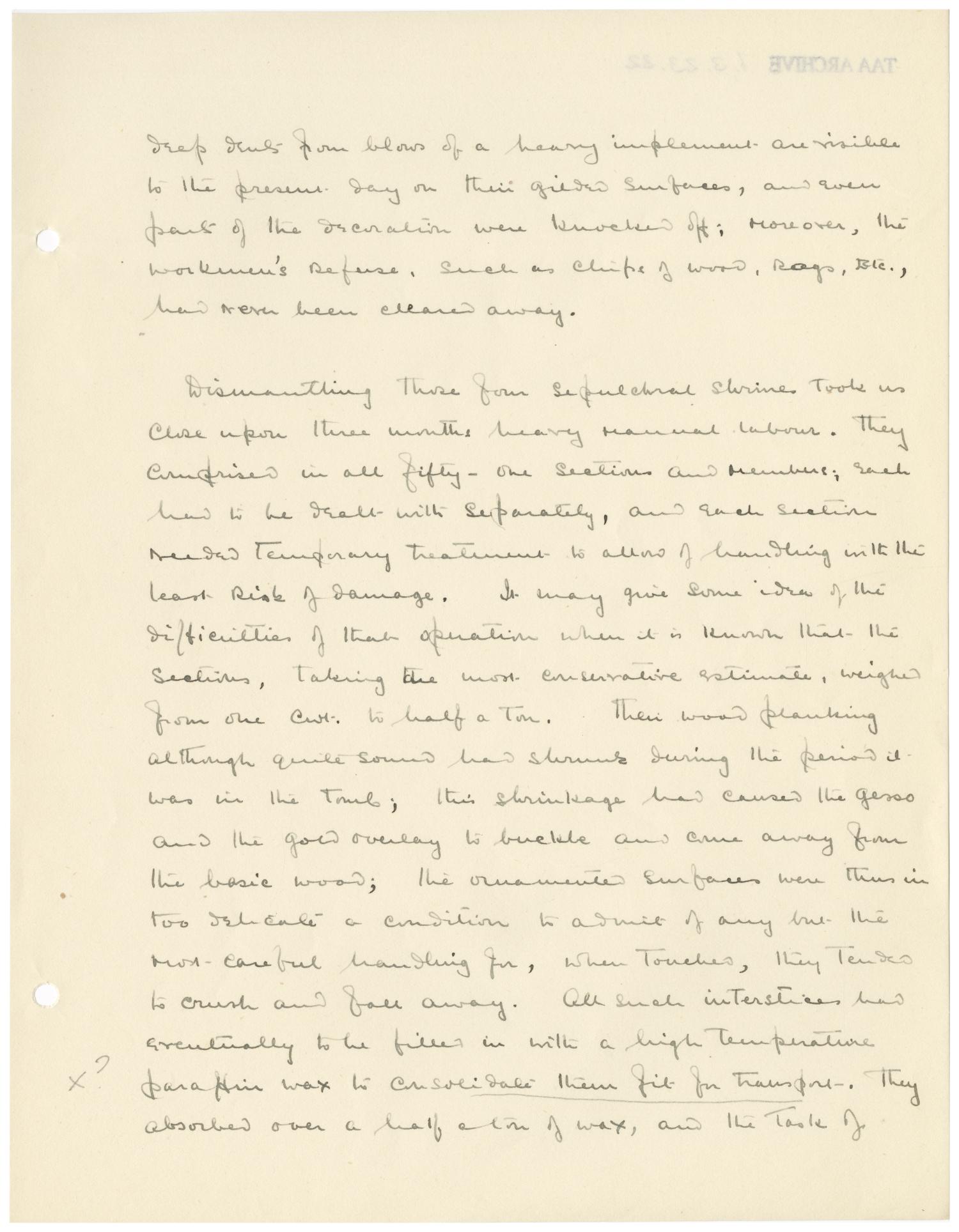
deep dents from blows of a heavy implement are visible
to the present day on their gilded surfaces, and even
parts of the decoration were knocked off; moreover, the
workmen’s refuse, such as chips of wood, rags, etc.,
has never been cleared away.
Dismantling those four sepulchral shrines took us
close upon three months heavy manual labour. They
comprised in all fifty-one sections and members; each
had to be dealt with separately, and each section
needed temporary treatment to allow of handling with the
least risk of damage. It may give some idea of the
difficulties of that operation when it is known that the
sections, taking the most conservative estimate, weighed
from one cwt. to half a ton. Their wood planking
although quite sound had shrunk during the period it
was in the tomb; this shrinkage had caused the gesso
and the gold overlay to buckle and come away from
the basic wood; the ornamented surfaces were thus in
too delicate a condition to admit of any but the
most careful handling for, when touched, they tended
to crush and fall away. All such interstices had
eventually to be filled in with a high temperature
<x?> paraffin wax to consolidate them fit for transport. They
absorbed over a half a ton of wax, and the task of