
TAA i.3.23.30
Page 18 of first draft on shrines, handwritten.

© Griffith Institute,
University of Oxford
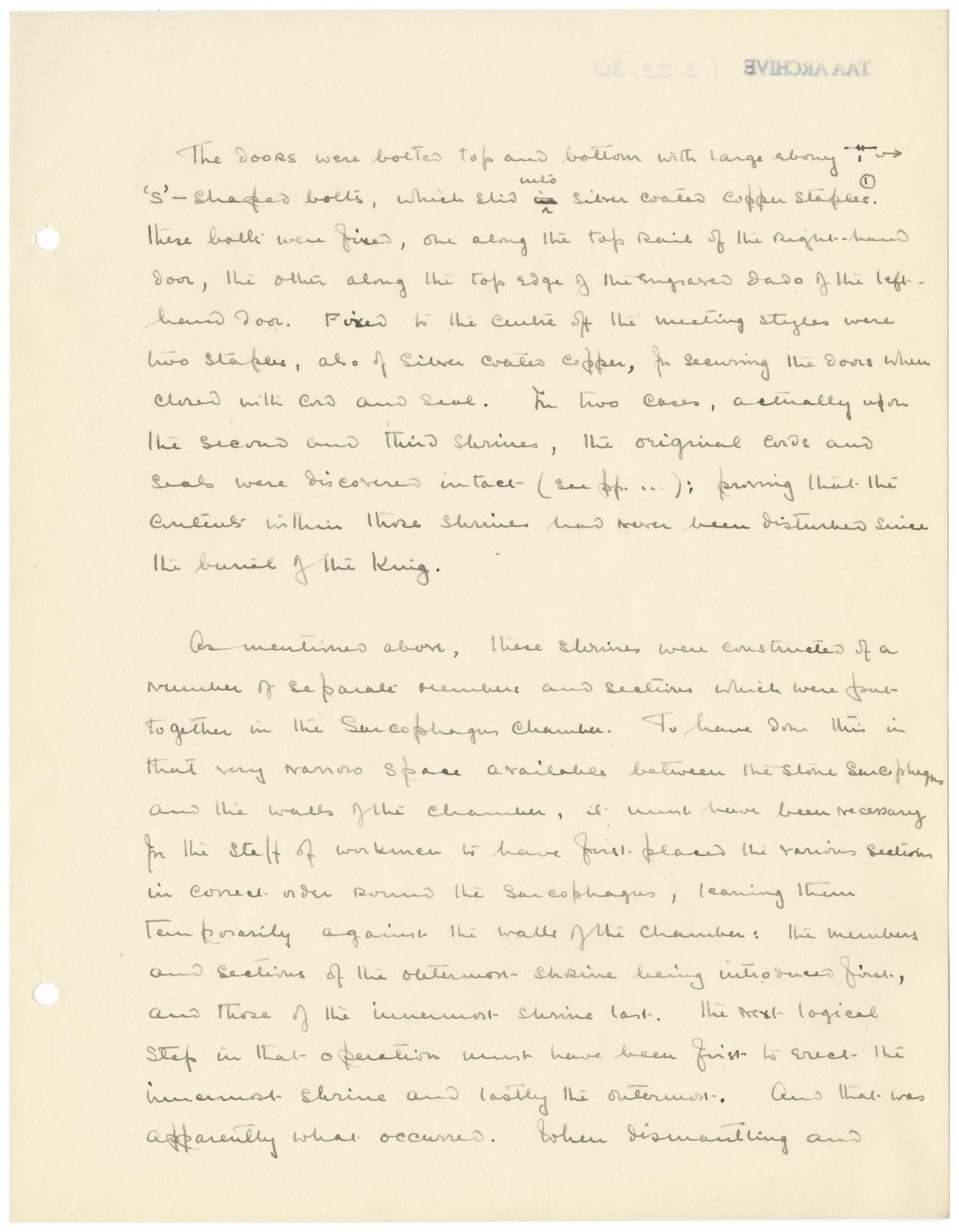
The doors were bolted top and bottom with large ebony [ 𓂀 ]
‘s’-shaped bolts, which slid in/<into> silver coated copper staples. (1)
These bolts were fixed, one along the top rail of the right-hand
door, the other along the top edge of the engraved dado of the left-
hand door. Fixed to the centre of the meeting styles were
two staples, also of silver coated copper, for securing the doors when
closed with cord and seal. In two cases, actually upon
the second and third shrines, the original cords and
seals were discovered intact (see pp. ...); proving that the
contents within those shrines had never been disturbed since
the burial of the King.
As mentioned above, these shrines were constructed of a
number of separate members and sections which were put
together in the Sarcophagus Chamber. To have done this in
that very narrow space available between the stone sarcophagus
and the walls of the chamber, it must have been necessary
for the staff of workmen to have first placed the various sections
in correct order round the sarcophagus, leaning them
temporarily against the walls of the chamber: the members
and sections of the outermost shrine being introduced first,
and those of the innermost shrine last. The next logical
step in that operation must have been first to erect the
innermost shrine and lastly the outermost. And that was
apparently what occurred. When dismantling and