
TAA i.3.23.11
Page 10 of second draft on shrines, handwritten.

© Griffith Institute,
University of Oxford
(X)
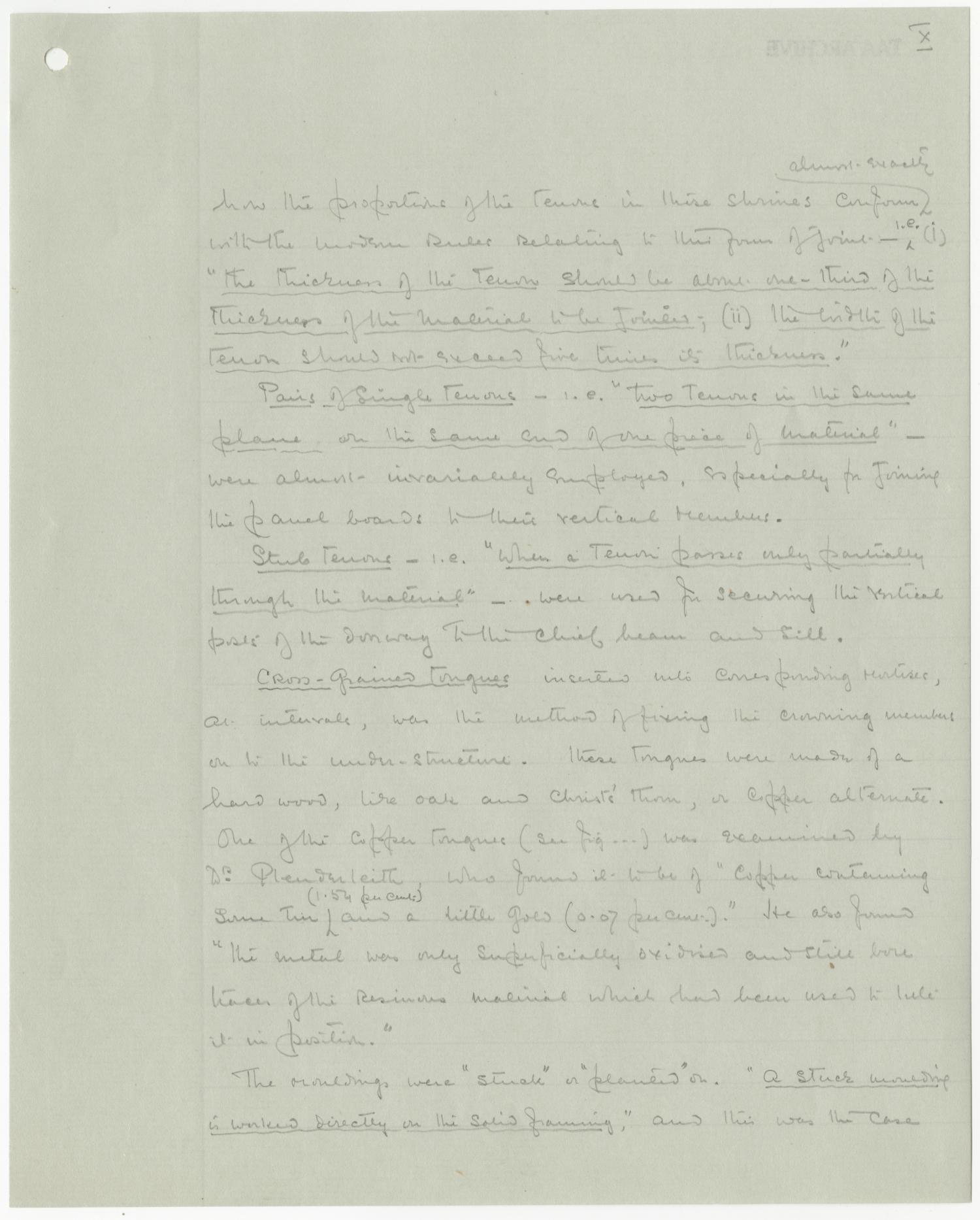
how the proportions of the tenons in these shrines conform <almost exactly>
with the modern rules relating to this form of joint – <i.e> (i)
“the thickness of the tenon should be about one-third of the
thickness of the material to be jointed; (ii) the width of the
tenon should not exceed five times its thickness.”
Pairs of Single Tenons – i.e. “two tenons in the same
plane on the same end of one piece of material” –
were almost invariably employed, especially for joining
the panel boards to their vertical members.
Stub Tenons – i.e. “When a tenon passes only partially
through the material” – were used for securing the vertical
posts of the doorway to the chief beam and sill.
Cross-grained tongues inserted into corresponding mortises,
at intervals, was the method of fixing the crowning members
on to the under-structure. These tongues were made of a
hard wood, like oak and Christ’s thorn, or copper alternate.
One of the copper tongues (see fig…) was examined by
Drs Plenderleith, who found it to be of “copper containing
some tin <(1.54 per cent)> and a little gold (0.07 per cent.).” He also found
“the metal was only superficially oxidised and still bore
traces of the resinous material which had been used to hold
it in position.”
The mouldings were “stuck” or “planted” on. “A stuck moulding
is worked directly on the solid framing,” and this was the case