
TAA i.3.14.8
Handwritten notes on gold found in jewellery and other items from the New Kingdom, page 8.

© Griffith Institute,
University of Oxford
(8)
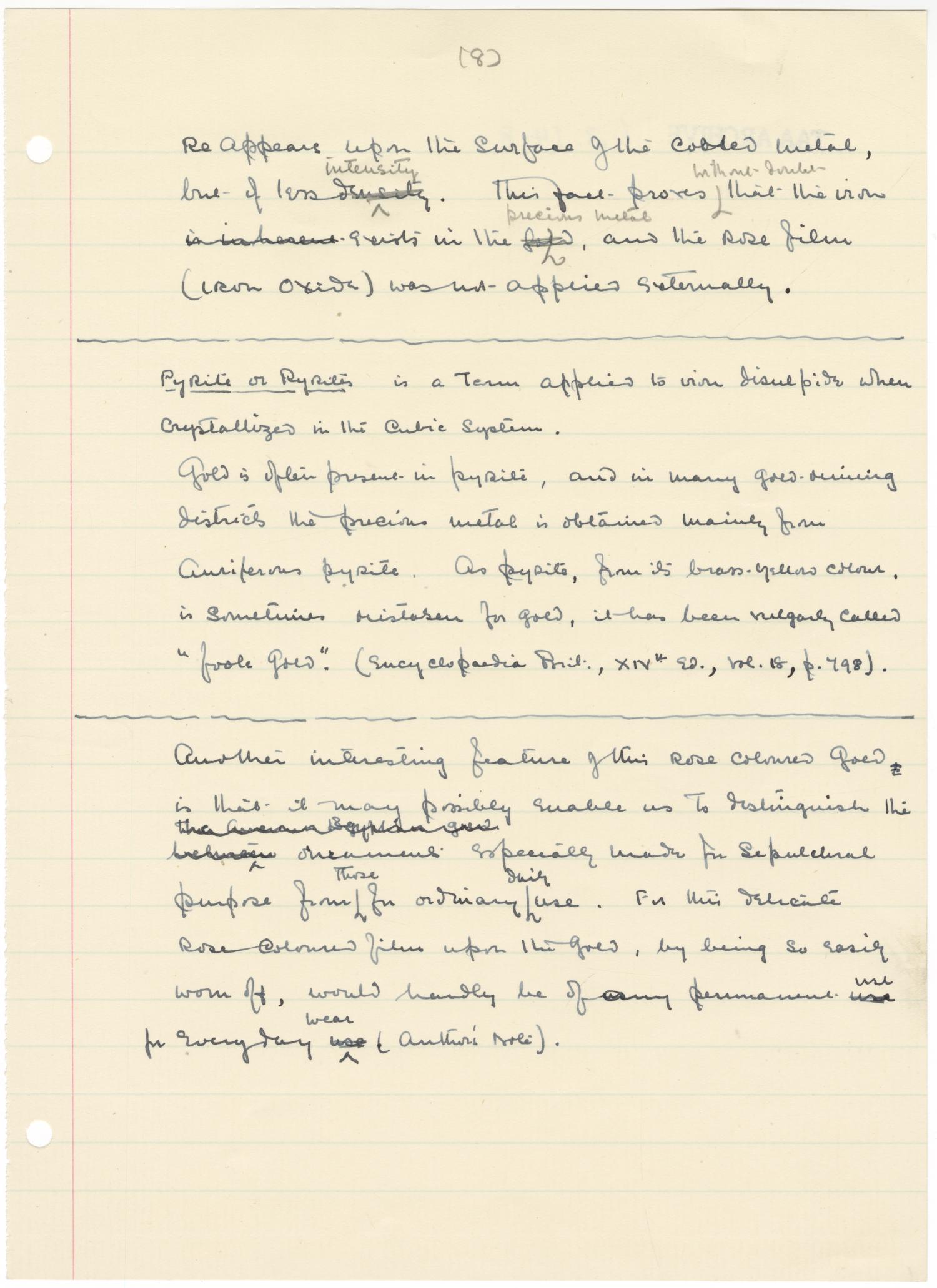
reappears upon the surface of the cooled metal,
but of less density/<intensity>. This fact proves <without doubt> that the iron
is inherent exists in the gold/<precious metal>, and the rose film
(iron oxide) was not applied externally.
Pyrite or Pyrites is a term applied to iron disulphide when
crystallized in the cubic system.
Gold is often present in pyrite, and in many gold-mining
districts the precious metal is obtained mainly from
auriferous pyrite. As pyrite, from its brass-yellow colour,
is sometimes mistaken for gold, it has been vulgarly called
“fools gold”. (Encyclopaedia Brit., XIVth Ed., Vol. 18, p. 798).
Another interesting feature of this rose coloured gold
is that it may possibly enable us to distinguish the
xxx[?] <the amxxx[?] Egypt on gold> ornaments especially made for sepulchral
purpose from <those> for ordinary <daily> use. For this delicate
rose coloured film upon the gold, by being so easily
worn off, would hardly be of x[?]/<a>ny permanent use/<use>
for everyday use/<wear> (Author’s Note).