
TAA i.3.14.7
Handwritten notes on gold found in jewellery and other items from the New Kingdom, page 7. Dr Alexander Scott and Dr Harold Plenderleith are also mentioned on this page.
© Griffith Institute,
University of Oxford
(7)
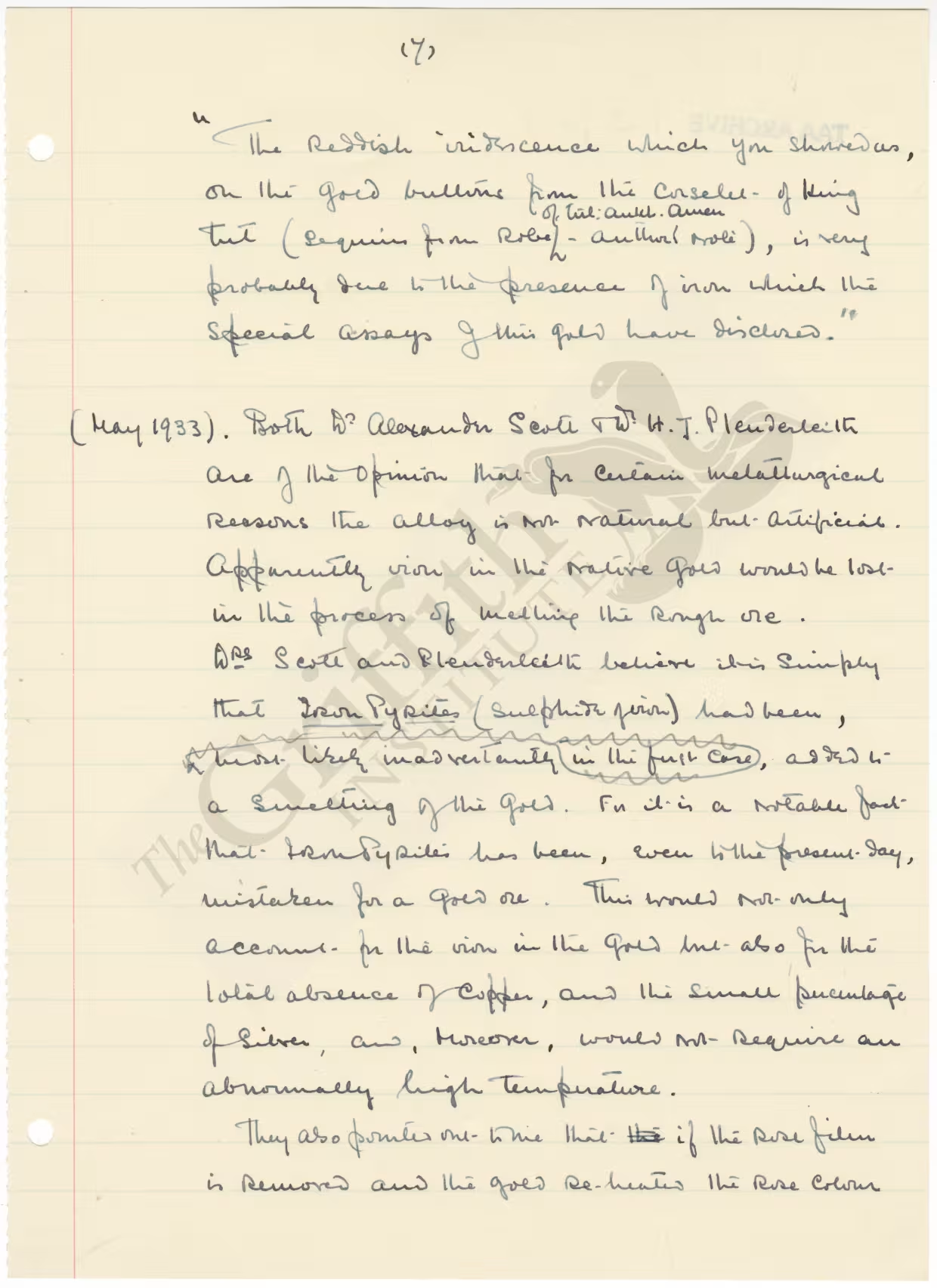
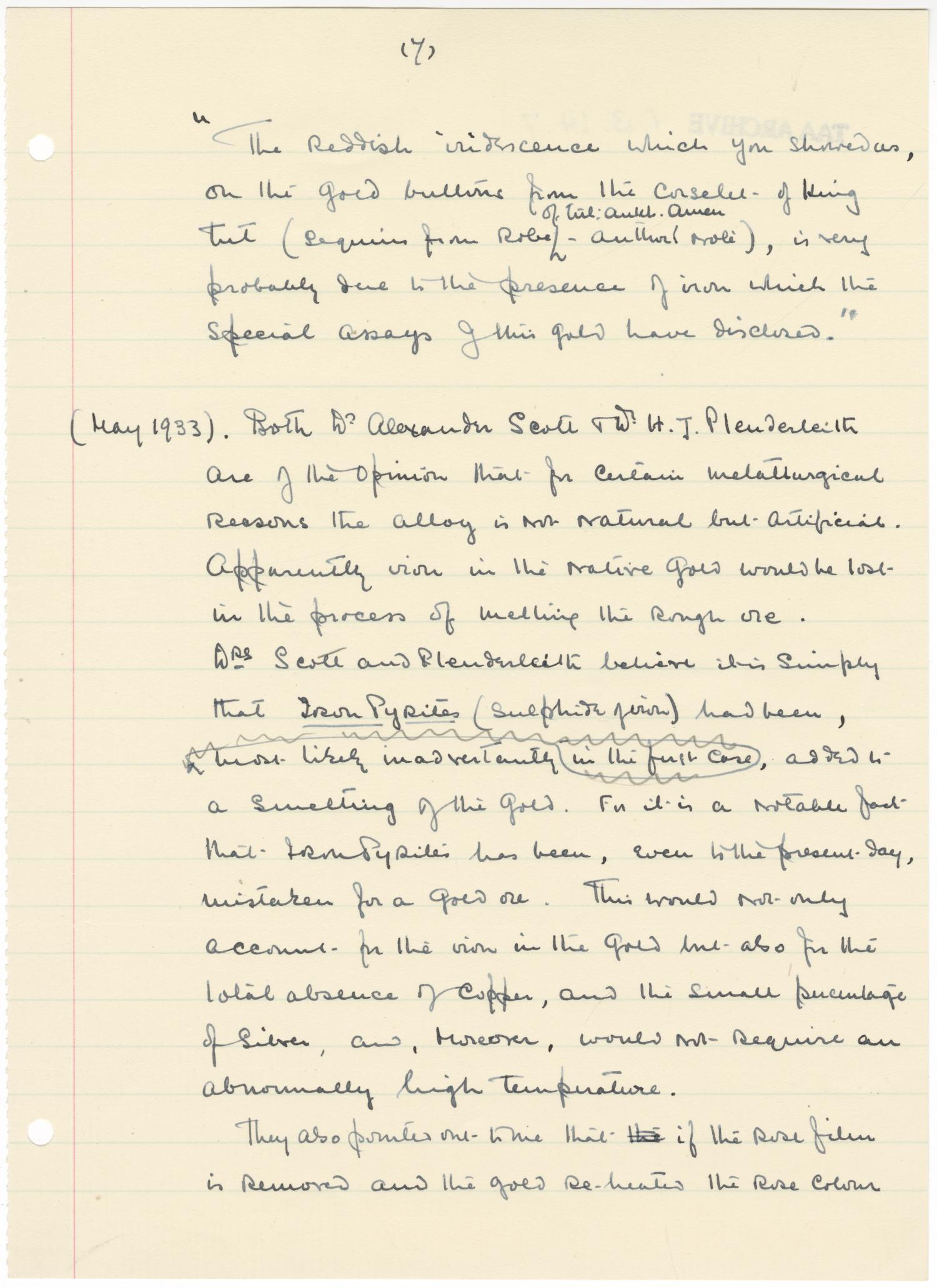
“The reddish iridescence which you showed us,
on the gold buttons from the corselet of king
Tut (sequins from robe <of Tut.Ankh.Amen> – Author’s Note), is very
probably due to the presence of iron which the
special assays of this gold have disclosed.”
(May 1933). Both Dr Alexander Scott & Dr H. J. Plenderleith
are of the opinion that for certain metallurgical
reasons the alloy is not natural but artificial.
Apparently iron in the native gold would be lost
in the process of melting the rough ore.
Drs Scott and Plenderleith believe it is simply
that Iron Pyrites (sulphide of iron) had been,
<in the first case> most likely inadvertently, added to
a smelting of the gold. For it is a notable fact
that Iron Pyrite has been, even in the present day,
mistaken for a gold ore. This would not only
account for the iron in the gold but also for the
total absence of copper, and the small percentage
of silver, and, moreover, would not require an
abnormally high temperature.
They also pointed out to me that the if the rose film
is removed and the gold re-heated the rose colour