
TAA i.3.1.31
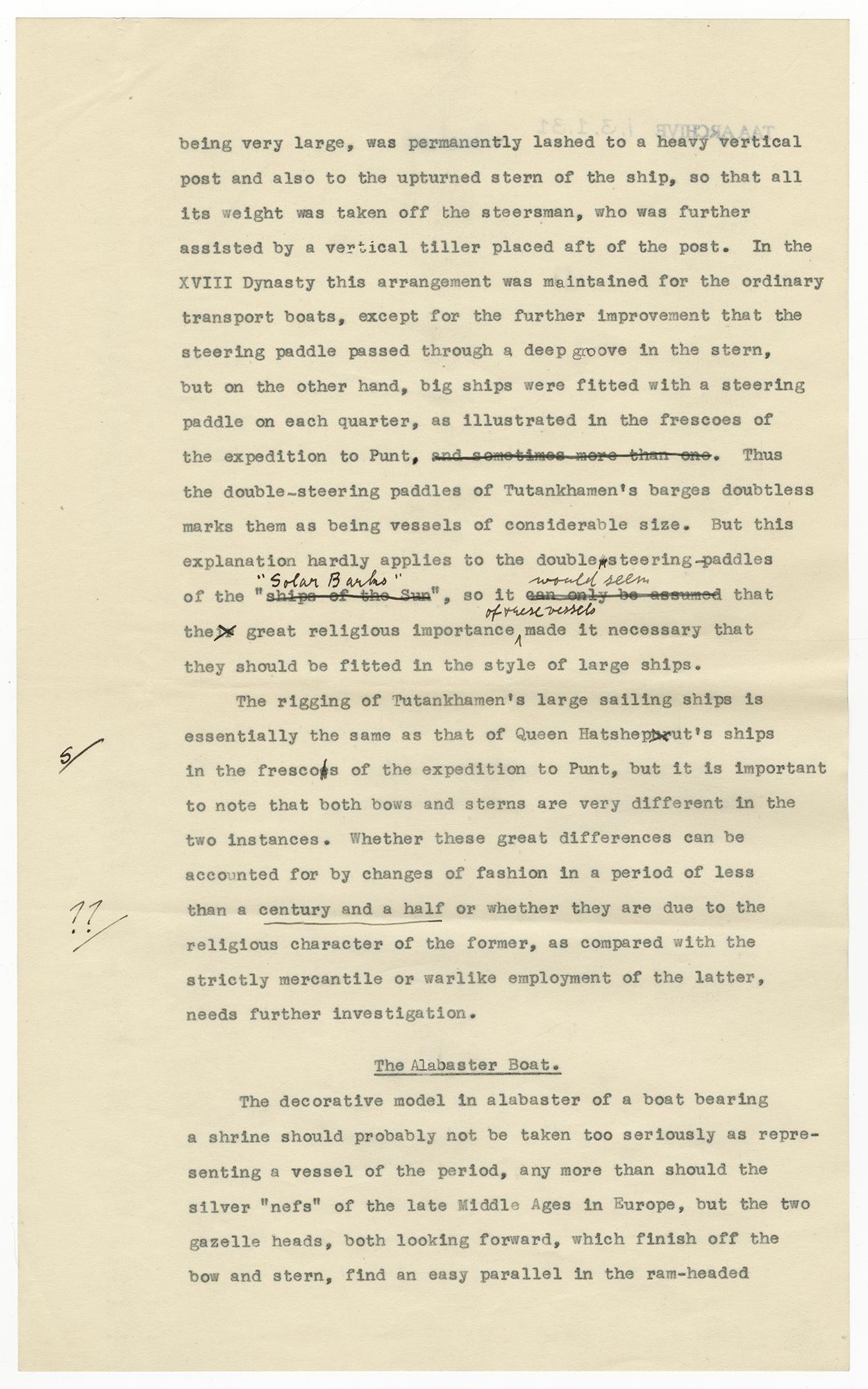
Typewritten and annotated report on boat models by G. S. Laird Clowes, specifically moon and solar barks.

© Griffith Institute,
University of Oxford
being very large, was permanently lashed to a heavy vertical
post and also to the upturned stern of the ship, so that all
its weight was taken off the steersman, who was further
assisted by a vertical tiller placed aft of the post. In the
XVIII Dynasty this arrangement was maintained for the ordinary
transport boats, except for the further improvement that the
steering paddle passed through a deep groove in the stern,
but on the other hand, big ships were fitted with a steering
paddle on each quarter, as illustrated in the frescoes of
the expedition to Punt,/<.> and sometimes more than one. Thus
the double<->steering paddles of Tutankhamen's barges doubtless
marks them as being vessels of considerable size. But this
explanation hardly applies to the double<->steering-paddles
of the "ships of the Sun/<Solar Barks>", so it can only be assumed/<would seem> that
their great religious importance <of these vessels> made it necessary that
they should be fitted in the style of large ships.
The rigging of Tutankhamen's large sailing ships is
essentially the same as that of Queen Hatshepur/<s>ut's ships
on the frescoes of the expedition to Punt, but it is important
to note that both bows and sterns are very different in the
two instances. Whether these great differences can be
accounted for by changes of fashion in a period of less
than a <??> century and a half or whether they are due to the
religious character of the former, as compared with the
strictly mercantile or warlike employment of the latter,
needs further investigation.
The Alabaster Boat.
The decorative model in alabaster of a boat bearing
a shrine should probably not be taken too seriously as repre-
senting a vessel of the period, any more than should the
silver "nefs" of the late Middle Ages in Europe, but the two
gazelle heads, both looking forward, which finish off the
bow and stern, find an easy parallel in the ram-headed