
TAA i.3.1.29
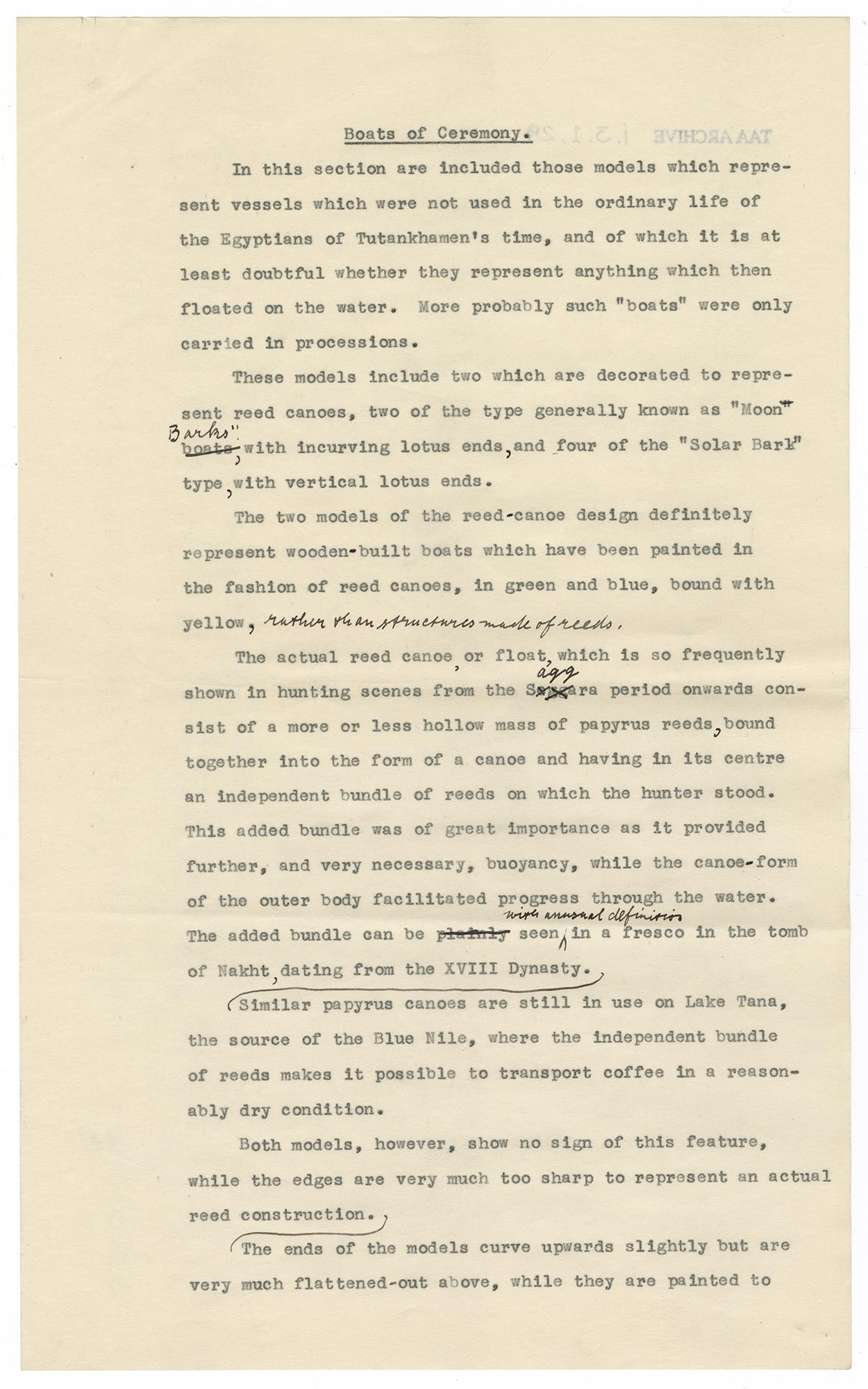
Typewritten and annotated report on boat models by G. S. Laird Clowes, titled 'Boats of Ceremony'.

© Griffith Institute,
University of Oxford
Boats of Ceremony.
In this section are included those models which repre-
sent vessels which were not used in the ordinary life of
the Egyptians of Tutankhamen's time, and of which it is at
least doubtful whether they represent anything which then
floated on the water. More probably such "boats" were only
carried in processions.
These models include two which are decorated to repre-
sent reed canoes, two of the type generally known as "Moon"
boats/<Barks"><,> with incurving lotus ends<,> and four of the "Solar Bark"
type<,> with vertical lotus ends.
The two models of the reed<->canoe design definitely
represent wooden<->built boats which have been painted in
the fashion of reed canoes, in green and blue, bound with
yellow<, rather than structures made of reeds.>
The actual reed canoe<,> or float, which is so frequently
shown in hunting scenes from the Sagg/<aqq>ara period onwards con-
sist of a more or less hollow mass of papyrus reeds<,> bound
together into the form of a canoe and having in its centre
an independent bundle of reeds on which the hunter stood.
This added bundle was of great importance as it provided
further, and very necessary, buoyancy, while the canoe<->form
of the outer body facilitated progress through the water.
The added bundle can be plainly seen <with unusual definition> in a fresco in the tomb
of Nakht<,> dating from the XVIII Dynasty.
Similar papyrus canoes are still in use on Lake Tana,
the source of the Blue Nile, where the independent bundle
of reeds makes it possible to transport coffee in a reason-
able dry condition.
Both models, however, show no sign of this feature,
while the edges are very much too sharp to represent an actual
reed construction.
The ends of the model curve upwards slightly but are
very much flattened-out above, while they are painted to