
TAA i.2.4.18
Part of the text is fully struck through, see document image for reference. Strikethrough is reserved for the author’s edits and deletions within the main body of the text, which would otherwise be difficult to distinguish.
Part of the text on this page is reproduced in the publication: Carter, Howard 1933. The tomb of Tut.ankh.Amen vol. 3. London: Cassell [PDF, 8.47 MB], 42, 61-2.

© Griffith Institute,
University of Oxford
[Nov. 11-13, continued]
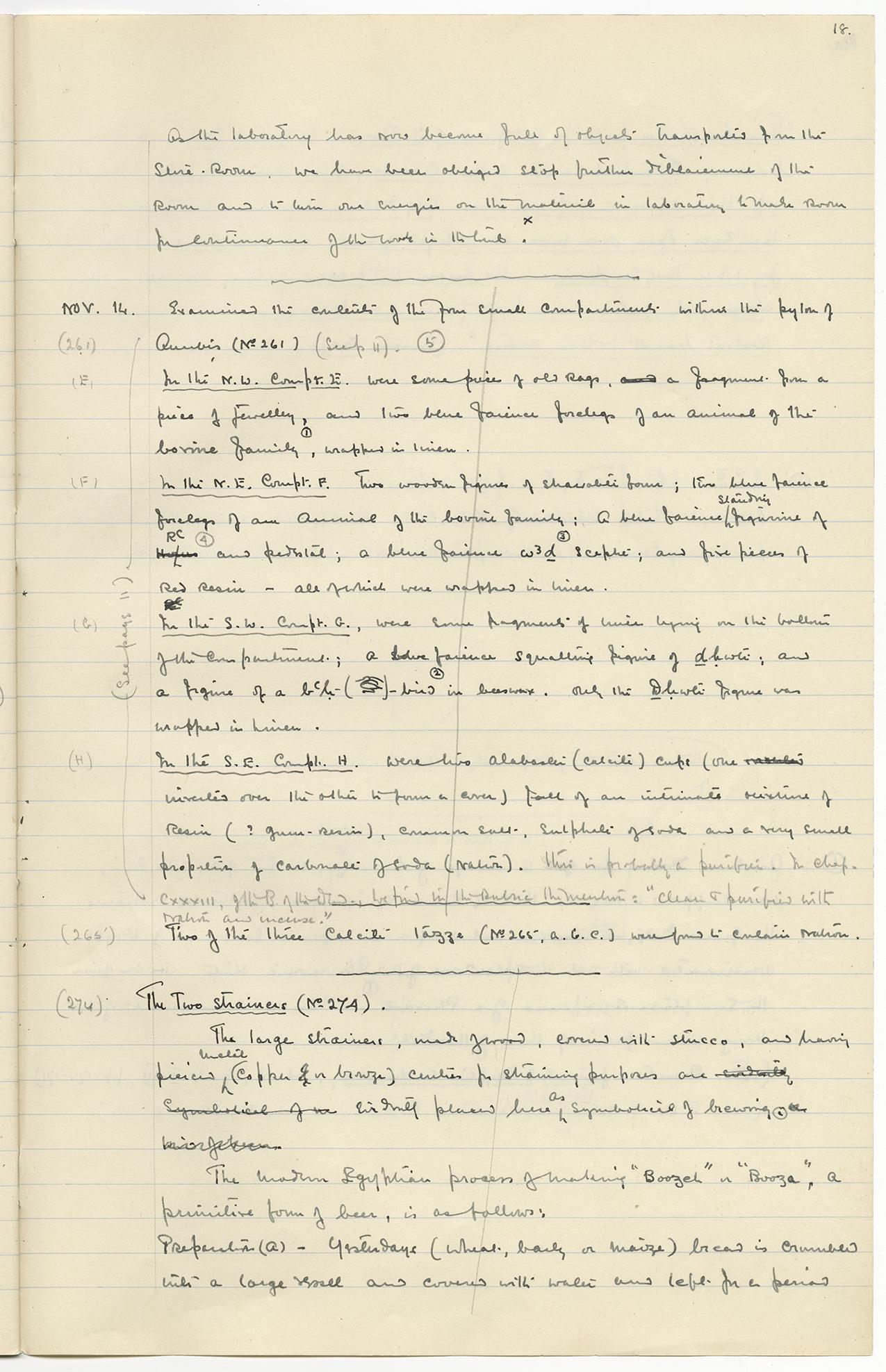
As the laboratory has now become full of objects transported from the
Store-Room, we have been obliged to stop further déblaiement of the
Room and to turn our energies on the material in laboratory to make room
for continuation of the work in the tomb.x
<x Note
Some dust and stone chips from the masons were left lying on the floor of the Store Room, they
never having been cleared away.>
Nov. 14.
(See page 11)
(261)
Examined the contents of the four small compartments within the pylon of
Anubis (No 261) (see page 11) (5)
<(5)
These compartments have I think been rumagedsic {rummaged} for objects of more valuable
material than we now find therein - thus it all is possible they cannot/<are not>
be said to be untouched or intact.>
(261)
Examined the contents of the four small compartments within the pylon of
Anubis (No. 261) (Supp. 11). (5)
(E)
In the N. W. Compt. E. were some pieces of old rags, and a fragment from a
piece of jewellery, and two blue faience forelegs of an animal of the
bovine family(1), wrapped in linen.
<(1)
[ 𓂀 ] - wḥm = Repeat.>
(F)
In the N. E. Compt. F. Two wooden figures of shawabti form; two blue faience
forelegs of an animal of the bovine family; a blue faience <standing> figurine of
Horus/<Rʿ>(4) and pedestal; a blue faience wȝḏ(3) sceptre; and five pieces of
red resin - all of which were wrapped in linen.
Rʿ
<(4)
Re, Horus or Harakhte – probably Horus, as the figure has NO solar disk.
"Numerous were the names of the Sun-god. The most general one, Re, denoted the
Sun itself. Horus or Har-akhte originally stood for the god, regarded as a bird of
prey with blazing eyes, while Khepre denoted the god in form of a beetle.
Finally the evening Sun was represented by Atum in the form of an old man.
The Sun god is usually represented with the head of a sparrow-hawk surmounted
by the Sun; this is encircled with its terrible servant, the fire spitting serpent,
who destroys his enemies. For there is no lack of enemies to oppose the progress
of the sun, and one of these, Apophis, the cloud and storm serpent, is the
embodiment of all that is terrible. But they cannot obstruct the progress of the
god, he accomplishes in triumph his journey across the heavens, and in
the evening arrives at the mountain of the West, where he is received by the Goddess
of the West. Here he quits his Morning bark in which he travels by day, and
enters the Evening bark to begin his mighty journey through the under-world.">
<(3)
[ 𓂀 ] wȝḏ = green.>
(G)
In the S. W. Compt. G., were some fragments of linen lying on the bottom
of the compartment; a s/<bl>ue faience squatting figure of ḏḥwti; and
a figure of a bʿḥ-( [ 𓂀 ] )-bird in beeswax. Only the Ḏḥwti figure was
wrapped in linen.
<(2)
[ 𓂀 ] bʿḥ = inundate. [ 𓂀 ] overflowing (See chap. LXI. B of dead Renouf, p 114)>
(H)
In the S. E. Compt. H. were two alabaster (calcite) cups (one inverted
inverted over the other to form a cover) full of an intrinatesic {indeterminate} mixture of
resin (? gum-resin), common salt, sulphate of soda and a very small
proportion of carbonate of soda (natron). <This is probably a purifier. In chap.
CXXXIII, of the B. of the Dead, we find in the rubric the mention: "clean & purified with
natron and incense.">
(265)
Two of the three calcite tazze (No 265, a.b.c.) were found to contain natron.
(274)
The Two strainers (No 274).
The large strainers, made of wood, covered with stucco, and having
pierced <metal> <(>copper ( or bronze) centres for straining purposes are evidently
symbolical of us evidently placed here <as> symbolical of brewing (.) a
kind of a beer [?]
The modern Egyptian process of making "Boozeh" or "Booza", a
primitive form of beer, is as follows:
Preparation (a) - Yesterdays (wheat, barley or maize) bread is crumbled
into a large vessel and covered with water and left for a period