
TAA i.2.4.16
The whole text is fully struck through on this page but is not indicated in the transcription, see document image for reference. Strikethrough is reserved for the author’s edits and deletions within the main body of the text, which would otherwise be difficult to distinguish.
Part of the text on this page is reproduced in the publication: Carter, Howard 1933. The tomb of Tut.ankh.Amen vol. 3. London: Cassell [PDF, 8.47 MB], 62-3.

© Griffith Institute,
University of Oxford
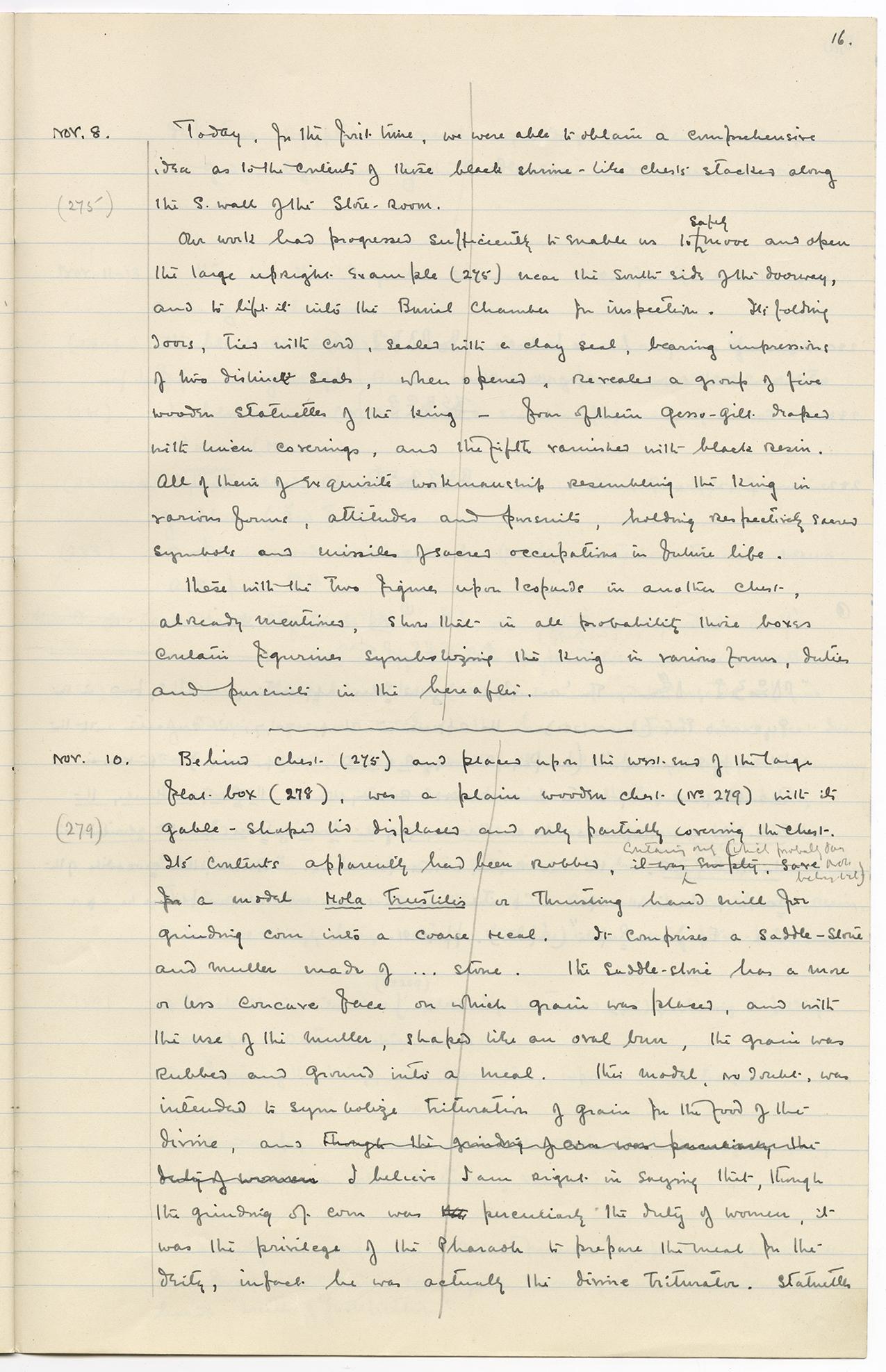
Nov. 8.
(275)
Today, for the first time, we were able to obtain a comprehensive
idea as to the contents of those black shrine-like chests stacked along
the S. wall of the Store-Room.
Our work had progressed sufficiently to enable us to <safely> move and open
the large upright example (275) near the south side of the doorway,
and to lift it into the Burial Chamber for inspection. Its folding
doors, tied with cord, sealed with a clay seal, bearing impressions
of two distincv/<t> seals, when opened, revealed a group of five
wooden statuettes of the king - four of them gesso-gilt draped
with linen coverings, and the fifth varnished with black resin.
All of them of exquisite workmanship resembling the King in
various forms, attitudes and pursuits, holding respectively sacred
symbols and missiles of sacred occupations in future life.
These with the two figures upon leopards in another chest,
already mentioned, show that in all probability those boxes
contain figurines symbolizing the King in various forms, duties
and pursuits in the hereafter.
Nov. 10.
(279)
Behind chest (275) and placed upon the west end of the large
flat box (278), was a plain wooden chest (No 279) with its
gable-shaped lid displaced and only partially covering the chest.
Its contents apparently had been robbed, it was empty, save/<containing only (which probably did not belong to it)>
for a model MolaTrustilis or thrusting hand mill for
grinding corn into a coarse meal. It comprises a saddle-stone
and muller made of … stone. The saddle-stone has a more
or less concave face on which grain was placed, and with
the use of the muller, shaped like an oval bun, the grain was
rubbed and ground into a meal. This model, no doubt, was
intended to symbolize trituration of grain for the food of the
divine, and though the grinding of corn was peculiarly the
duty of women I believe I am right in saying that, though
the grinding of corn was the peculiarly the duty of women, it
was the privilege of the Pharaoh to prepare the meal for the
deity, in fact he was actually the divine triturator. Statuettes