
TAA i.2.4.12
The whole text is fully struck through on this page but is not indicated in the transcription, see document image for reference. Strikethrough is reserved for the author’s edits and deletions within the main body of the text, which would otherwise be difficult to distinguish.
The text on this page is reproduced in the publication: Carter, Howard 1933. The tomb of Tut.ankh.Amen vol. 3. London: Cassell [PDF, 8.47 MB], 43-5.

© Griffith Institute,
University of Oxford
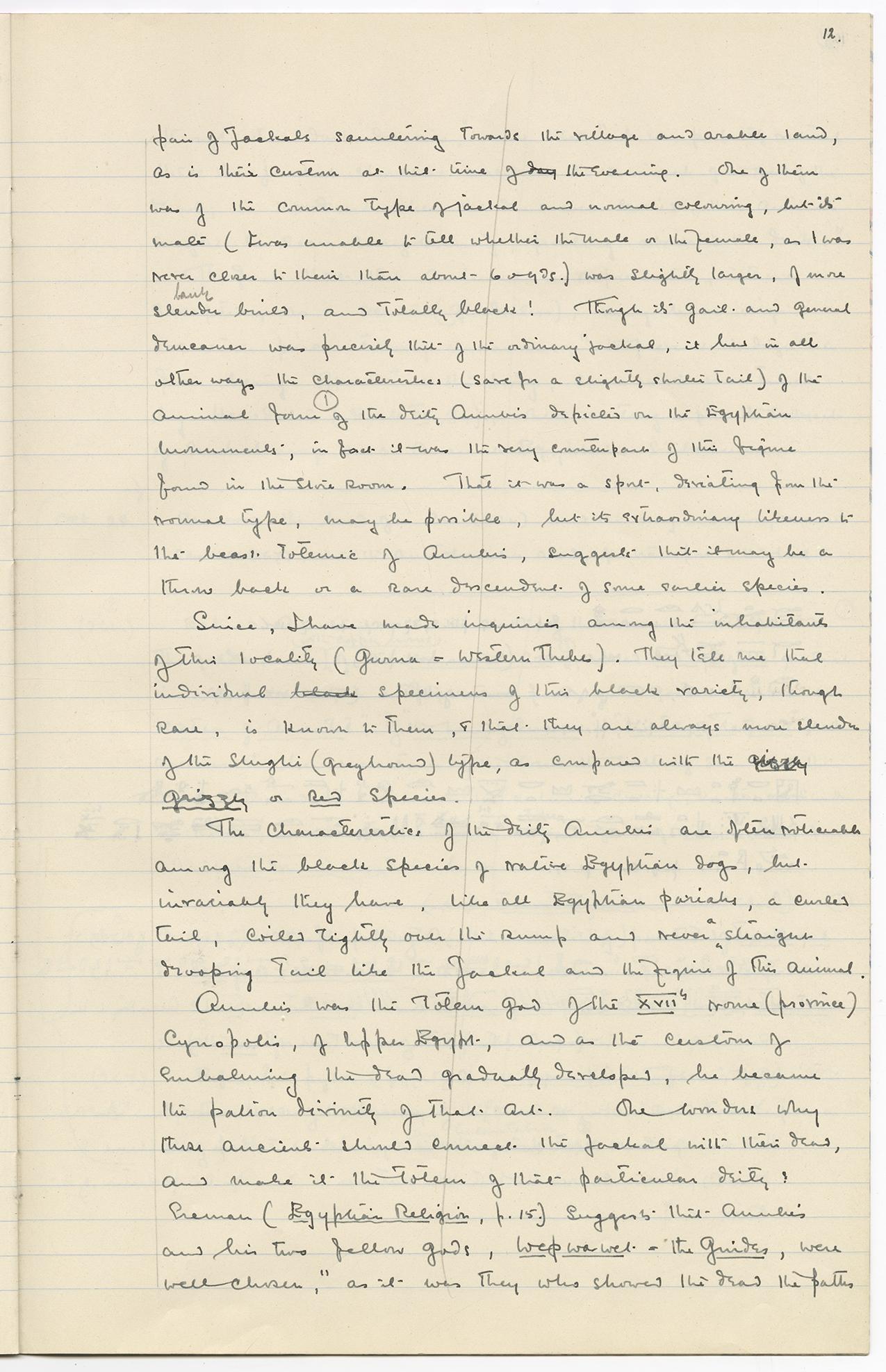
pair of jackals sauntering towards the village and arable land,
as is the custom at that time of day the evening. One of them
was of the common type of jackal and normal colouring, but its
mate (I was unable to tell whether the male or the female, as I was
never closer to them than about 60 yds.) was slightly larger, of more
slender <lank> build, and totally black! Though its gait and general
demeaner was precisely that of the ordinary jackal, it has in all
other ways the characteristics (save for a slightly shorter tail) of the
animal form(1) of the deity Anubis depicted on the Egyptian
monuments, in fact it was the very counterpart of this figure
found in the Store Room. That it was a sportsic {sort}, deviating from the
normal type, may be possible, but its extraordinary likeness to
the beast totemic of Anubis, suggests that it may be a
throw back or a rare descendant of some earlier species.
<Anderson, Mamaliasic {Mammalia}, Egypt . pp. 213, 215.
Canis Lupister, Ehrenb. (pl. XXX) Gizeh Dec.1891., Winter pelage.
(1) Canis Variegatus, Cretzsehm. {Philipp Jakob Cretzschmar} (pl. XXXI). Form very lank, ears large.
"So far as is at present known, this large eared and long-legged
jackal is confined to the coast-land from Suakin to Berbera Somaliland">
Since, I have made inquiries among the inhabitants
of this locality (Gurna = Western Thebes). They tell me that
individual black specimens of this black variety, though
rare, is known to them, & that they are always more slender
of the Slughi {Sloughi} (greyhound) type, as compared with the grizzly
grizzly or Red species.
The characteristics of the deity Anubis are often noticeable
among the black species of native Egyptian dogs, but
invariably they have, like all Egyptian pariahs, a curled
tail, coiled tightly over the rump and never <a> straight
drooping tail like the jackal and the figure of this animal.
Anubis was the totem god of the XVIIth Nome (province)
Cynopolis, of Upper Egypt, and as the custom of
embalming the dead gradually developed, he became
the patron divinity of that art. One wonders why
those ancients should connect the jackal with their dead,
and make it the totem of that particular deity?
Erman (Egyptian Religion, p. 15.) suggests that Anubis
and his two fellow gods, Wepwawet = the Guides, were
well chosen, "as it was they who showed the dead the paths