
TAA i.2.4.11
The whole text is fully struck through on this page but is not indicated in the transcription, see document image for reference. Strikethrough is reserved for the author’s edits and deletions within the main body of the text, which would otherwise be difficult to distinguish.
The text on this page is reproduced in the publication: Carter, Howard 1933. The tomb of Tut.ankh.Amen vol. 3. London: Cassell [PDF, 8.47 MB], 41-2, 43.

© Griffith Institute,
University of Oxford
(261)
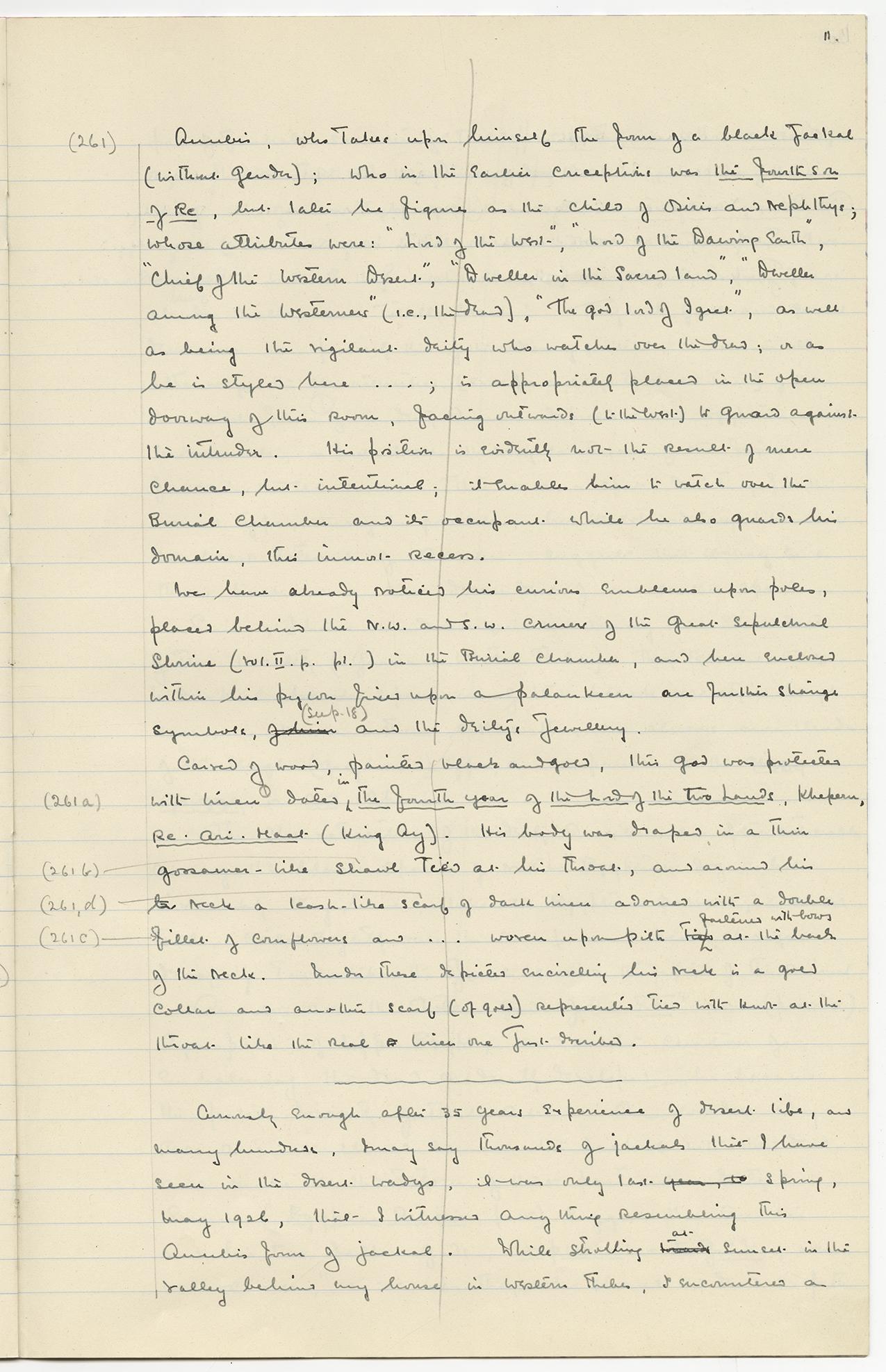
Anubis, who takes upon himself the form of a black jackal
(without gender); who is the earlier conceptions was the fourth son
of Re, but later he figures as the child of Osiris and Nephthys;
whose attributes were: "Lord of the West", "Lord of the Dawingsic {Dawning} Earth",
"Chief of the Western Desert", "Dweller in the Sacred land", "Dweller
among the Westerners" (i.e., the dead), "The god lord of Igret", as well
as being the vigilant deity who watches over the dead; or as
he is styled here …; is appropriately placed in the open
doorway of this Room, facing outwards (to the West) to guard against
the intruder. His position is evidently not the result of mere
chance, but intentional; it enables him to watch over the
Burial Chamber and its occupant while he also guards his
domain, this innermost Recess.
We have already noticed his curious emblems upon poles,
placed behind the N.W. and S.W. corner of the Great Sepulchral
Shrine (Vol. II. p. pl. ) in the Burial Chamber, and here enclosed
within his pylon fixed upon a palankeen are further strange
symbols, of him <(Sup. 18)> and the deity's Jewellery.
(261a)
Carved of wood, painted black and gold, this god was protected
with linen dated <in> the fourth year of the Lord of the Two Lands, Kheperu,
Re . Ari . Maat (King Ay). His body was draped in a thin
(261b)
gossamer-like shawl tied at this throat, and around his
(261, d)
h neck a leash-like scarf of dark linen adorned with a double
(261C)
fillet of cornflowers and … woven upon pith tied/<fastened with bows> at the back
of the neck. Under these depicted encircling his neck is a gold
collar and another scarf (of gold) represented tied with knot at the
throat like the real r linen one just described.
Curiously enough after 35 years experience of desert life, and
many hundreds, I may say thousands of jackals that I have
seen in the desert wadys, it was only last year, la Spring,
May 1926, that I witnessed any thing resembling this
Anubis form of jackal. While strolling towards/<at> sunset in the
valley behind my house in Western Thebes, I encountered a