
TAA i.2.1.27

© Griffith Institute,
University of Oxford
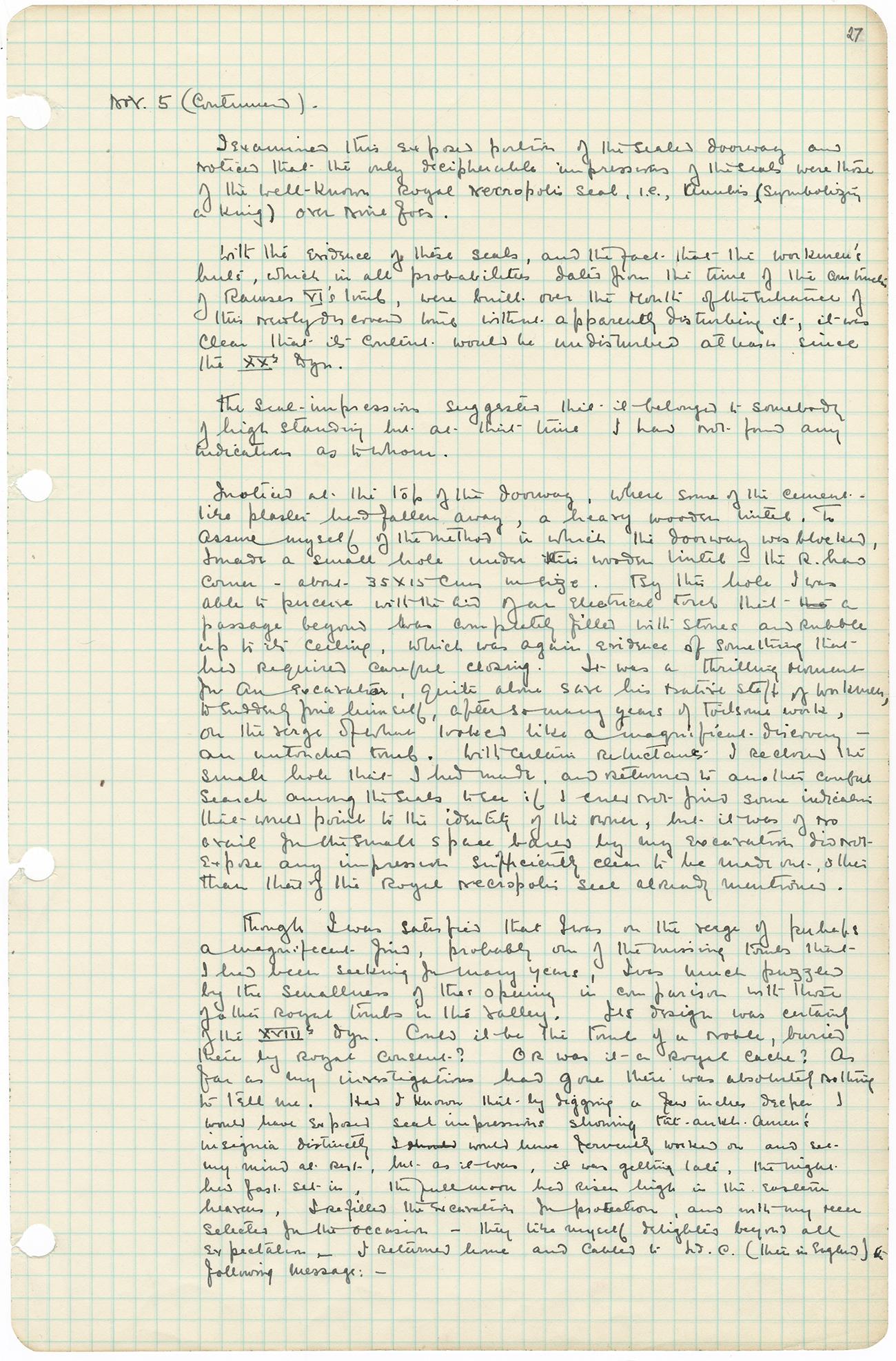
Nov. 5 (Continued).
I examined this exposed portion of the sealed doorway and
noticed that the only decipherable impressions of the seals were those
of the well-known Royal Necropolis seal, i.e., l/<A>nubis ,/<(>symbolizing
a king,/<)> over nine foes.
With the evidence of these seals, and the fact that the workmen's
huts, which in all probabilities dated from the time of the construction
of Ramses VI's tomb, were built over the mouth of the Entrance of
this newly discovered tomb without apparently disturbing it, it was
clear that its content would be undisturbed at least since
the XXth Dyn.
The seal-impressions suggested that it belonged to somebody
of high standing but at that time I had not found any
indications as to whom.
I noticed at the top of the doorway, where some of the cement-
like plaster had fallen away, a heavy wooden lintel. To
assure myself of the method in which the doorway was blocked,
I made a small hole under it/<th>is wooden lintel - the R. hand
corner, about 35 x 15 cms in size. By this hole I was
able to perceive with the aid of an electrical torch that the a
passage beyond h/<w>as completely filled with stones and rubble
up to its ceiling, which was again evidence of something that
had required careful closing. It was a thrilling moment
for an excavate/<o>r, quite alone save his native staff of workmen,
to suddenly find himself, after so many years of toilsome work,
on the verge of what looked like a magnificntsic {magnificent} discovery -
an untouched tomb. With certain reluctanct/<ce> I reclosed the
small hole that I had made, and returned to another careful
search among the seals to see if I could not find some indication
that would point to the identity of the owner, but it was of no
avail for the small space bared by my excavation did not
expose any impression sufficiently clear to be made out, other
than that of the Royal Necropolis seal already mentioned.
Though I was satisfied that I was on the verge of perhaps
a magnificent find, probably one of the missing tombs that
I had been seeking for many years, I was much puzzled
by the smallness of this opening in comparison with those
of other Royal tombs in the Valley. Its design was certainly
of the XVIIIth Dyn. Could it be the tomb of a noble, buried
there by Royal consent ? OR was it a Royal cache ? As
far as my investigations had gone there was absolutely nothing
to tell me. Had I known that by digging a few inches deeper I
would have exposed seal impressions showing Tût-ankh-Amen's
insignia distinctly I should would have fervently worked on and set
my mind at rest, but as it was, it was getting late, the night
had fast set in, the full moon had risen high in the eastern
heavens, I refilled the excavation for protection, and with my men
selected for the occasion - they like myself delighted beyond all
expectation ,/<-> I returned home and cabled to Ld. C. (then in England) <the>
following message: -