
TAA i.2.1.25

© Griffith Institute,
University of Oxford
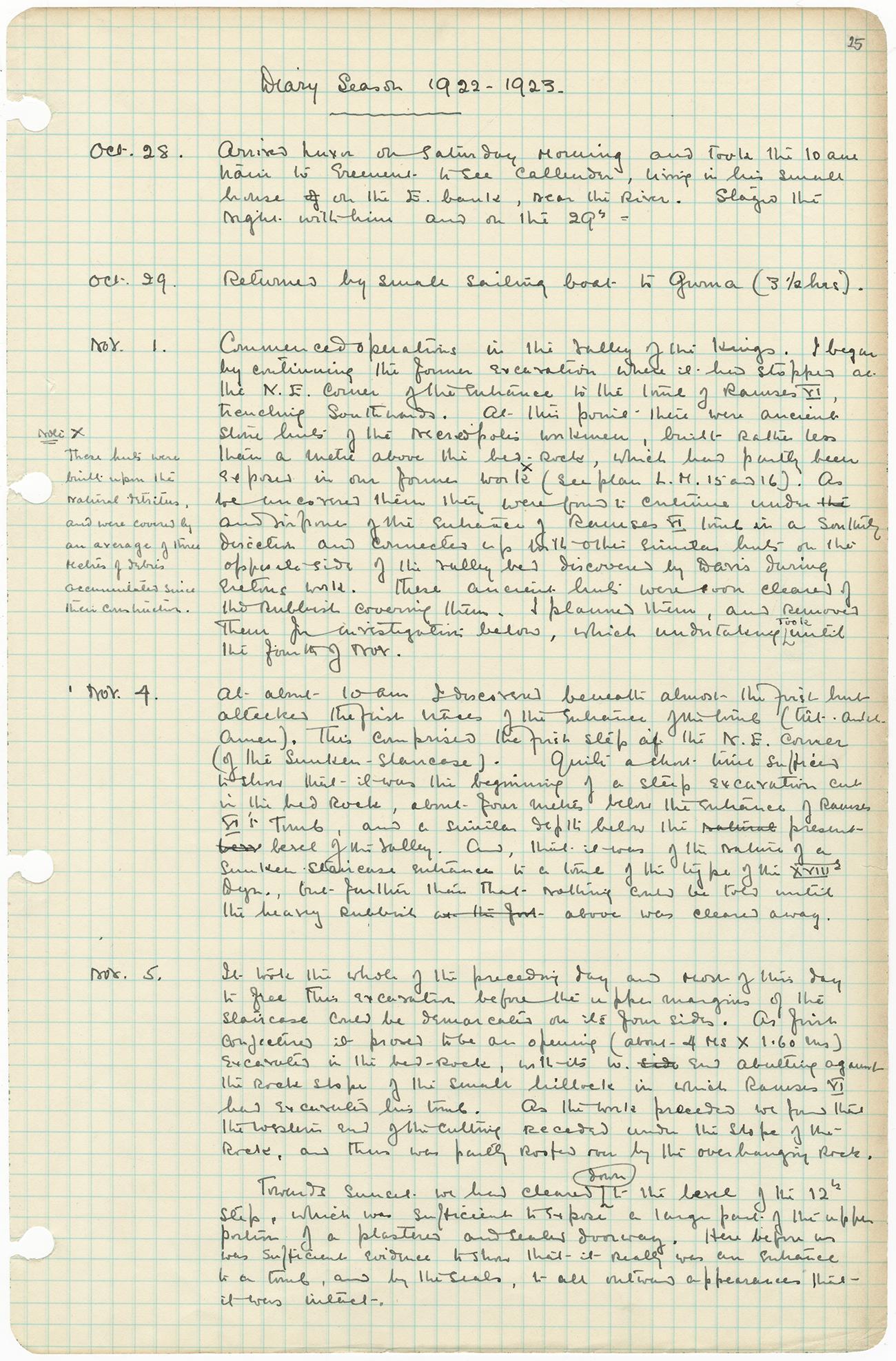
Diary Season 1922-1923.
Oct. 28.
Arrived Luxor on Saturday morning and took the 10 am
train to Erementsic {Ermant; Armant} to see Callender, living in his small
house of on the E. bank, near the River. Stayed the
night with him and on the 29th =
Oct. 29.
Returned by small sailing boat to Gurna (3 ½ hrs).
Nov. 1.
Commenced operations in the Valley of the Kings. I began
by continuing the former excavation where it had stopped at
the N. E. Corner of the Entrance to the tomb of Ramses VI,
trenching Southwards. At this point there were ancient
stone huts of the Necropolis workmen, built rather less
than a metre above the bed-rock, which had partly been
exposed in our former workX (see plan L. M. 15 and 16). As
we uncovered them they were found to continue under the
and in front of the Entrance of Ramses VI tomb in a Southerly
direction and connected up with other similar huts on the
opposite side of the Valley bed discovered by Davis during
Burtons work. These ancient huts were soon cleared of
the rubbish covering them. I planned them, and removed
them for investigation below, which undertaking <took> until
the fourth of Nov.
Note X
These huts were
built upon the
natural detritus,
and were covered by
an average of three
metres of debris
accumulated since
their construction.
Nov. 4.
At about 10 am I discovered beneath almost the first hut
attacked the first traces of the Entrance of the tomb (Tût-Ankh-
Amen). This comprised the first step at/<of> the N. E. Corner
(of the Sunken-Staircase). Quite a short time sufficed
to show that it was the beginning of a steep excavation cut
in the bed rock, about four metres below the Entrance of Ramses
VI's Tomb, and a similar depth below the natural present
leve level of the Valley. And, that it was of the nature of a
Sunken-Staircase Entrance to a tomb of the type of the XVIIIth
Dyn., but further than that nothing could be told until
the heavy rubbish at the foot above was cleared away.
Nov. 5.
It took the whole of the preceding day and most of this day
to free this excavation before the upper margins of the
staircase could be demarcated on its four sides. As first
conjectured it proved to be an opening (about 4 MS x 1.60 ms)
excavated in the bed-rock, with its w. side end abutting against
the rock slope of the small hillock in which Ramses VI
had excavated his tomb. As the work pre/<o>cededsic {proceeded} we found that
the western end of the cutting receded under the slope of the
rock, and thus was partly roofed over by the overhanging rock.
Towards sunset we had cleaned <down> to the level of the 12th
step, which was sufficient to expose a large part of the upper
portion of a plastered and sealed doorway. Here before us
was sufficient evidence to show that it really was an entrance
to a tomb, and by the seals, to all outward appearances that
it was intact.