
TAA i.3.9.8
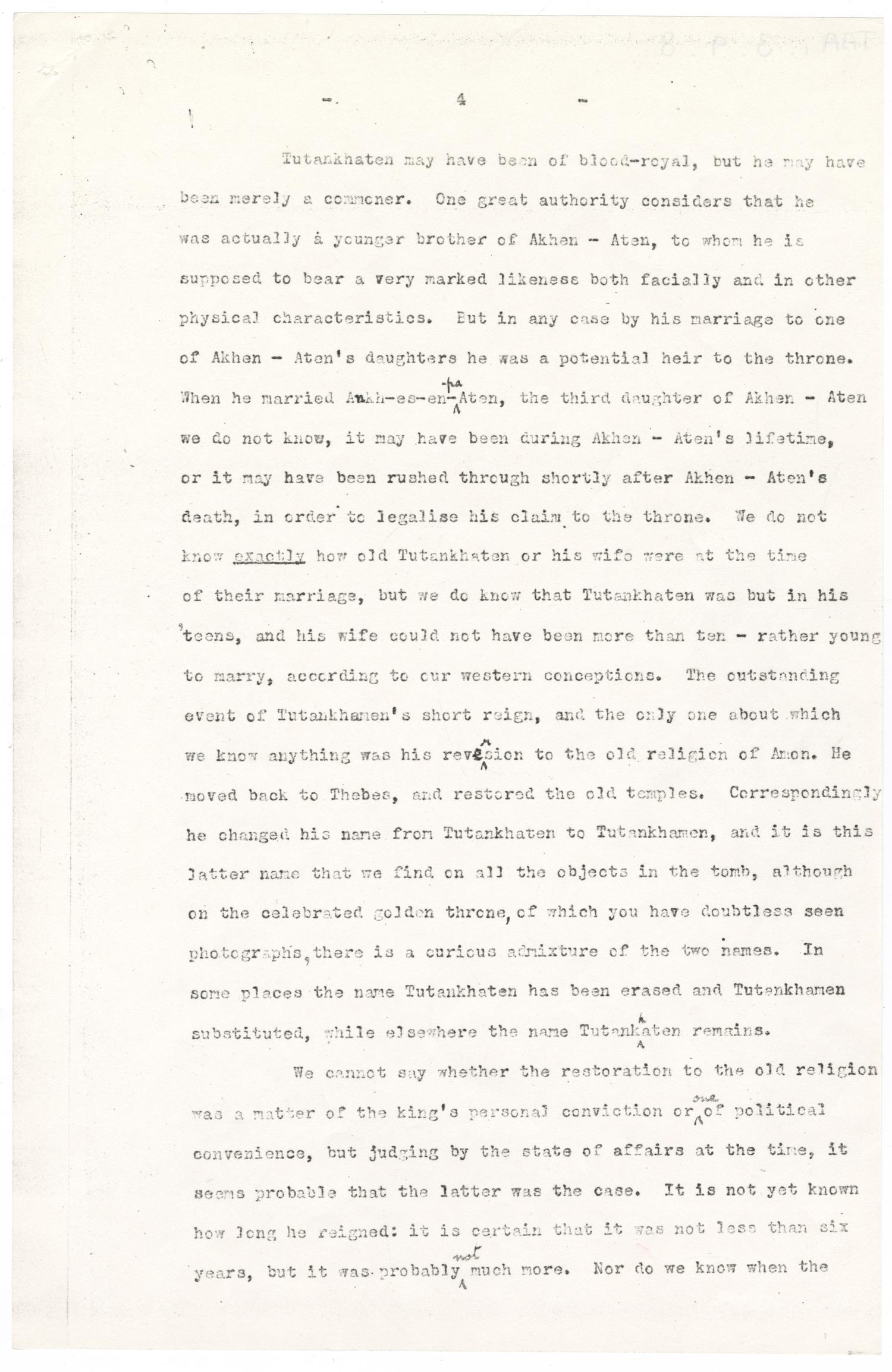
Photocopy of typewritten and annotated notes for a lecture titled 'Scientific Aspects of the Egyptian Discoveries', page 4.

© Griffith Institute,
University of Oxford
– 4 –
Tutankhaten may have been of blood-royal, but he may have
been merely a commoner. One great authority considers that he
was actually a younger brother of Akhen – Aten, to whom he is
supposed to bear a very marked likeness both facially and in other
physical characteristics. But in any case by his marriage to one
of Akhen – Aten’s daughters he was a potential heir to the throne.
When he married Ax[?]/<n>kh-es-en<-pa>-Aten, the third daughter of Akhen – Aten
we do not know, it may have been during Akhen – Aten’s lifetime,
or it may have been rushed through shortly after Akhen-Aten’s
death, in order to legalise his claim to the throne. We do not
know exactly how old Tutankhaten or his wife were at the time
of their marriage, but we do know that Tutankhaten was but in his
’teens, and his wife could not have been more than ten – rather young
to marry, according to our western conceptions. The outstanding
event of Tutankhamen<’>s short reign, and the only one about which
we know anything was his revi/<e><r>sion to the old religion of Amon. He
moved back to Thebes, and restored the old temples. Correspondingly
he changed his name from Tutankhaten to Tutankhamen, and it is this
latter name that we find on all the objects in the tomb, although
on the celebrated golden throne<,> of which you have doubtless seen
photographs, there is a curious admixture of the two names. In
some places the name Tutankhaten has been erased and Tutankhamen
substituted, while elsewhere the name Tutank<h>aten remains.
We cannot say whether the restoration to the old religion
was a matter of the king’s personal conviction or <one> of political
convenience, but judging by the state of affairs at the time, it
seems probable that the latter was the case. It is not yet known
how long he reigned: it is certain that it was not less than six
years, but it was probably <not> much more. Nor do we know when the