
TAA i.3.9.32
Photocopy of typewritten and annotated notes for a lecture titled 'Scientific Aspects of the Egyptian Discoveries', page 28.
© Griffith Institute,
University of Oxford
– 28 –
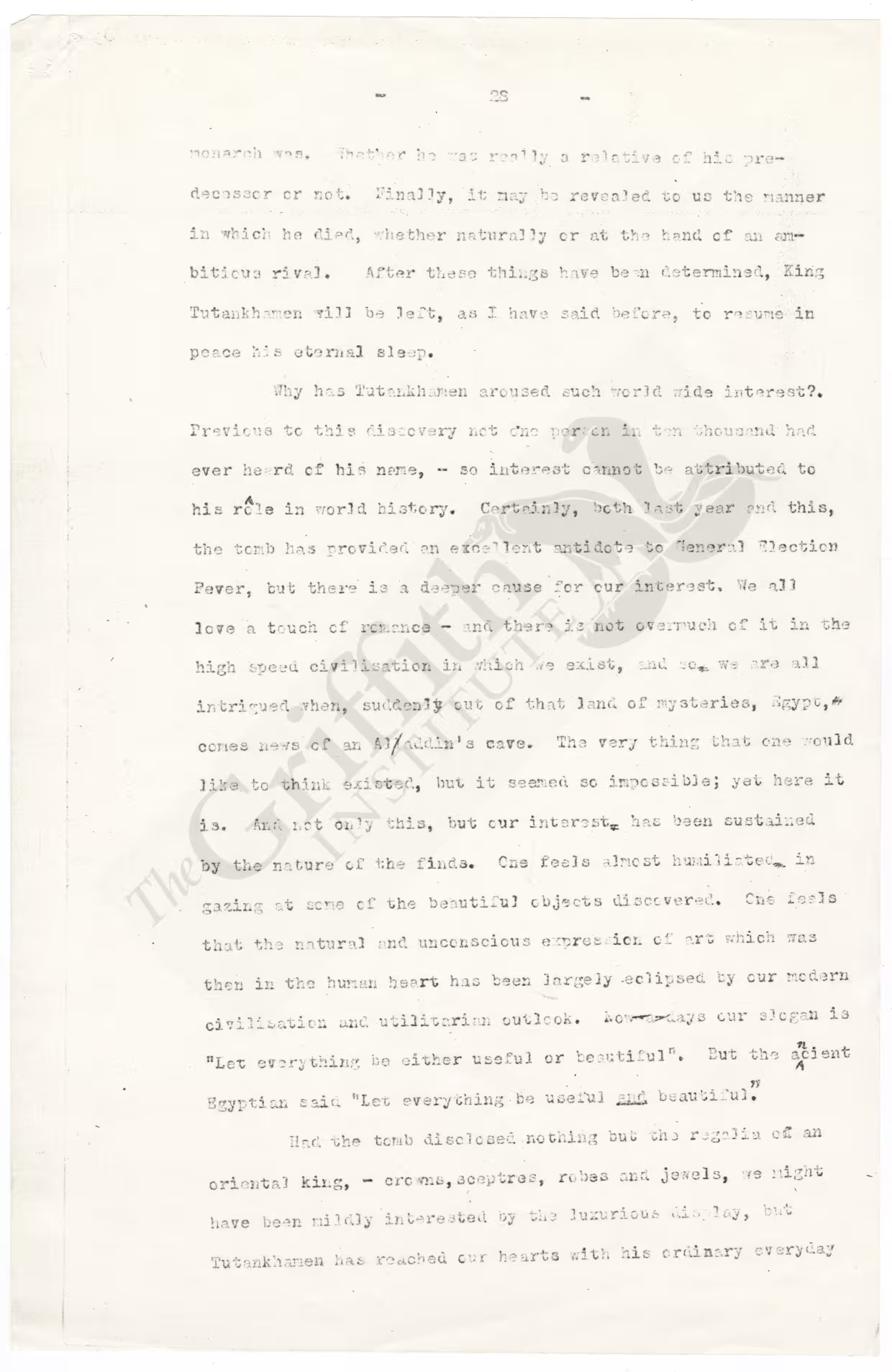
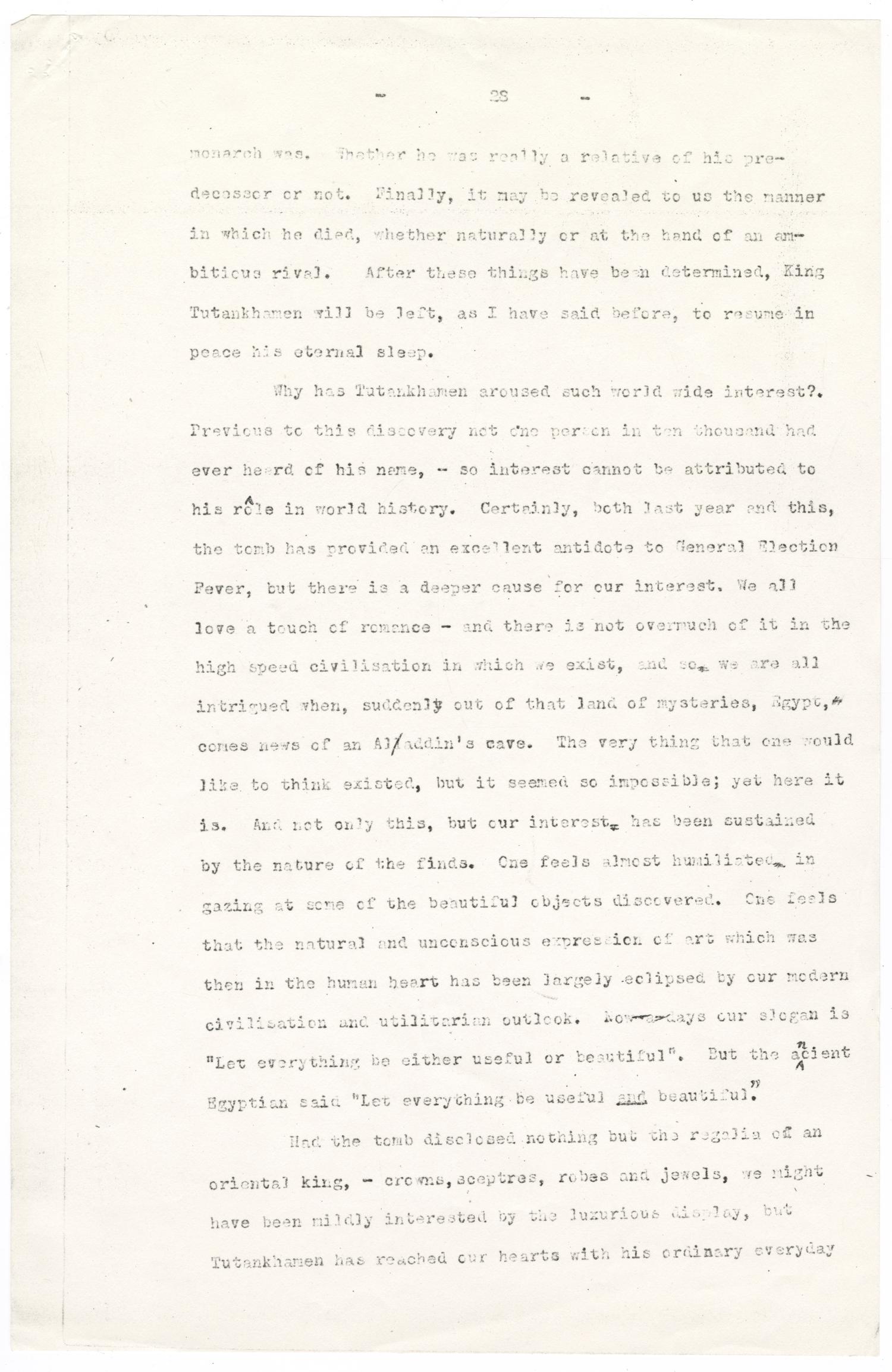
monarch was. Whether he was really a relative of his pre-
decessor or not. Finally, it may be revealed to us the manner
in which he died, whether naturally or at the hand of an am-
bitious rival. After these things have been determined, King
Tutankhamen will be left, as I have said before, to resume in
peace his eternal sleep.
Why has Tutankhamen aroused such world wide interest?.
Previous to this discovery not one person in ten thousand had
ever heard of his name, – so interest cannot be attributed to
his role in world history. Certainly, both last year and this,
the tomb has provided an excellent antidote to General Election
Fever, but there is a deeper cause for our interest. We all
love a touch of romance – and there is not overmuch of it in the
high speed civilisation in which we exist, and so, we are all
intrigued when, suddenlt/<y> out of that land of mysteries, Egypt, -
comes news of an Alladdin's cave. The very thing that one would
like to think existed, but it seemed so impossible; yet here it
is. And not only this, but out interest, has been sustained
by the nature of the finds. One feels almost humiliated, in
gazing at some of the beautiful objects discovered. One feels
that the natural and unconscious expression of art which was
then in the human heart has been largely eclipsed by our modern
civilisation and utilitarian outlook. Now-a-days our slogan is
"Let everything be either useful or beautiful". But the a<n>cient
Egyptian said "Let everything be useful and beautiful<">.
Had the tomb disclosed nothing but the regalia ox[?]/<f> an
oriental king, – crowns, sceptres, robes and jewels, we might
have been mildly interested by the luxurious display, but
Tutankhamen has reached our hearts with his ordinary everyday