
TAA i.3.9.29
Photocopy of typewritten and annotated notes for a lecture titled 'Scientific Aspects of the Egyptian Discoveries', page 25.
Alfred Lucas is mentioned on this page.
© Griffith Institute,
University of Oxford
– 25 –
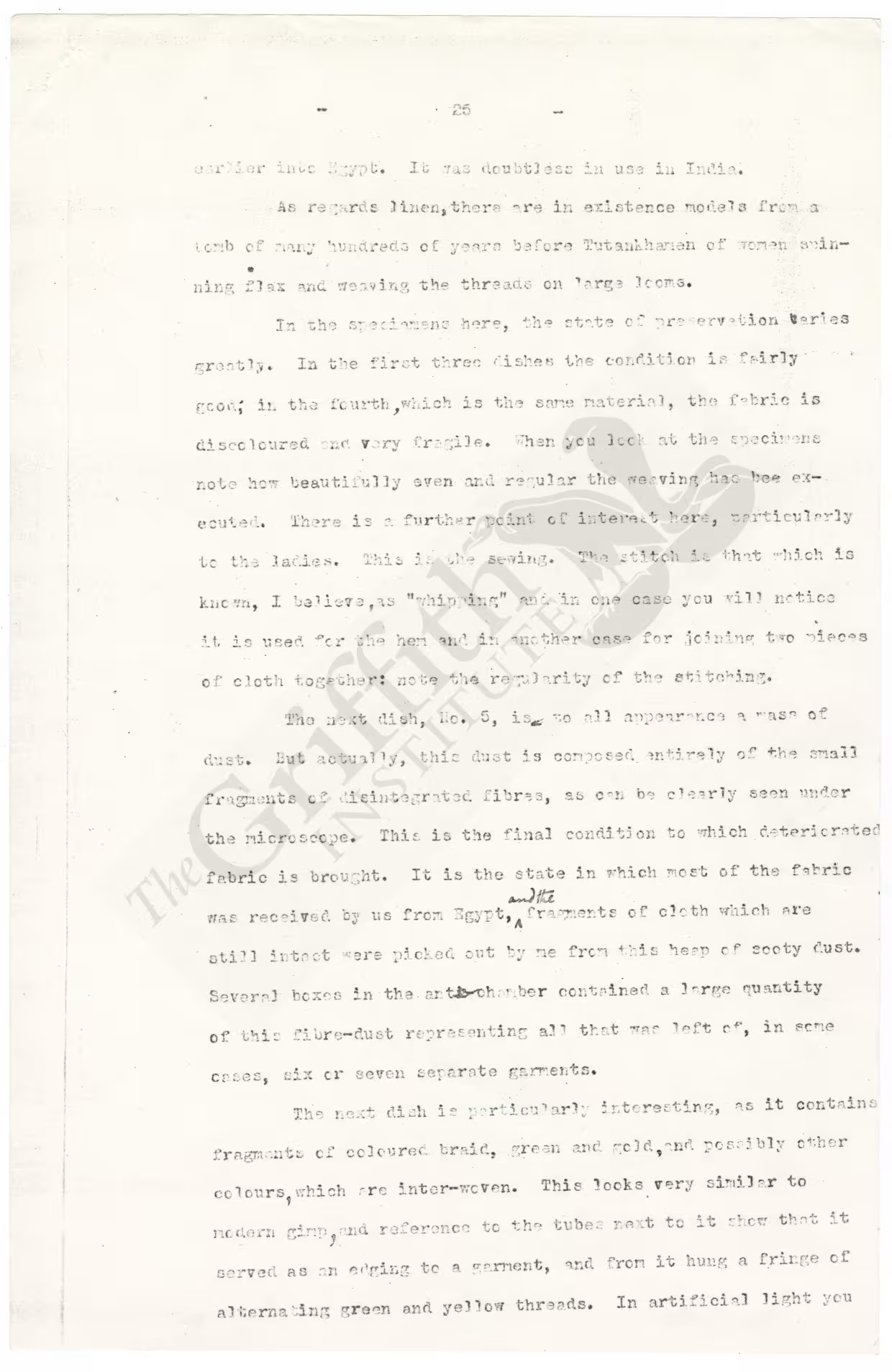
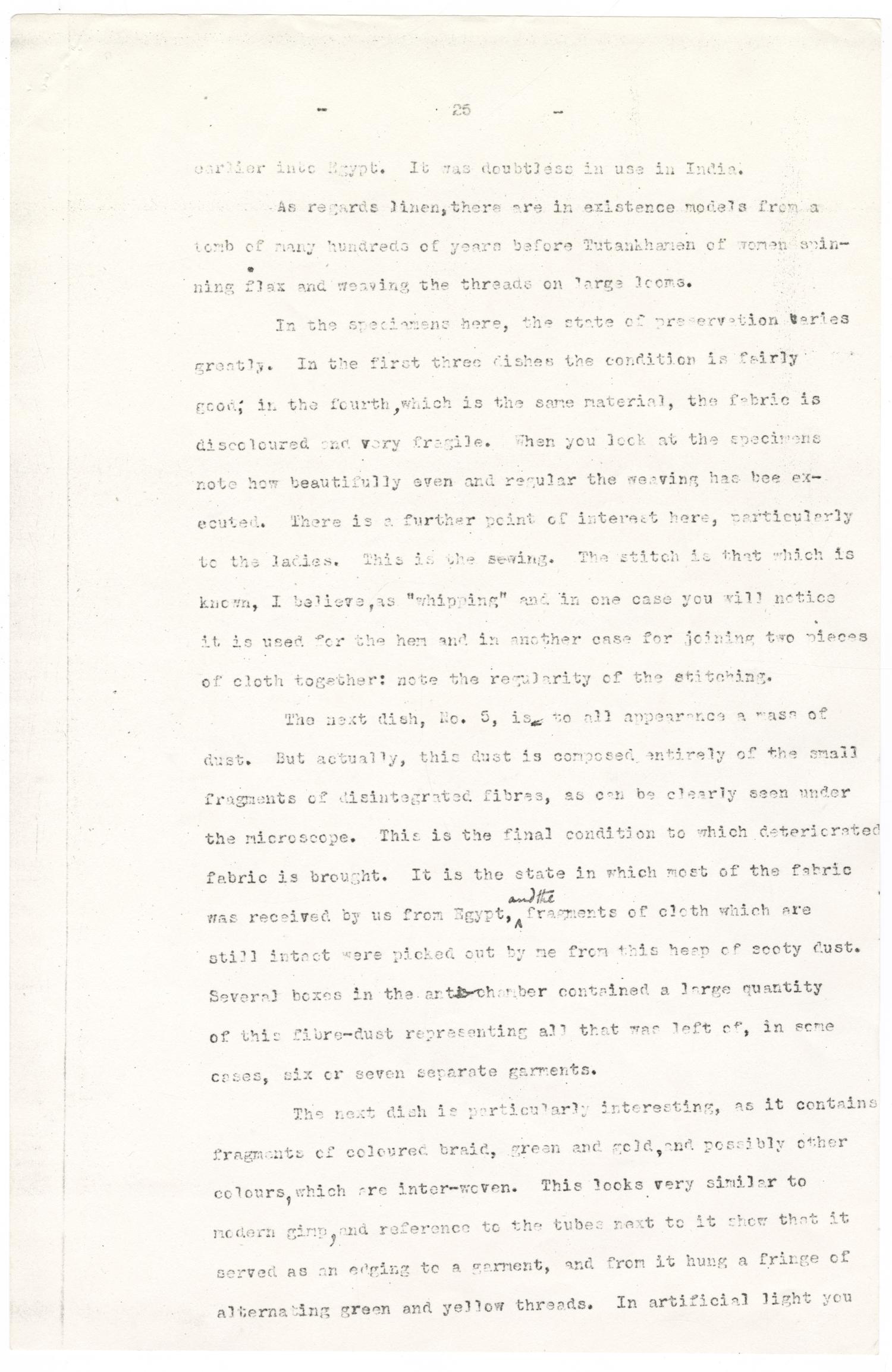
earlier into Egypt. It was doubtless in use in India.
As regards linen, there are in existence models from a
tomb of many hundreds of years before Tutankhamen of women spin-
ing flax and weaving the threads on large looms.
In the speciamenssic here, the state of preservation <v>aries
greatly. In the first three dishes the condition is fairly
good<;> in the fourth, which is the same material, the fabric is
discoloured and very fragile. When you look at the specimens
note how beautifully even and regular the weaving has beesic ex-
ecuted. There is a further point of interest here, particularly
to the ladies. This is the sewing. The stitch is that which is
known, I believe<,> as "whipping" and in one case you will notice
it is used for the hem and in another case for joining two pieces
of cloth together: note the regularity of the stitching.
The next dish, No. 5, is, to all appearance a mass of
dust. But actually, this dust is composed entirely of the small
fragments of disintegrated fibres, as can be clearly seen under
the microscope. This is the final condition to which deteriorated
fabric is brought. It is the state in which most of the fabric
was received by us from Egypt, <and the> fragments of cloth which are
still intact were picked out by me from this heap of sooty dust.
Several boxes in the anti/<e>-chamber contained a large quantity
of this fibre-dust representing all that was left of, in some
cases, six or seven separate garments.
The next dish is particularly interesting, as it contains
fragments of coloured braid, green and gold<,> and possibly other
colours<,> which are inter-woven. This looks very similar to
modern gimp<,> and reference to the tubes next to it show that it
served as an edging to a garment, and from it hung a fringe of
alternating green and yellow threads. In artificial light you