
TAA i.2.4.39
Text below includes notes from previous/facing page 38.
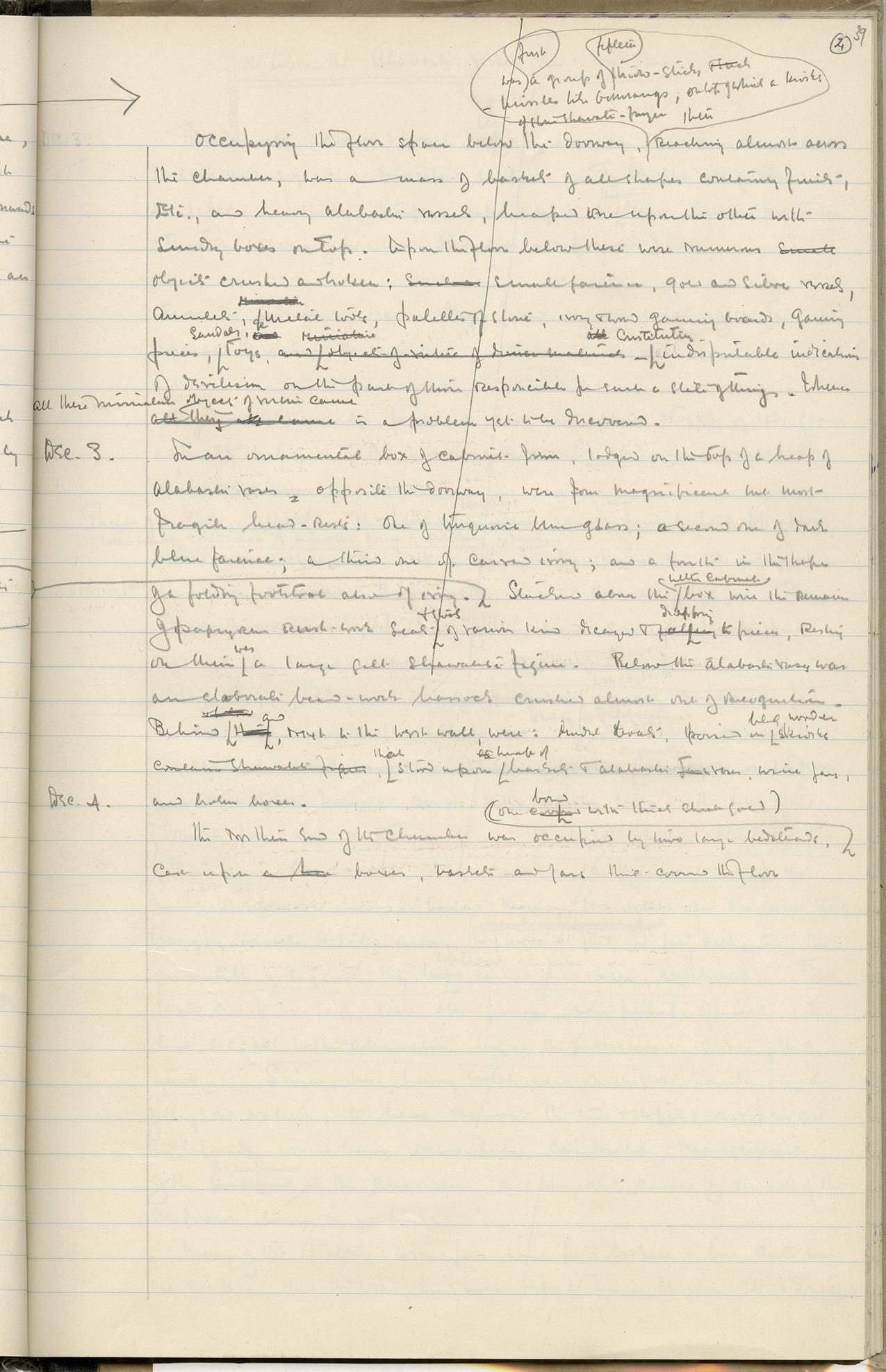
Carter also mentions baskets containing fruits, alabaster vessels, boxes, small faience, gold (Carter object number 394?) and silver vessels (Carter object numbers 469 and /or 620(37)?), amulets, gaming pieces, sandals, toys, baskets and wine jars without further specification.
Text within the/each pair of double asterisks (** ... **) indicates a section that is fully struck through. On this page, strikethrough formatting is reserved for the author’s edits and deletions within the main body of the text, which would otherwise be difficult to distinguish.
Draft, Carter, Howard 1933. The tomb of Tut.ankh.Amen vol. 3. London: Cassell, 102-103.

© Griffith Institute,
University of Oxford
{Dec. 2.}
<I now propose to make a more detailed survey of the contents of the Annexe,
following the system we had to adopt in cleaning and examining them. First
we had to clear sufficient floor space for our feet, the best we could, head downwards
from the threshold of the doorway which is rather more than a metre above the
floor. This had to be done with the greatest care, for a/<the> hasty removal of an
object would might cause an avalanche of delicate material heaped
high up far from our reach. We then stepped in and removed the
most precarious objects that were within reach, but first numbering and
photographing them before touching them. Often to reach an object which
the slightest disturbance would cause to fall whesic had to lean over supported by
a rope sling held by the men in the Antechamber. In this manner we
gained ingress into the Chamber.>
**Occupying the floor space below the doorway, <was <first> a group of <fifteen> throw sticks & such
- missiles like bomerangs {boomerangs}, on top of which a kiosks
of stone shawabti-figures then> reaching almost across
the chamber, was a mass of baskets of all shapes containing fruits,
etc., and heavy alabaster vessels, heaped u/<o>ne upon the other with
sundry boxes on top. Upon the floor below these were numerous small
objects crushed and broken; such as small faience, gold and silver vessels,
amulets, <miniature> metal tools, palettes of stone, ivory & wood gaming boards, gaming
pieces, <sandals, and> toys, and <miniature> objects-of-virtue diverse materials <all> - <constituting> indisputable indications
of devilism on the part of those responsible for such a state of things. Whence
all they all came/<all these miniature objects of virtue came> is a problem yet to be discovered.
Dec. 3.
In an ornamental box of cabinet form, lodged on the top of a heap of
alabaster vases, opposite the doorway, were four magnificent but most
fragile head-rests: one of turquoise blue glass; a second one of dark
blue faience; a third one of carved ivory; and a fourth in the shape
of a folding footstool also of ivory. <An unfortunate jolt and these would have fallen and smashed into
many pieces.> Stacked above the <little cabinet> box were the remains
of papyrus rush-work seats <& stools> of various kind[s] decayed & falling/<dropping> to pieces, resting
on them <was> a large gilt shawabti figure.** Below the alabaster vases was
an elaborate bead-work hassock crushed almost out of recognition.
Behind these/<& below>/<and>, next to the West wall, were: Model Boats, poised on <black wooden> sh/<k>iosks
contain[ing] Shawabti figures, <that> stood upon <a heap of> baskets & alabaster jars/<vases>, wine jars,
and broken boxes.
Dec. 4
The Northern end of the Chamber was occupied by two large bedsteads, <(one covered/bound with thick sheet gold)>
cast upon a hea boxes, baskets and jars that covered the floor