
TAA i.2.4.37
Text below includes notes from previous/facing page 36.
The whole text is fully struck through on this page but is not indicated in the transcription. On this page, strikethrough formatting is reserved for the author’s edits and deletions within the main body of the text, which would otherwise be difficult to distinguish.
Draft, Carter, Howard 1933. The tomb of Tut.ankh.Amen vol. 3. London: Cassell, 100-101, continued from TAA i.2.4.035.

© Griffith Institute,
University of Oxford
{Dec. 1. 1927, continued}
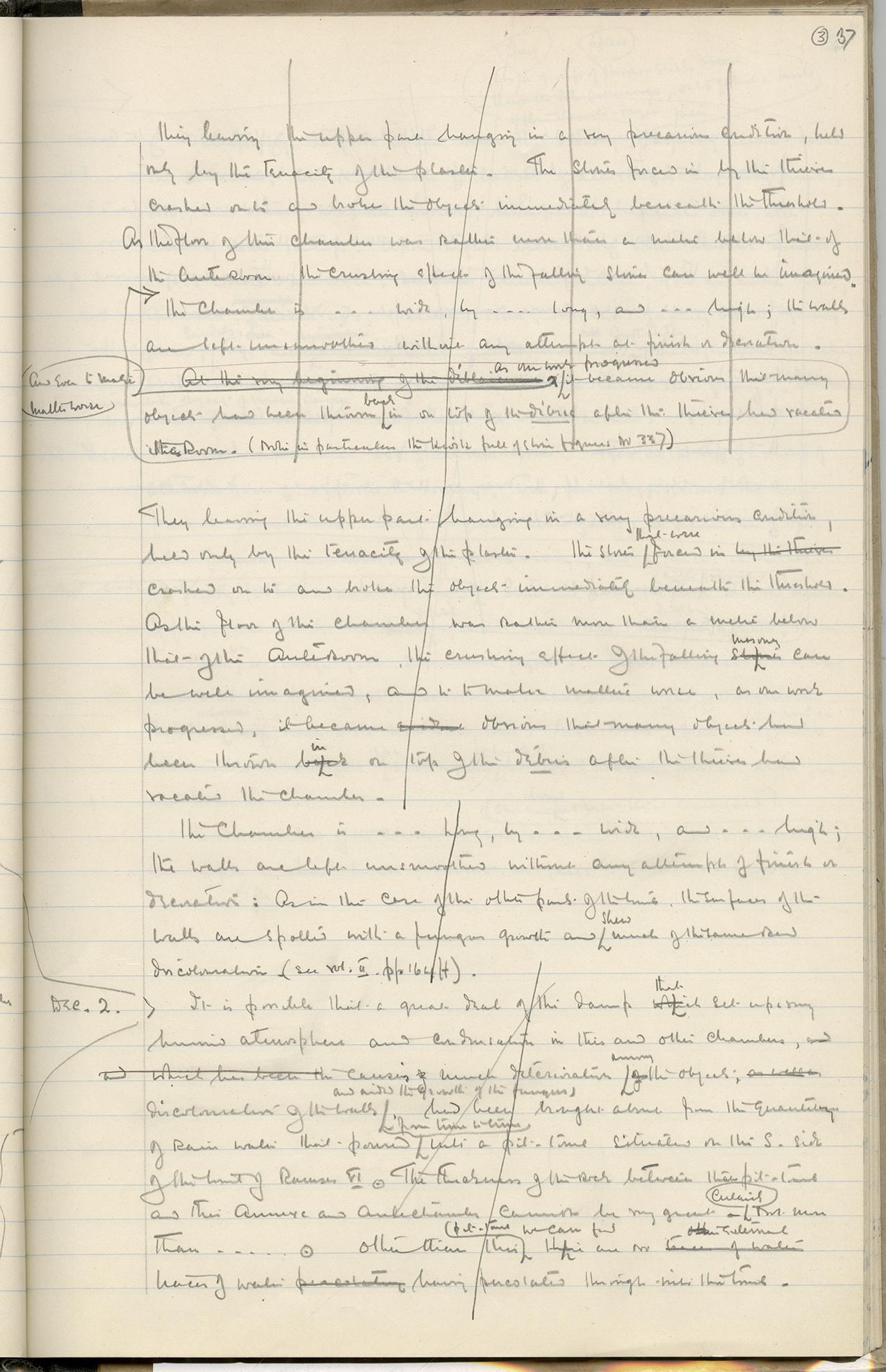
they leaving the upper part hanging in a very precarious condition, held
only by the tenacity of the plaster. The stones forced in by the thieves
crashed on to and broke the objects immediately beneath the threshold.
As the floor of this chamber was rather more than a metre below that of
the Anteroom, the crushing effect of the falling stones can well be imagined.
<At the very beginning of the déblaiement/<And even to make matters worse> <as our work
progressed> it became obvious that many
objects had been thrown <back> in on top of the débris after the thieves had vacated
it/<the> Room. (Note in particular the Kiosk full of stone figures No 337)>
The Chamber is . . . wide, by . . . . long, and . . . high; the walls
are left unsmoothed without any attempt at finish or decoration.
They leaving the upper part hanging in a very precarious condition,
held only by the tenacity of the plaster. The stones <that were> forced in by the thieves
crashed on to and broke the objects immediately beneath the threshold.
As the floor of this chamber was rather more than a metre below
that of the Anteroom, the crushing effect of the falling stones/<masonry> can
be well be imagined, and to tosic make matters worse, as our work
progressed, it became evident obvious that many objects had
been thrown back/<in> on top of the débris after the thieves had
vacated the chamber.
The Chamber is . . . long, by . . . wide, and . . . high;
the walls are left unsmoothed without any attempt at finish or
decoration: As in the case of the other parts of the tomb, the surfaces of the
walls are spotted with a fungus growth and <shew> much of the same red
discolouration ./<(>see vol. II. pp 164 ff).
Dec. 2.
<Note.
Copper or Bronze adze inscribed (inlaid gold), blade bound with gold bands, blade missing.
This is of heavy metal - [?] Why was it left?
{Dec. 2}
It is possible that a great deal of the damp that <had> set up a heavy humid
atmosphere and condensation in this and other chambers in the tomb, had
been brought about origin[ated][?] from quantities of rain water that had poured
from time to time into a pit-tomb nearby, situated <nearby> on the south side of the
tomb of Ramses VI. The thickness of the rock between that pit-tomb and our <these chambers>
tomb cannot be very great, certainly not more than ... metres. The water
would easily <in time> <wants/works might easily> salinatesic the rock, and the moisture[?] being almost the <pink> discolouration <pink[?]> of the walls,
and aid aid the growth of the fungus <growth>, and the humid within therefore/<manifestly> caused/<e>
much of the/<of the> deterioration of the among the objects.
In this Annexe the discolouration of both the walls & deposit upon the objects,
particularly the alabaster Jars, was far greater on the No South end of the chamber than
at the north end. In fact on the North end the objects but shew very little trace at all.
This might be due to the string webbing of the bedstead over them absorbing the moisture.>
It is possible that a great deal of the damp which/<that> set up a very
humid atmosphere and condensation in this and other chambers, and
<and> which has been the cause<s> of much deterioration <among> of the objects; as well as
discolouration of the walls <and aided the growth of the fungus,>, had been brought about from the quantities/<y>
of rain water that poured <from time to time> into a pit-tomb situated on the S. side
of the tomb of Ramses VI. The thickness of the rock between that pit-tomb
and this Annexe and Antechamber cannot be very great - <certainly> not more
than . . . . . . other than this <pit-tomb> there/<we can find> are no traces of water/<other/<external>>
traces of water percolating having percolated through into the tomb.