
TAA i.2.4.33
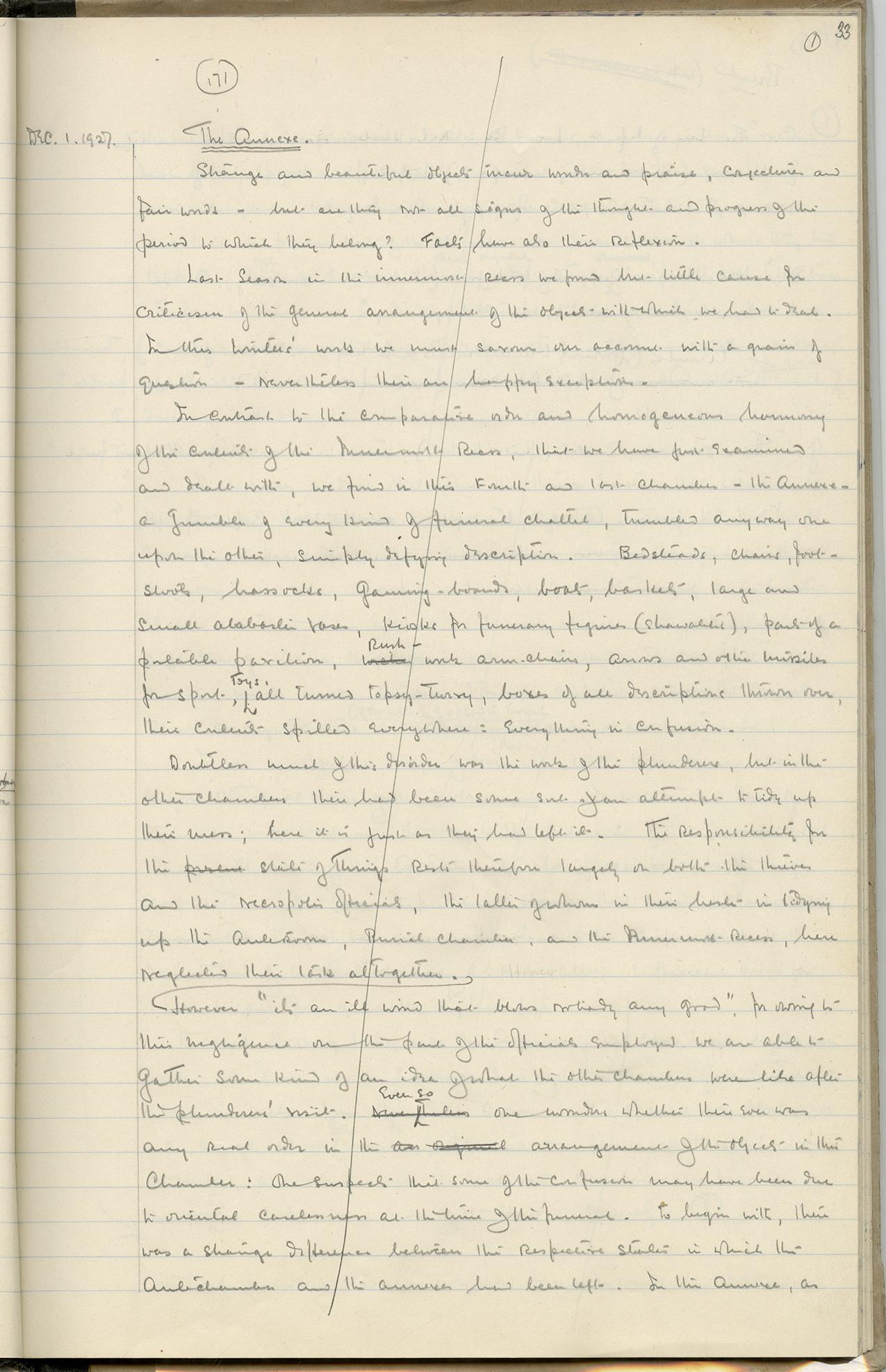
Carter mentions, without further specification "bedsteads, chairs, foot-stools, hassocks, gaming-boards, boats, baskets, large and small alabaster vases, kiosks for funerary figures (shawabtis), parts of a portable pavilion, wicker/<rush>-work arm-chairs, arrows and other missiles for sport, <toys,> all turned topsy-turvy, boxes of all descriptions thrown over, their contents spilled everywhere: everything in confusion. " This could refer to the following objects: bedsteads 377, 466, 497, 586; chair 349; foot-stools 378, 414, 442.b, 442.e, 511, 592, 613; hassocks 354, 361, 431.b; gaming-boards 345, 593; boats 352, 375, 437, 460, 462, 463, 464, 481, 491, 513, 556, 572, 578, 581, 597, 598, 609, 610, 612, 617; kiosks for funerary figures (shawabtis) 337, 380, 418, 459, 496, 512, 514, 517, 519, 602, 605, 608; parts of a portable pavilion 367.a, 438, 465, 620(118); wicker/<rush>-work arm-chair 457; arrows 390, 596.u, 596.v.
The whole text is fully struck through on this page but is not indicated in the transcription. On this page, strikethrough formatting is reserved for the author’s edits and deletions within the main body of the text, which would otherwise be difficult to distinguish.
Draft, Carter, Howard 1933. The tomb of Tut.ankh.Amen vol. 3. London: Cassell, 98-99, continued on TAA i.2.4.035.

© Griffith Institute,
University of Oxford
<(171)>
Dec. 1. 1927
The Annexe.
Strange and beautiful objects incur wonder and praise, conjecture and
fair words - but are they not all signs of the thought and progress of the
period to which they belong? Facts have also their reflexion.
Last Season in the innermost recess we found but little cause for
criticism of the general arrangement of the objects with which we had to deal.
In this Winter's work we must savour our account with a grain of
question - nevertheless there are happy exceptions.
In contrast to the comparative order and homogeneous harmony
of the contents of the Innermost Recess, that we have just examined
and dealt with, we find in this Fourth and last chamber - the Annexe -
a jumble of every kind of funerary chattels, tumbled any way one
upon the other, simply defying description. Bedsteads, chairs, foot-
stools, hassocks, gaming-boards, boats, baskets, large and
small alabaster vases, kiosks for funerary figures (shawabtis), parts of a
portable pavilion, wicker/<rush>-work arm-chairs, arrows and other missiles
for sport, <toys,> all turned topsy-turvy, boxes of all descriptions thrown over,
their contents spilled everywhere: everything in confusion.
Doubtless much of this disorder was the work of the plunderers, but in the
other chambers there had been some sort of an attempt to tidy up
their mess; here it is just as they had left it. The responsibility for
the present state of things rests therefore largely on both the thieves
and the Necropolis officials, the latter of whom in their haste in tidying
up the Anteroom, Burial Chamber, and the Innermost Recess, here
neglected their task altogether. <However "its an ill wind that blows nobody any good", for owing to>
this negligence on the part of the officials employed we are able to
gather some kind of an idea of what the other chambers were like after
the plunderer' visit. Nevertheless/<Even so> one wonders whether there ever was
any real order in the arr original arrangement of the objects in this
Chamber: one suspects that some of the confusion may have been due
to oriental carelessness at the time of the funeral. To begin with, there
was a strange difference between the respective states in which the
Antechamber and the Annexe had been left. In the Annexe, as