
TAA i.3.33.3
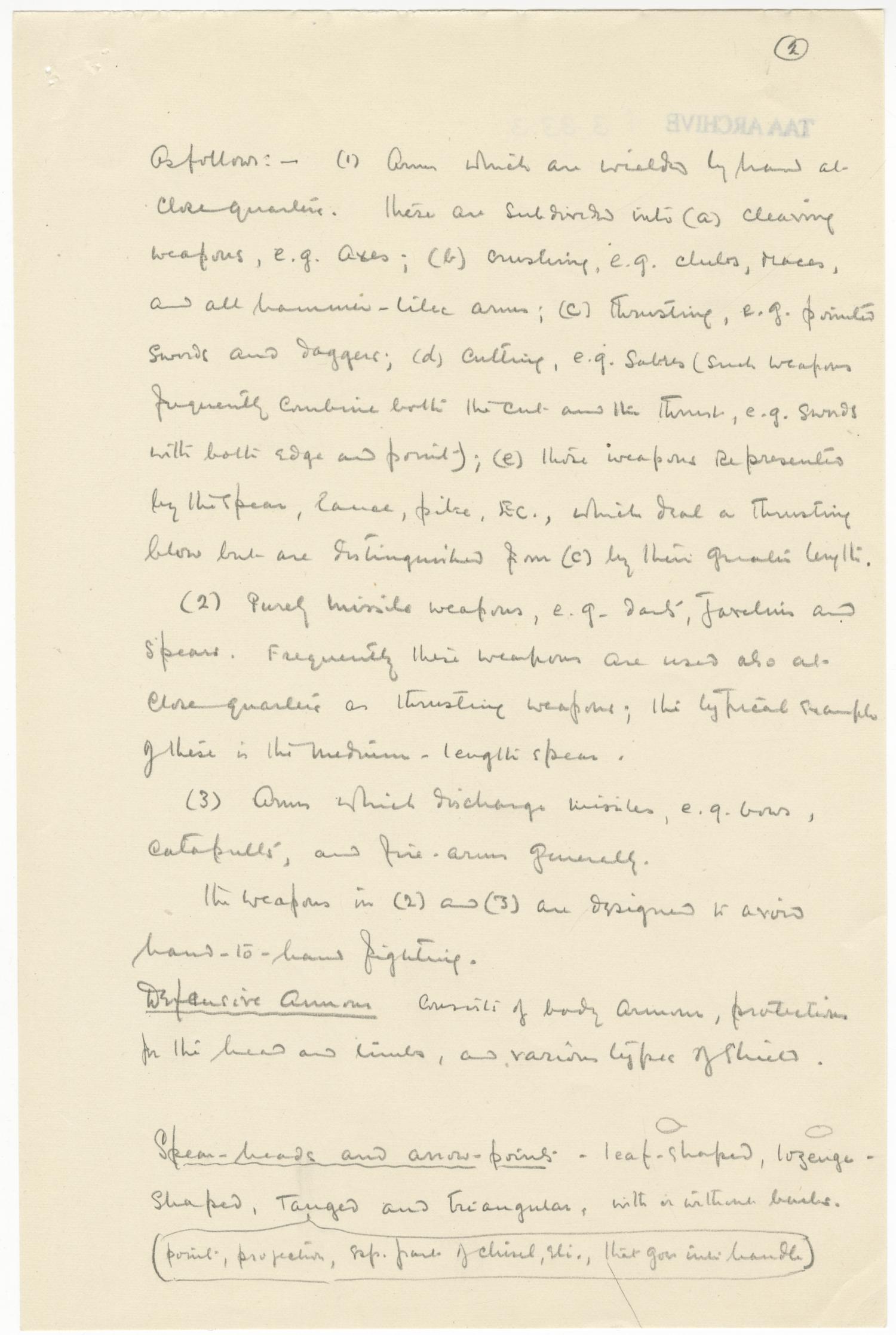
Handwritten notes on arms and armour, page 2.

© Griffith Institute,
University of Oxford
(2)
as follows:- (1) Arms which are wielded by hand at
close quarters. These are subdivided into (a) cleaving
weapons, e.g. axes; (b) crushing, e.g. clubs, maces,
and all hammer-like arms; (c) thrusting, e.g. pointed
swords and daggers; (d) cutting, e.g. sabres (such weapons
frequently combine both the cut and the thrust, e.g. swords
with both edge and point); (e) those weapons represented
by the spear, lance, pike, &c, which deal a thrusting
blow but are distinguished from (c) by their greater length.
(2) Purely missile weapons, e.g. darts, javelins and
spears. Frequently these weapons are used also at
close quarters as thrusting weapons; the typical example
of these is the medium-length spear.
(3) Arms which discharge missiles, e.g. bows,
catapults, and fire-arms generally.
The weapons in (2) and (3) are designed to avoid
hand-to-hand fighting.
Defensive armour consists of body armour, protection
for the head and limbs, and various types of shield.
Spear-heads and arrow-points – leaf-shaped [ 𓂀], lozenge [ 𓂀]
shaped, tanged <(point, projection, esp. part of chisel, etc., that goes into handle)>
and triangular, with or without backs.