TAA i.3.9.1
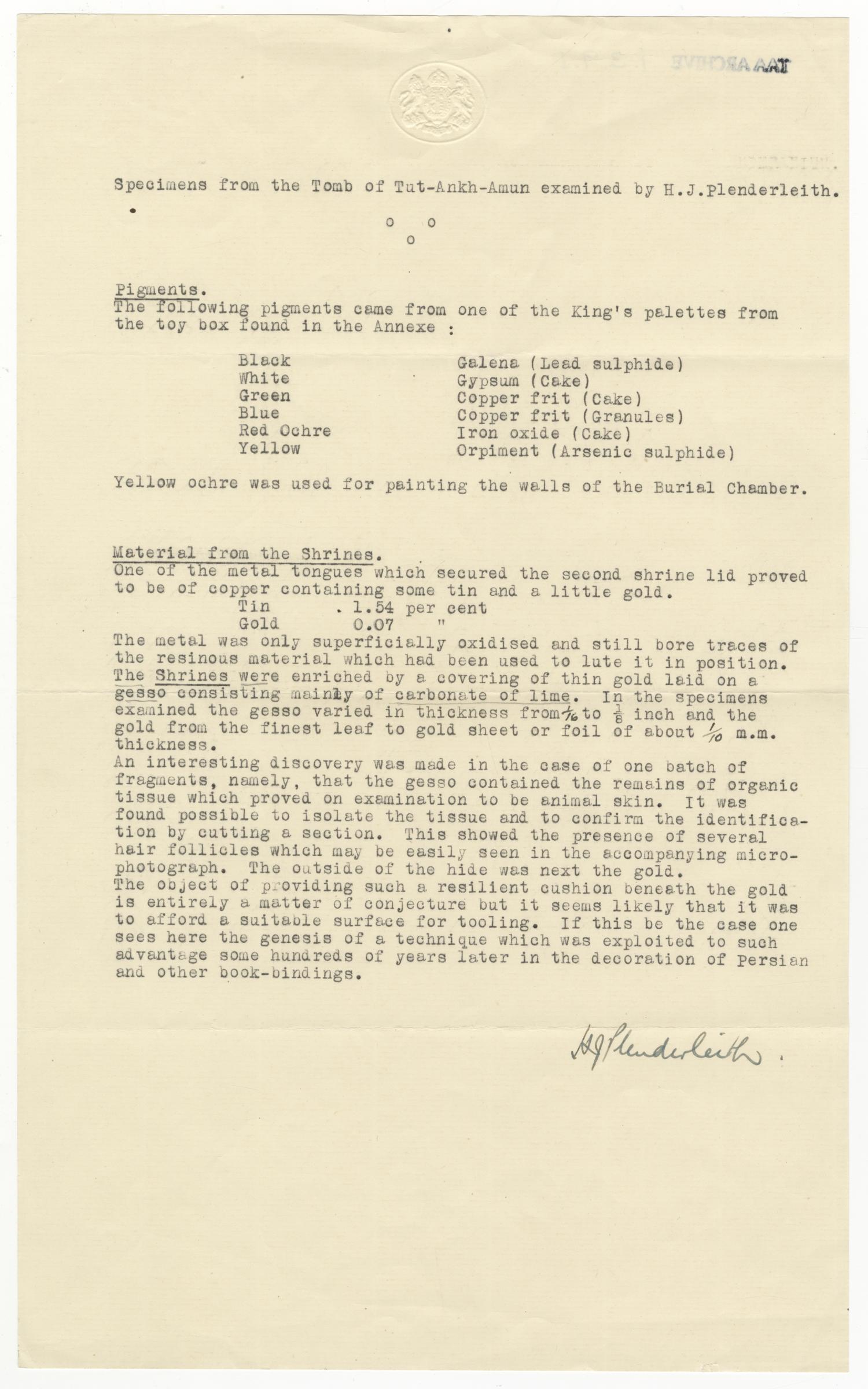
Undated typewritten notes on examined specimens including comments on pigments and material from the shrines.

© Griffith Institute,
University of Oxford
Specimens from the Tomb of Tut-Ankh-Amun examined by H.J. Plenderleith.
Pigments.
The following pigments came from one of the King's palettes from
the toy box found in the Annexe:
Black Galena (Lead sulphide)
White Gypsum (Cake)
Green Copper frit (Cake)
Blue Copper frit (Granules)
Red Ochre Iron oxide (Cake)
Yellow Orpiment (Arsenic sulphide)
Yellow ochre was used for painting the walls of the Burial Chamber.
Material from the Shrines.
One of the metal tongues which secured the second shrine lid proved
to be of copper containing some tin and a little gold.
Tin .1.54 per cent
Gold 0.07 "
The metal was only superficially oxidised and still bore traces of
the resinous material which had been used to lute it in position.
The Shrines were enriched by a covering of thin gold laid on a
gesso consisting maine/<l>y of carbonate of lime. In the specimens
examined the gesso varied in thickness from <1/16> to 1/8 inch and the
gold from the finest leaf to gold sheet or foil of about 1/10 m.m.
thickness.
An interesting discovery was made in the case of one batch of
fragments, namely, that the gesso contained the remains of organic
tissue which proved on examination to be animal skin. It was
found possible to isolate the tissue and to confirm the identifica-
tion by cutting a section. This showed the presence of several
hair follicles which may be easily seen in the accompanying micro-
photograph. The outside of the hide was next [to] the gold.
The object of providing such a resilient cushion beneath the gold
is entirely a matter of conjecture but it seems likely that it was
to afford a suitable surface for tooling. If this be the case one
sees here the genesis of a technique which was exploited to such
advantage some hundreds of years later in the decoration of Persian
and other book-bindings.
H. J. Plenderleith.