
TAA i.3.4.recto
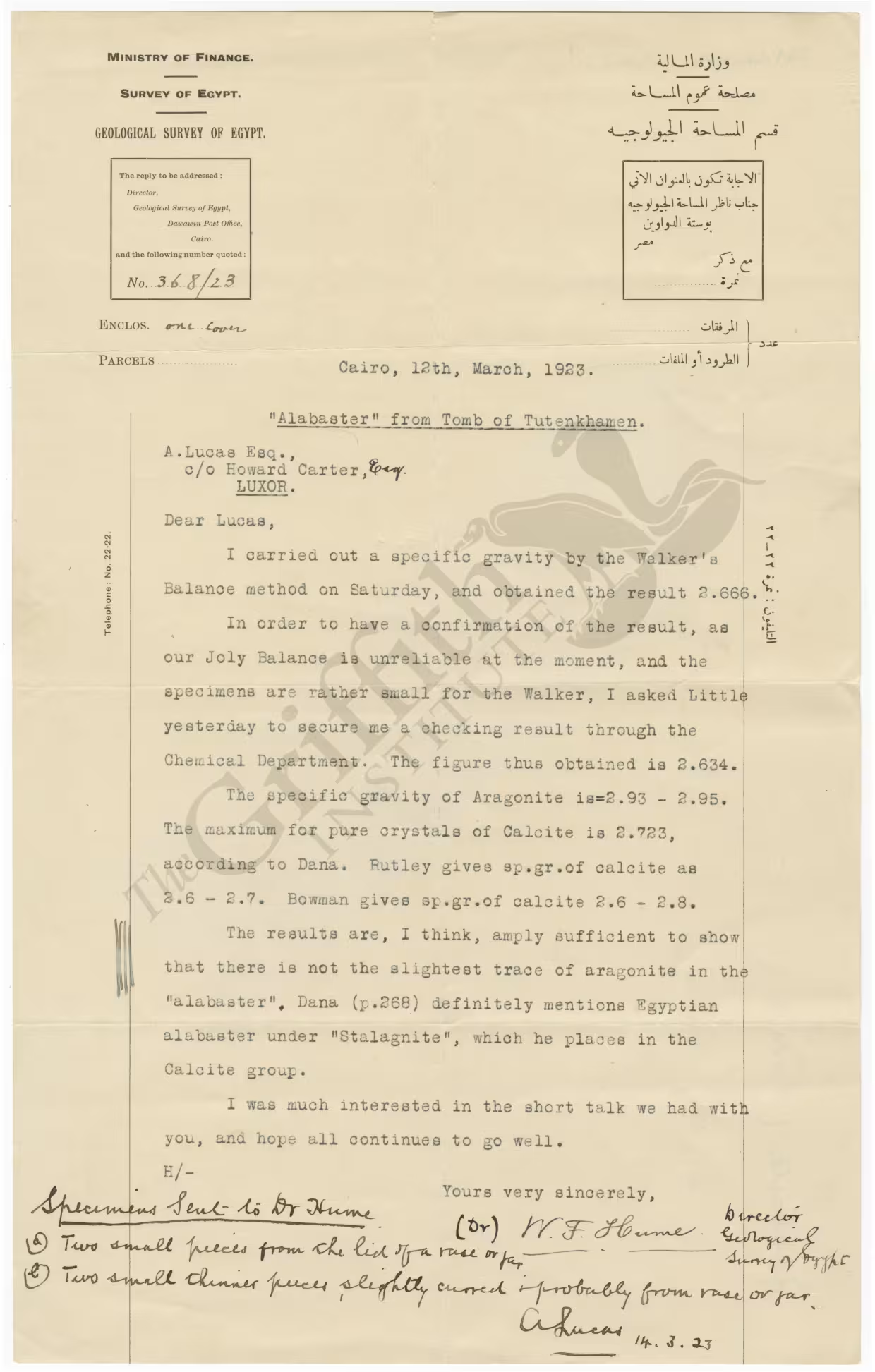
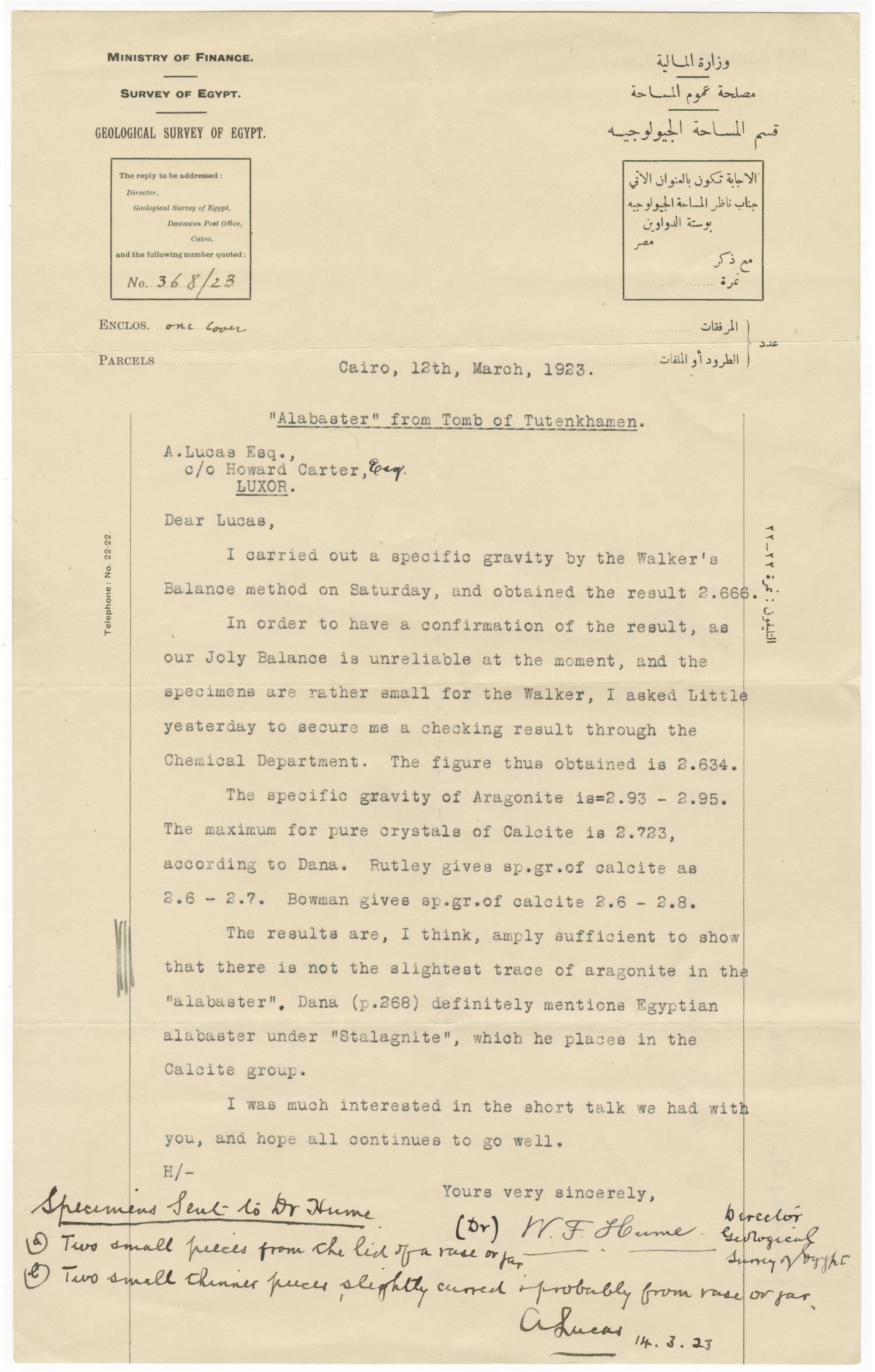
Typewritten letter from William F. Hume to Alfred Lucas on the scientific results of tested alabaster; handwritten reply from Alfred Lucas dated 14 March 1923.
© Griffith Institute,
University of Oxford
MINISTRY OF FINANCE.
SURVEY OF EGYPT.
GEOLOGICAL SURVEY OF EGYPT.
The reply to be addressed:
Director,
Geological Survey of Egypt,
Dawawin Post Office,
Cairo.
and the following number quoted:
No. 368/23
ENCLOS. one cover
Parcels .......
Telephone: No. 22.22.
Cairo, 12th, March, 1923.
"Alabaster" from Tomb of Tutenkhamen.
A. Lucas Esq.,
c/o Howard Carter, Esq.
LUXOR.
Dear Lucas,
I carried out a specific gravity by the Walker's
Balance method on Saturday, and obtained the result 2.666.
In order to have a confirmation of the result, as
our Joly Balance is unreliable at the moment, and the
specimens are rather small for the Walker, I asked Little
yesterday to secure me a checking result through the
Chemical Department. The figure thus obtained is 2.634.
The specific gravity of Aragonite is=2.93 – 2.95.
The maximum for pure crystals of Calcite is 2.723,
according to Dana. Rutley gives sp. gr. of calcite as
2.6 – 2.7. Bowman gives sp. gr. of calcite 2.6 – 2.8.
The results are, I think, amply sufficient to show
that there is not the slightest trace of aragonite in the
"alabaster". Dana (p. 268) definitely mentions Egyptian
alabaster under "Stalagnite", which he places in the
Calcite group.
I was much interested in the short talk we had with
you, and hope all continues to go well.
H/
Yours very sincerely, Director
(Dr) W. F. Hume Geological
Survey of Egypt
<Specimens sent to Dr Hume.
(a) Two small pieces from the lid of a vase or jar.
(b) Two small thinner pieces, slightly curved & probably from vase or jar.
A. Lucas
14.3.23>