TAA i.3.28.7.recto
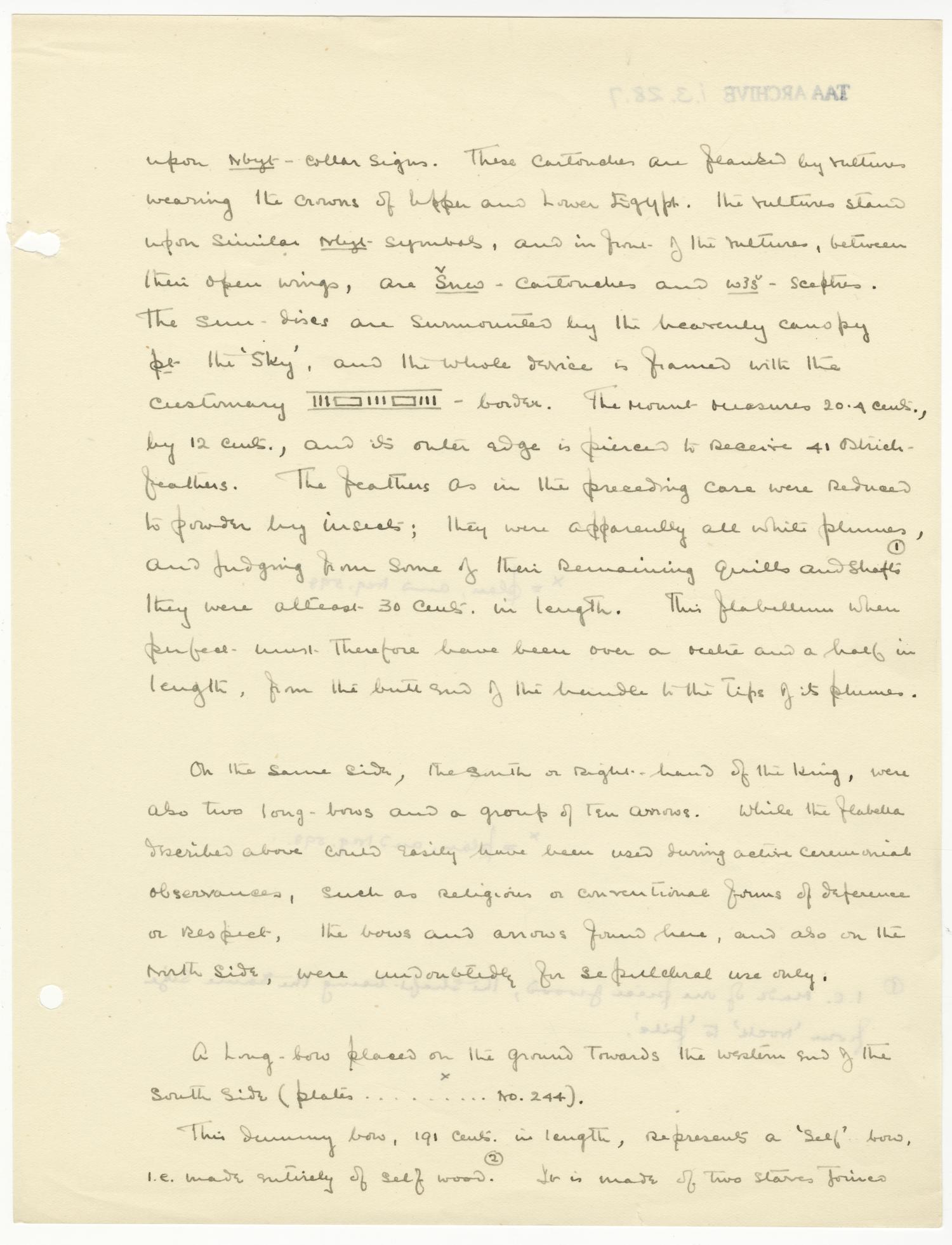
Handwritten report on the objects found between the sarcophagus and the sepulchral shrines, page 7.

© Griffith Institute,
University of Oxford
upon nbyt-collar signs. These cartouches are flanked by vultures
wearing the crowns of Upper and Lower Egypt. The vultures stand
upon similar nbyt-symbols, and in front of the vultures, between
their open wings, are šnw-cartouches and wȝš-sceptres.
The sun-discs are surmounted by the heavenly canopy
pt the ‘sky’, and the whole device is framed with the
customary [ 𓂀 ] – border. The mount measures 20.4 cents.,
by 12 cents., and its outer edge is pierced to receive 41 ostrich-
feathers. The feathers as in the preceding case were reduced
to powder by insects; they were apparently all white plumes,
and judging from some of their remaining quills and shafts <(1)>
they were at least 30 cents. in length. The flabellum when
perfect must therefore have been over a metre and a half in
length, from the butt end of the handle to the tips of its plumes.
On the same side, the south or right-hand of the king, were
also two long-bows and a group of ten arrows. While the flabella
described above could easily have been used during active ceremonial
observances, such as religious or conventional forms of deference
or respect, the bows and arrows found here, and also on the
north side, were undoubtedly for sepulchral use only.
A long-bow placed on the ground towards the western end of the
south side (plates ... .x. ... No. 244).
This dummy bow, 191 cents. in length, represents a ‘self’ bow,
i.e. made entirely of self wood <(2)>. It is made of two staves joined