
TAA i.3.28.2
Handwritten report on the objects found between the sarcophagus and the sepulchral shrines, page 2. The whole text or part of the text is fully struck through on this page but is not indicated in the transcription. On this page, strikethrough formatting is reserved for the author’s edits and deletions within the main body of the text, which would otherwise be difficult to distinguish.

© Griffith Institute,
University of Oxford
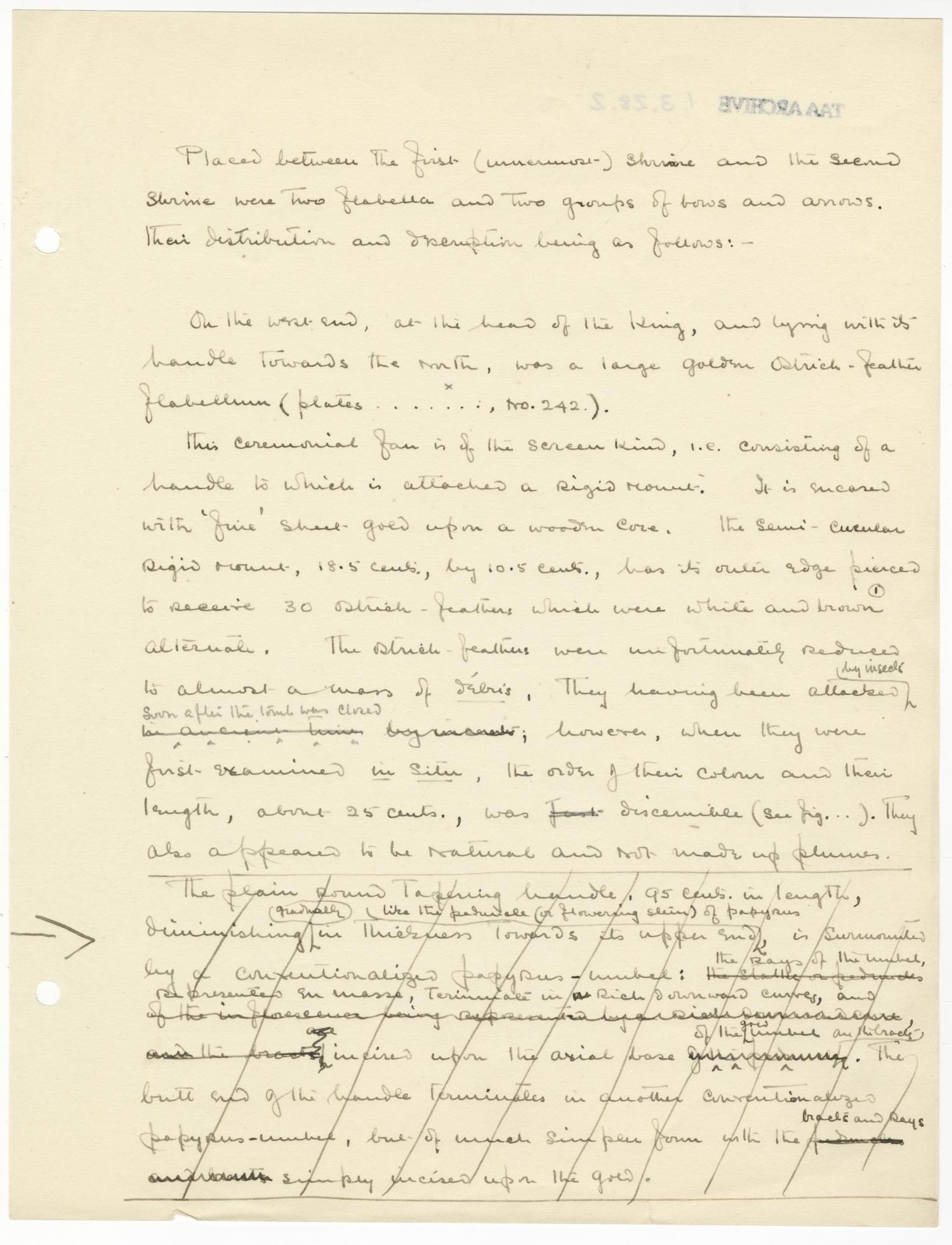
Placed between the first (innermost) shrine and the second
shrine were two flabella and two groups of bows and arrows.
Their distribution and description being as follows:-
On the west end, at the head of the king, and lying with its
handle towards the north, was a large golden ostrich-feather
flabellum (plates ... ... ... x, No.242.).
This ceremonial fan is of the screen kind, i.e. consisting of a
handle to which is attached a rigid mount. It is encased
with ‘fine’ sheet gold upon a wooden core. The semi-circular
rigid mount, 18.5 cents., by 10.5 cents., has its outer edge pierced
to receive 30 ostrich-feathers which were white and brown <(1)>
alternate. The ostrich feathers were unfortunately reduced
to almost a mass of débris, they having been attacked <by insects>
in ancient times/<soon after the tomb was closed> by insects; however, when they were
first examined in situ, the order of their colour and their
length, about 25 cents., was just discernible (see fig. ...). They
also appeared to be natural and not made up plumes.
The plain round tapering handle, 95 cents. in length,
diminishing <gradually> in thickness towards its upper end <like the peduncle (or flowering stem) of papyrus>, is surmounted
by a conventionalized papyrus-umbel: the staxxx[?] or peduncle[?]/<the rays of the umbel,> represented en masse, terminate in in rich downward curves, and
of the inflorescence being represented by a rich downward curve
and the bracts <are> incised upon the axial base of the peduncle/<of the <gold> umbel are the bracts.> The
butt end of the handle terminates in another conventionalized
papyrus-umbel, but of much simpler form with the peduncle[?]/<bracts and rays>
and bracts simply incised upon the gold.