
TAA i.3.27.3
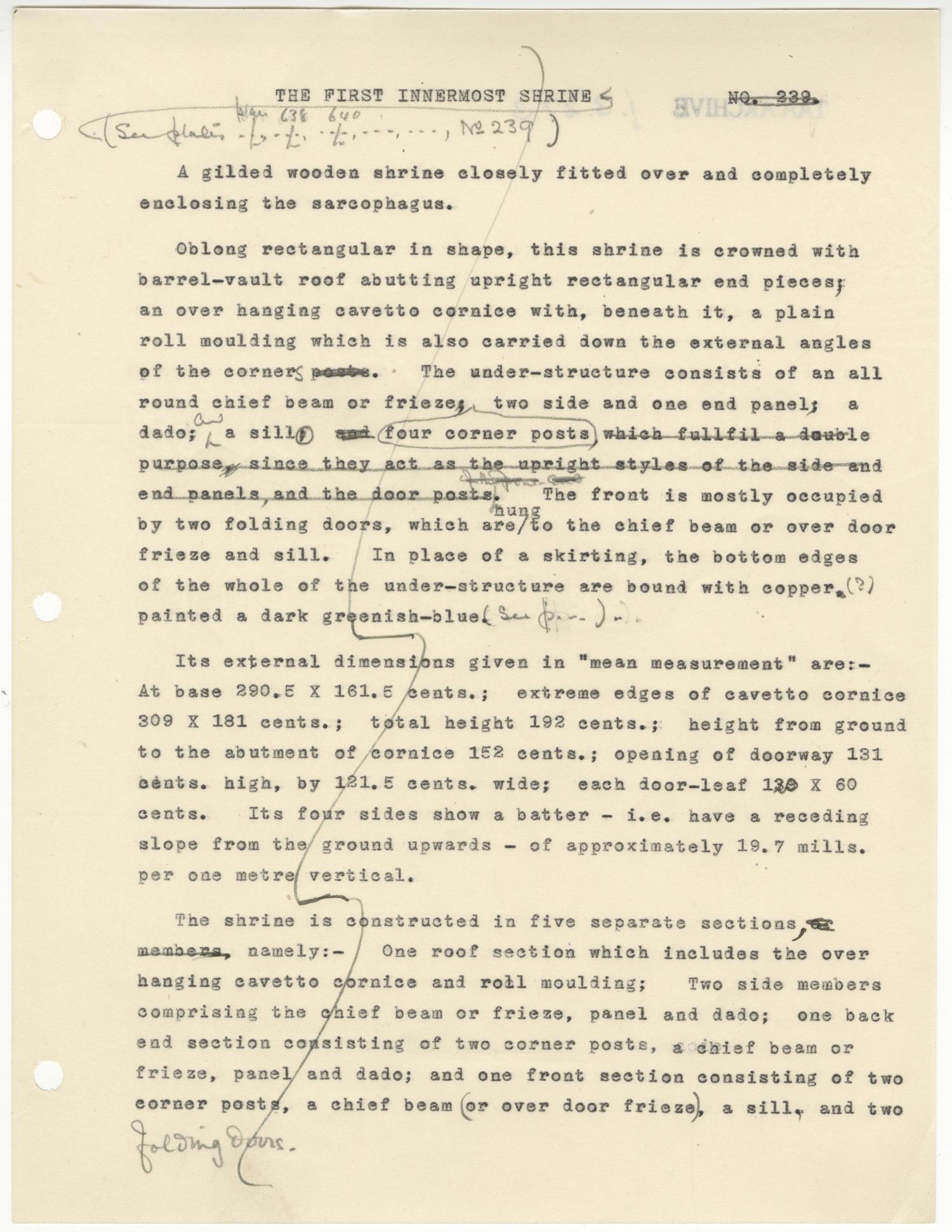
Annotated typewritten report on fourth (innermost) sepulchral shrine, page 1. Carter uses the correct object number (239) for this shrine but refers to it as the "first outermost shrine".
The whole text or part of the text is fully struck through on this page but is not indicated in the transcription. On this page, strikethrough formatting is reserved for the author’s edits and deletions within the main body of the text, which would otherwise be difficult to distinguish.

© Griffith Institute,
University of Oxford
THE FIRST INNERMOST SHRINE NO. 239
<(See plates … <plan>, … <638> … <640>… No 239)
A gilded wooden shrine closely fitted over and completely
enclosing the sarcophagus.
Oblong rectangular in shape, this shrine is crowned with
barrel-vault roof abutting upright rectangular end pieces;
an over hanging cavetto cornice with, beneath it, a plain
roll moulding which is also carried down the external angles
of the corner<s> posts. The under-structure consists of an all
round chief beam or frieze; <four corner posts> two side and one end panel; a
dado; <and> a sill. and which fullfilsica double
purpose, since they act as the upright styles of the side and
end panels, and the door posts <of the front end>. The front is mostly occupied
by two folding doors, which are /<hung> to the chief beam or over
door frieze and sill. In place of a skirting, the bottom edges
of the whole of the under-structure are bound with copper, (?)
painted a dark greenish-blue. (see p...).
Its external dimensions – given in “mean measurement” are:-
At base 290.5 X 161.5 cents.; extreme edges of the cavetto cornice
309 X 181 cents.; total height 192 cents.; height from ground
to the abutment of cornice 152 cents.; opening of doorway 131
cents. high, by 121.5 cents. wide; each door-leaf 139/<0> X 60
cents. Its four sides show a batter – i.e. have a receding
slope from the ground upwards – of approximately 19.7 mills.
per one metre vertical.
The shrine is constructed in five separate sections, or
members, namely:- One roof section which includes the over
hanging cavetto cornice and roll moulding; Two side members
comprising the chief beam or frieze, panel, and dado; one back
end section consisting of two corner posts, a chief beam or
frieze, panel and dado; and one front section consisting of two
corner posts, a chief beam (or over door frieze), a sill, and two
folding doors.