
TAA i.3.23.26
Page 14 of first draft on shrines, handwritten. Leonard Boodle is also mentioned on this page.

© Griffith Institute,
University of Oxford
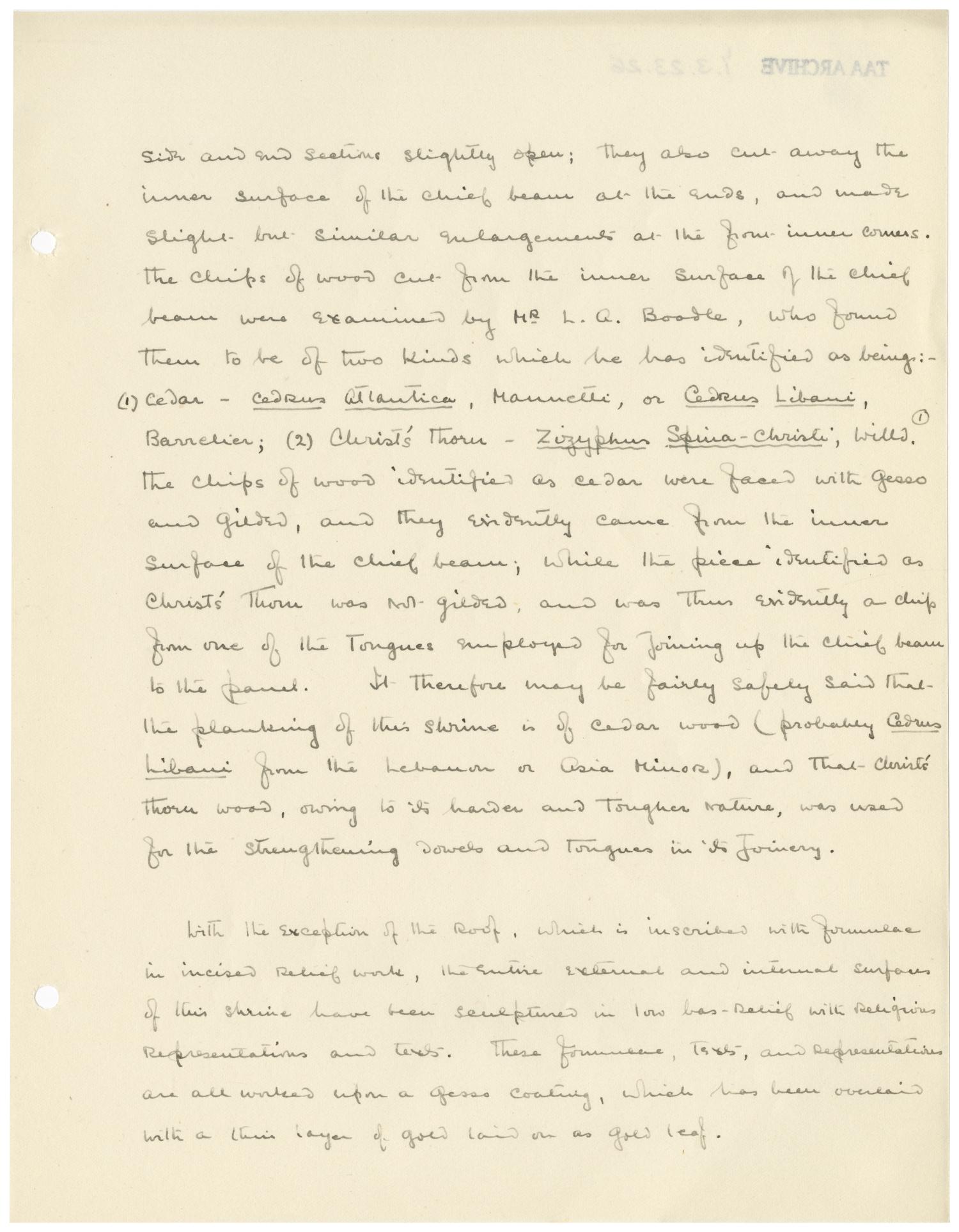
side and end sections slightly open; they also cut away the
inner surface of the chief beam at the ends, and made
slight but similar enlargements at the front inner corners.
The chips of wood cut from the inner surface of the chief
beam were examined by MR L. A. Boodle, who found
them to be of two kinds which he has identified as being:-
(1) Cedar – Cedrus Atlantica, Mannetti, or Cedrus Libani,
Barrelier; (2) Christ's thorn – Zizyphus Spina-Christi; Willow. (1)
The chips of wood identified as cedar were faced with gesso
and gilded, and they evidently came from the inner
surface of the chief beam; while the piece identified as
Christ’s thorn was not gilded, and was thus evidently a chip
from one of the tongues employed for joining up the chief beam
to the panel. It therefore may be fairly safely said that
the planking of this shrine is of cedar wood (probably Cedrus
Libani from the Lebanon or Asia Minor), and that Christ’s
thorn wood, owing to its harder and tougher nature, was used
for the strengthening dowels and tongues in its joinery.
With the exception of the roof, which is inscribed with formulae
in incised relief work, the entire external and internal surfaces
of this shrine have been sculptured in low bas-relief with religious
representations and texts. These formulae, texts, and representations
are all worked upon a gesso coating, which has been overlaid
with a thin layer of gold laid on as gold leaf.