
TAA i.3.23.24
Page 12 of first draft on shrines, handwritten.

© Griffith Institute,
University of Oxford
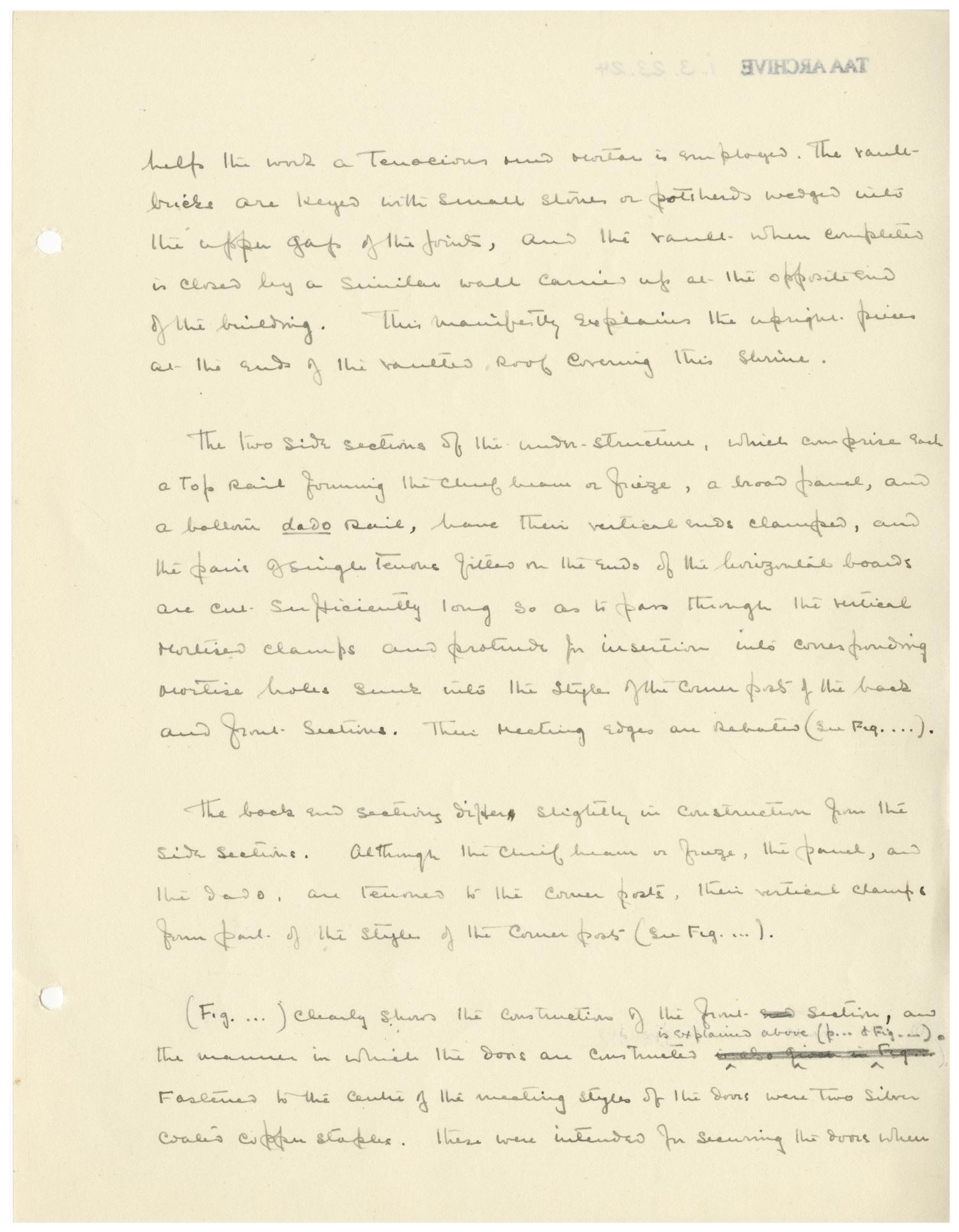
help the work a tenacious mud mortar is employed. The vault-
bricks are keyed with small stones or potsherds wedged into
the upper gap of the joints, and the vault when completed
is closed by a similar wall carried up at the opposite end
of the building. This manifestly explains the upright pieces
at the ends of the vaulted roof covering this shrine.
The two side sections of the under-structure, which comprise each
a top rail forming the chief beam or frieze, a broad panel, and
a bottom dado rail, have their vertical ends clamped, and
the pairs of single tenons fitted on the ends of the horizontal boards
are cut sufficiently long so as to pass through the vertical
mortised clamps and protrude for insertion into corresponding
mortise holes sunk into the styles of the corner posts of the back
and front sections. Their meeting edges are rebated (see Fig. ...).
The back end sections differs slightly in construction from the
side sections. Although the chief beam or frieze, the panel, and
the dado, are tenoned to the corner posts, their vertical clamps
form part of the style of the corner posts (see Fig. ...).
(Fig. ...) clearly shows the construction of the front end section, and
the manner in which the doors are constructed is also given in Fig …/<is explained above (p. ... & Fig. ...).>
Fastened to the centre of the meeting styles of the doors were two silver
coated copper staples. These were intended for securing the doors when