
TAA i.3.1.27
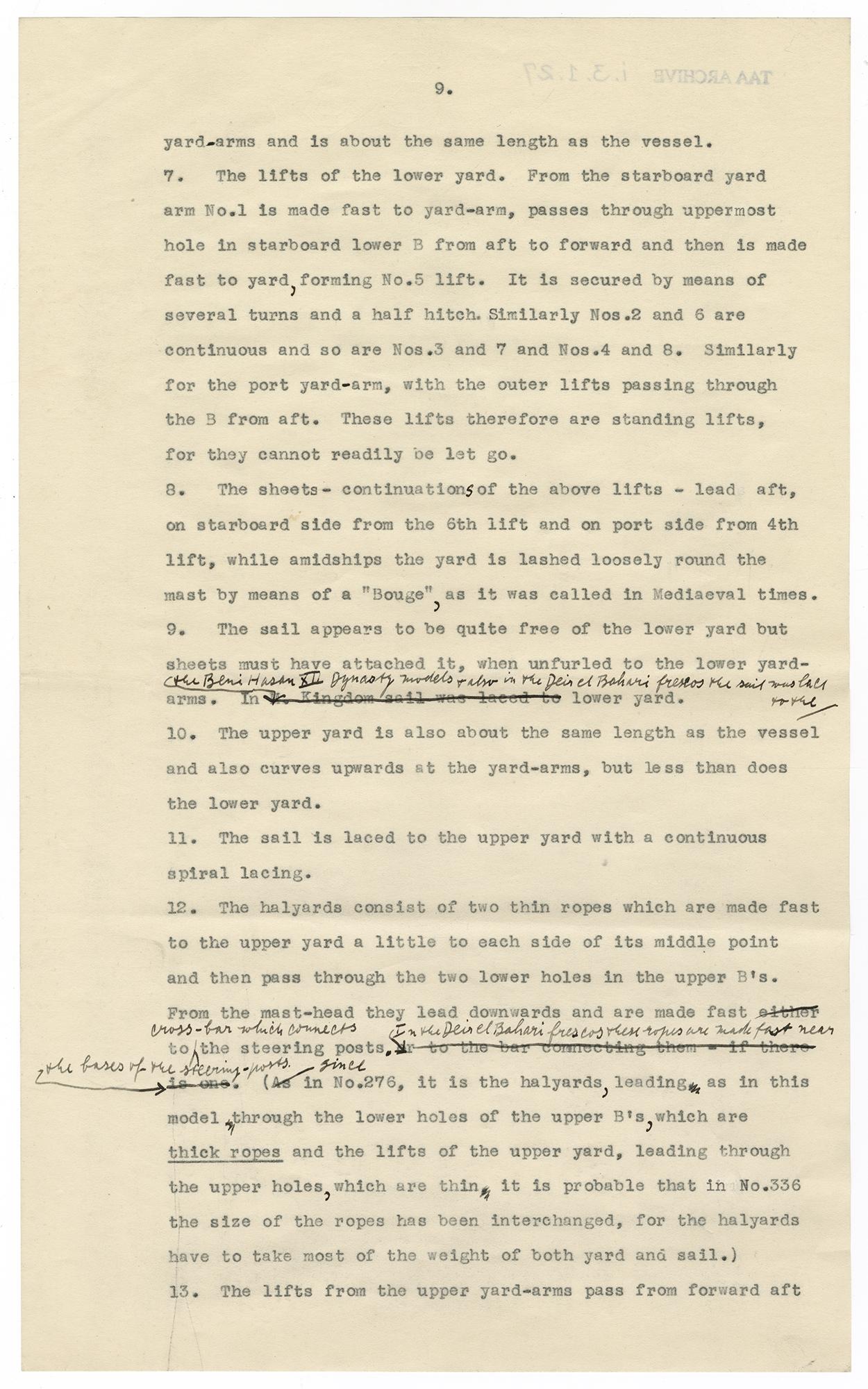
Typewritten and annotated report on boat-models by G. S. Laird Clowes, page 9.

© Griffith Institute,
University of Oxford
9.
yard-arms and is about the same length as the vessel.
7. The lifts of the lower yard. From the starboard yard
arm No.1 is made fast to yard-arm, passes through uppermost
hole in starboard lower B from aft to forward and then is made
fast to yard<,> forming No.5 lift. It is secured by means of
several turns and a half hitch. Similarly Nos.2 and 6 are
continuous and so are Nos.3 and 7 and Nos.4 and 8. Similarly
for the port yard<->arm, with the outer lifts passing through
the B from aft. These lifts therefore are standing lifts,
for they cannot readily be let go.
8. The sheets – continuation<s> of the above lifts – lead aft,
on starboard side from the 6th lift and on port side from 4th
lift, while amidships the yard is lashed loosely round the
mast by means of a "Bouge"<,> as it was called in Mediaeval times.
9. The sail appears to be quite free of the lower yard but
sheets must have attached it, when unfurled to the lower yard-
arms. In M. Kingdom sail was laced to/<the Beni Hasan XII Dynasty models & also in the Deir el Bahari frescos the sail was laced to the> lower yard.
10. The upper yard is also about the same length as the vessel
and also curves upwards at the yard-arms, but less than does
the lower yard.
11. The sail is laced to the upper yard with a continuous
spiral lacing.
12. The halyards consist of two thin ropes which are made fast
to the upper yard a little to each side of its middle point
and then pass through the two lower holes in the upper B's.
From the mast-head they lead downwards and are made fast either
to <cross-bar which connects> the steering posts<.> or to the bar connecting them if there
is one./<In the Deir el Bahari frescos these ropes are made fast near
the bases of the steering-posts.> (As/<Since> in No.276, it is the halyards<,> leading, as in this model ,through the lower holes of the upper B's<,> which are
thick ropes and the lifts of the upper yard, leading through
the upper holes<,> which are thin, it is probable that in No.336
the size of the ropes has been interchanged, for the halyards
have to take most of the weight of both yard and sail.)
13. The lifts from the upper yard-arms pass from forward aft