
TAA i.3.1.23
Typewritten and annotated report on boat-models by G. S. Laird Clowes, page 6.

© Griffith Institute,
University of Oxford
6.
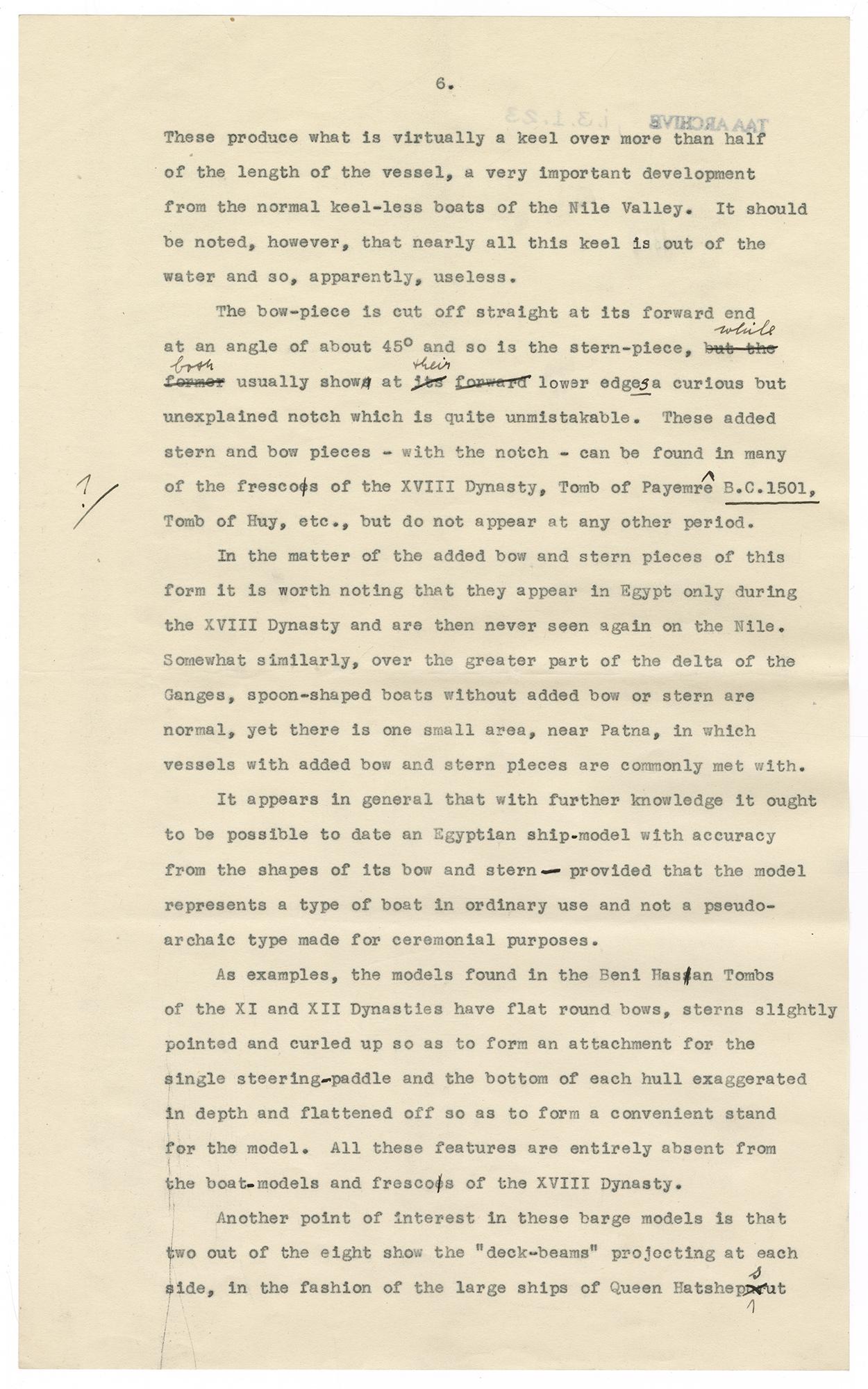
These produce what is virtually a keel over more than half
of the length of the vessel, a very important development
from the normal keel-less boats of the Nile Valley. It should
be noted, however, that nearly all this keel is out of the
water and so, apparently, useless.
The bow-piece is cut off straight at its forward end
at an angle of about 45o and so is the stern-piece, but the/<while>
former/<both> usually shows at its/<their> forward lower edge<s> a curious but
unexplained notch which is quite unmistakable. These added
stern and bow pieces – with the notch – can be found in many
<?> of the frescoes of the XVIII Dynasty, Tomb of Payemrê B.C.1501,
Tomb of Huy, etc., but do not appear at any other period.
In the matter of the added bow and stern pieces of this
form it is worth noting that they appear in Egypt only during
the XVIII Dynasty and are then never seen again on the Nile.
Somewhat similarly, over the greater part of the delta of the
Ganges, spoon-shaped boats without added bow or stern are
normal, yet there is one small area, near Patna, in which
vessels with added bow and stern pieces are commonly met with.
It appears in general that with further knowledge it ought
to be possible to date an Egyptian ship<->model with accuracy
from the shapes of its bow and stern <–> provided that the model
represents a type of boat in ordinary use and not a pseudo-
archaic type made for ceremonial purposes.
As examples, the models found in the Beni Hassan Tombs
of the XI and XII Dynasties have flat round bows, sterns slightly
pointed and curled up so as to form an attachment for the
single steering<->paddle and the bottom of each hull exaggerated
in depth and flattened off so as to form a convenient stand
for the model. All these features are entirely absent from
the boat<->models and frescoes of the XVIII Dynasty.
Another point of interest in these barge models is that
two out of the eight show the "deck-beams" projecting at each
side, in the fashion of the large ships of Queen Hatshepur/<s>ut